Nicotinamide, EGCG Combination May Promote Natural Brain Cleaning: In Vivo Study
-
An NIH-funded study by UC Irvine researchers found that this bioactive combination helped remove protein buildup associated with Alzheimer's disease in mice.
A combination of two bioactive compounds, nicotinamide and a green tea antioxidant called epigallocatechin gallate, appeared to rejuvenate aging brain cells and clear away the buildup of harmful proteins associated with Alzheimer’s disease, according to a new in vivo study conducted by researchers at UC Irvine. The findings were published in GeroScience.
The paper looked at a combination of naturally-occurring compounds – a form of vitamin B3 called nicotinamide and a green tea antioxidant called epigallocatechin gallate (ECG) – can reinstate levels of guanosine triphosphate, an essential energy molecule in brain cells.
In neurons, treatment reversed age-related cellular deficits and improved brain cells’ ability to clear amyloid protein aggregates, which are associated with Alzheimer’s disease.
“As people age, their brains show a decline in neuronal energy levels, which limits the ability to remove unwanted proteins and damaged components,” said lead author Gregory Brewer, adjunct professor of biomedical engineering at UC Irvine. “We found that restoring energy levels helps neurons regain this critical cleanup function.”
The researchers used an encoded fluorescent sensor called GEVAL to track guanosine triphosphate GTP levels in neurons from aged Alzheimer’s model mice. GTP levels declined with age, particularly in the mitochondria, leading to impaired autophagy (the process by which cells clear damaged components).
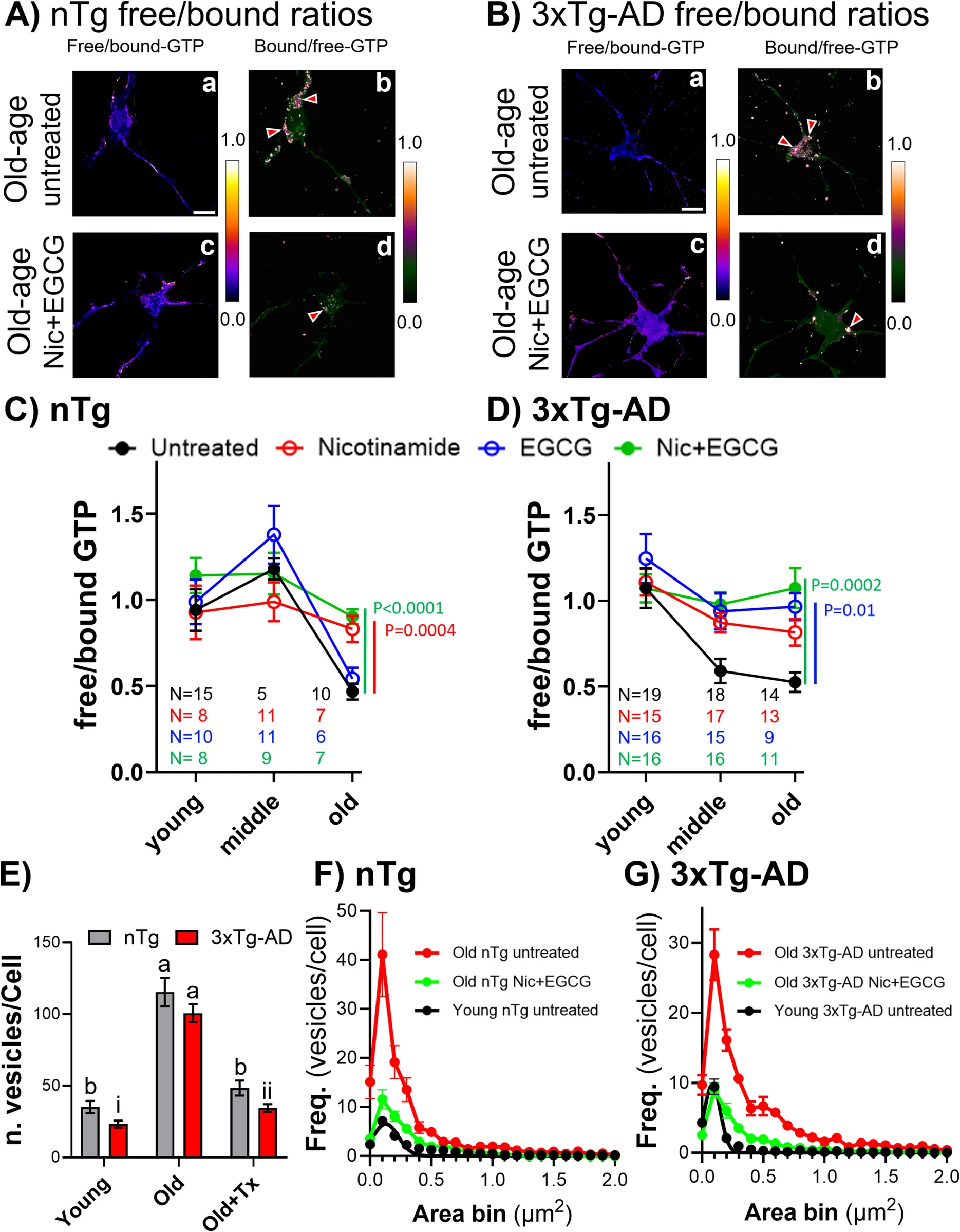
A 24-hour of treatment with nicotinamide and EGCG restored GTP levels to those seen in younger cells. This revival led to improved energy metabolism; activation of key GTPases involved in cellular trafficking, Rab7 and Arl8b; and efficient clearance of amyloid beta aggregates. Oxidative stress was also reduced.
“This study highlights GTP as a previously underappreciated energy source driving vital brain functions,” Brewer said. “By supplementing the brain’s energy systems with compounds that are already available as dietary supplements, we may have a new path toward treating age-related cognitive decline and Alzheimer’s disease.”
“More work is going to be required to find the best way to administer this treatment, since a recent clinical trial involving UC Irvine researchers showed that oral nicotinamide was not very effective because of inactivation in the bloodstream.”
-
@AlphaZance Thanks
Treatments of old neurons with energy precursor and Nrf2-inducer restored GTP levels and size of vesicles in both genotypes. A Free/bound GTP levels (a) and bound/free GTP levels (b) in untreated old age (20 months) nTg neurons. Treatment of old age (23 months) nTg neurons increased the free/bound GTP levels in the cytoplasm and dendrites (c) and reduced the bound/free GTP levels (d). B In untreated old age (26 months) 3xTg-AD neurons, free/bound GTP levels (a) and bound/free GTP levels (b). In old age 3xTg-AD, the decay observed in free/bound GTP levels was restored to basal levels with combination treatment (c), reducing the bound/free GTP levels (d). Red arrows indicate accumulation of vesicles in both genotypes. C Treatment restored the free/bound GTP levels in old age nTg neurons. D In 3xTg-AD neurons, combination treatment prevented the decrease in free/bound GTP at middle and old ages. Each point is the mean of 7–10 fields from each mouse culture (N cultures). E A large increase in vesicles with bound GTP was observed in old age in both genotypes. Different lowercase letters and numbers indicate significant differences (p < 0.0001) after Tukey correction for multiple comparisons. F, G Treatment with nicotinamide and EGCG combination reduced the number of bound GTP vesicles in old age neurons in both genotypes (nTg: young 2 months and old 24 months; 3xTg-AD: 2 months and 18 months)
Treatment of age-related decreases in GTP levels restores endocytosis and autophagy (2025)


Hello! It looks like you're interested in this conversation, but you don't have an account yet.
Getting fed up of having to scroll through the same posts each visit? When you register for an account, you'll always come back to exactly where you were before, and choose to be notified of new replies (either via email, or push notification). You'll also be able to save bookmarks and upvote posts to show your appreciation to other community members.
With your input, this post could be even better 💗
Register Login