Carbamates - underrated feature of CO2
-
When proteins are under the influence of CO2 they form Carbamates, which changes their function.
In the literature this is mostly researched for hemoglobin, but it happens with every neurotransmitter, hormone... every protein in the body."The Haldane-Bohr effect applies to proteins in general. When there's a lot of carbon dioxide, it basically changes the pH, or the isoelectric point of the protein, making it less accessible to oxygen, and that in itself is a protection against... the attack of oxygen against proteins, but more than that, the particular group that carbon dioxide sticks to on a protein such as hemoglobin is an amino group, and any amino group in your body, whether it's on your DNA or your enzymes or the so-called hormone receptors, these all contain amino groups which when there's enough carbon dioxide, it will stick to those groups and in the absence of carbon dioxide, other stuff will stick to those, such as glycation, various free radical fragments of unsaturated fats will tend to stick to those and derange the hormones. Insulin, for example, is... a different hormone in the presence of CO2 or in the absence of CO2, so everything in your body is different when it's well saturated with CO2. You can't suffer the side effects of diabetes, for example, if your proteins are well protected."
-Ray Peat
"Neurotransmitter aralkylamines, such as phenethylamine, tyramine, dopamine, tryptamine, serotonin, and histamine, absorb aerial CO2, and heteronuclear multiple bond connectivity (HMBC) correlations between the carbon derived from CO2 and the α-hydrogen of the several amines were confirmed in the D2O solution."
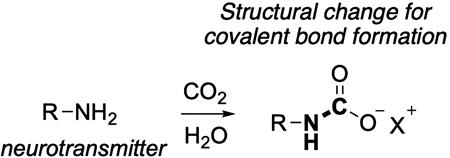
https://www.jstage.jst.go.jp/article/cpb/73/9/73_c25-00463/_article
There is one study showing that carbamates are a majore metabolite in (bull) sperm. And bulls that were more fertile had higher levels of carbamates.
"...carbamate is the fourth most abundant metabolite of the bovine spermatozoa with the second highest VIP score. Carbamate was first reported in seminal plasma from healthy and asthenozoospermic men [27]. However, it is new the description of carbamate in bull spermatozoa as well as its higher abundance in sperm from HF bulls. Endogenous carbamate is generated by the interaction of cellular carbon dioxide (CO2) with an NH2 group of primary and secondary amines [60, 61] when the concentration of CO2 increases [62]. The formation of carbamate influences the function of hemoglobin as well [63]. Although the importance of carbamate in sperm physiology is unknown, we can speculate that the spermatozoon, like other cells, employs several mechanisms to maintain the cell pH [64]. Therefore, carbamate formation might be an important mechanism by which spermatozoa regulate their intracellular pH."
https://pmc.ncbi.nlm.nih.gov/articles/PMC6749656/#Fig6
Ray Peat was once again much ahead of his time, talking about this more than 15 years ago.

Hello! It looks like you're interested in this conversation, but you don't have an account yet.
Getting fed up of having to scroll through the same posts each visit? When you register for an account, you'll always come back to exactly where you were before, and choose to be notified of new replies (either via email, or push notification). You'll also be able to save bookmarks and upvote posts to show your appreciation to other community members.
With your input, this post could be even better 💗
Register Login