B6 toxicity solved with B5
-
Know someone taking 100-200mg b6 as p5p per day, they assumed it doesn't have neuropathy potential as the other form of b6. They were also taking 1 cap of 450mg pantethine b5 with the b6 and no issues. They stopped the b5 and within a week they developed inability to stand on toes, numbness in feet, foot drop, difficulty walking. I got them to drop the b6 entirely and megadose pantethine 4x caps a day and within hours neuropathy was going away.
I learned this from Chris Masterjohn's article where he explains it has to do with CoA and if you are taking b6 it is a good idea to take b5.
-
I learned this from Chris Masterjohn's article where he explains it has to do with CoA and if you are taking b6 it is a good idea to take b5.
Well seen. Thanks for pointing this limit out. I've made some research to try to get more info about the process.
I'll write an article what to care for and how much pantothenic acid (B5) is required when taking HD PLP (B6)
And yes some people have brain trouble when taking more than 20-25 B6 PLP form. Probably because there is cystein excess (in relation with CoA).
I'll try to make it clearer:
Need a high dose of B5 to support the Coenzyme A synthesis pathway, managing excess cysteine without depleting the nerve cell's energy, said my source.
Not clear enough so.
I'll came back with a link and details. -
@LucH https://we.tl/t-Hbh4C5ifxvEPJVGH
pdf explaining it
file hosting expires in 72hrs -
pdf explaining it
Thanks for sharing.

A lot of work in perspective (25 pages)
-
Good one OP and thanks for that important nuance about both forms of B6. I try to keep an eye peeled for B6 info.
I have nothing to back the following up but i once read someone discussing another potential B6 pyridoxine pitfall, that long term use can cause the gluteals and back leg muscles to atrophy and sag. No study was noted nor was the dose or protocol discussed. Hearsay but something i may follow up on.
-
B6 pyridoxine pitfall
PNP is toxic when taking HD. (...)
-
B6 pyridoxine pitfall
PNP is toxic when taking HD. (...)
That part is understood, hence the cautions we apply; lower doses, occasional abstentions and substitutions with P5P etc. And of course it isn't all bad with PNP being rather therapeutic for certain conditions with the right protocol. The addition of B5 is intriguing in this context.
-
The pyridoxine paradox and my right wrist**
Context:
Conversation with the AI: I set Google AI straight.
I wanted to get useful info why CoA could be a problem with HD B6 PLP (the active form)
According to IA I had to deal with a traffic jam when taking HD B PNP (pyridoxine5’- phosphate): The Coenzyme A (CoA) is a bottleneck when Vitamin B5 lacks whenever I push onto the accelerator (to get cellular energy). I didn’t get what I wanted and quit the +/ deaf-dialog.Here is a part of the talk. And as always: be cautious with IA (never get twice the same answer or hardly ...)
My answer
Sorry but I haven't the same analyze. I take HD B6 PLP, the active form. I take it only when I have problems with my wrist and it's efficacious (low grade inflammation). And yes, the upper RDA seems to be 20-25 mg PLP. A big variety here (impact). But in fact, only the ground tells the truth. What I know is that I have to be cautious on timing (with staples for 3 weeks, and a pause for 8-10 days).
And by the way, it wasn’t PNP but PLP. I know HD pyridoxine (PNP) is toxic.
Excess vitamin B6 initially causes numbness and tingling in the extremities. Subsequently, it impairs movement coordination and leads to a loss of balance (gait unsteadiness / instability and dizziness). Finally, the nervous system reacts—specifically by interfering with absorption or blocking receptors—resulting in severe neuropathies.To sum up: the liver becomes overwhelmed—congested and exhausted—and ultimately unable to process the toxins associated with normal metabolism. This accumulation and oxidation lead to mitochondrial dysfunction caused by a failing enzymatic chain (involving transaminases). Initial symptoms often include tingling in the extremities, followed by a lack of limb coordination, as the brain eventually acts to protect itself by shutting down access (a feedback effect involving acetylcholine).
References :
- Chris Masterjohn
- Studies on the toxicity of pyridoxine compared to P5P (notably the work of Vrolijk et al., 2017) demonstrated that inactive pyridoxine competitively inhibits pyridoxal kinase and causes cell death.
- Literature on B6-related sensory neuropathy: look for publications focusing on dorsal root ganglion neurons (DRG neurons) and mitochondrial oxidative stress.
PLP assimilation pathway under saturation conditions
In cases of excess vitamin B6 associated with the metabolic cycle involving PNP (pyridoxine 5'-phosphate), the molecule that the liver can no longer properly transform or eliminate is pyridoxal 5'-phosphate (PLP)—which accumulates to toxic levels (as aldehydes)—or pyridoxine (PN), which remains unchanged. [1, 2]In the context of a specific enzymatic blockage (such as dysfunction or saturation of the hepatic enzyme PNPO), it is PNP (pyridoxine 5'-phosphate) itself that accumulates abnormally in hepatic cells and becomes toxic. [1, 2]
The hepatic saturation mechanism
• PNP accumulation: Normally, the liver uses the enzyme PNPO (pyridoxine 5'-phosphate oxidase) to convert PNP into PLP (the active form of B6). In cases of saturation or enzymatic deficiency, PNP accumulates and inhibits other vital enzymes [1, 2, 3]. Animal-source B6 is pyridoxal; plant-source B6 is pyridoxine.- https://journals.asm.org/doi/10.1128/jb.00521-21
- https://www.ncbi.nlm.nih.gov/books/NBK557436/
- https://www.genecards.org/card/PNPO
• PLP excess and toxicity: If conversion runs at full capacity due to excessive intake, PLP accumulates beyond the transport capacity of liver proteins (such as albumin), causing direct toxicity to tissues (nerves and liver). [1, 2, 3]
- https://en.wikipedia.org/wiki/Vitamin_B6
- https://www.thieme-connect.com/products/ejournals/pdf/10.1055/a-2773-6076.pdf
- https://www.altisavitamins.com/fr/vitamine-b6-pyridoxine-hcl-ou-pyridoxal-5’-phosphate-p5p
• Pyridoxine (PN) saturation: The liver becomes overwhelmed by unmetabolized pyridoxine. This floods into the bloodstream and blocks cellular receptors, acting as a B6 antagonist. [1, 2]
• Anticipation and dosage are keys to avoid a bottleneck.
However, the cellular mechanism won't simply malfunction—as if everything suddenly ground to a halt—overnight. There are warning signs (tingling, limb weakness, and issues with movement coordination). Consequently, these can be managed through dosage adjustments (loading phase, maintenance phase, and recovery periods). Furthermore, individual reactions to specific dosages will vary. Yet, given the risk of a cumulative "brain shutdown," it is far better to be proactive and err on the side of caution. This doesn't mean raising false alarms (like the warnings surrounding high-dose Vitamin B6), but rather modulating intake—and thus the effects—in anticipation of potential issues. -
@BioEclectic that claim makes sense based on the ability of b6 to cause neuropathy. less muscle control via nerve damage leads to atrophy of muscles.
-
I learned this from Chris Masterjohn's article where he explains it has to do with CoA and if you are taking b6 it is a good idea to take b5.
After reading Sunsunsun’s comment on B5/CoA, as a likely kinetic bottleneck in cellular energy and side-effects on nerve cells, I decided to go deeper in the mechanism.
Here are the main points (excerpts) if you are taking HD B6 or trying to optimize the energy levels, when talking about interaction from some supplements like betaine (as a traffic controller) or the Choline-Egg-TMG Connection (role in cell energy & signaling).
Summary of the pathway
In short, B6 PLP acts as the accelerator pedal for creating cysteine. If you step on that pedal with 20–25 mg of PLP, you must dramatically increase the supply of Vitamin B5 (at a 2:1 ratio) to prevent the system from exhausting. The extra B5 safely captures the excess cysteine, escorts it into Coenzyme A production, and prevents the cellular energy depletion that triggers a neurological shutdown.
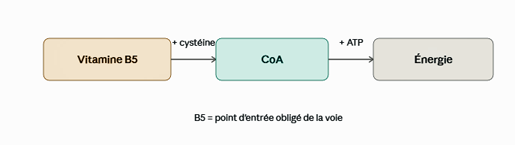
Even before I even introduce the higher-dose B5 (200 mg), my setup was already highly defensive. The combination of TMG, Choline/Eggs, and periodic Methyl-B9/B12 creates a massive upstream buffer. It actively prevents a massive, sudden tidal wave of cysteine from hitting the B5 pathway all at once, while Inositol protects the nerve membranes.
Further details can be found on my forum to see how I manage and more, e.g.: “How I Manage Brain scrambling following admin issues” in order to block “the noise”, enhance alpha brain waves and synergize GABA-like effects when combining magnesium bisglycinate (1.3 g), L-theanine (200 mg), taurine powder (500-1000 mg).
NB1: You’ll need caffeine to go through the doc (10 pages docx), with references.
NB2: These references don’t go through when I post here on bioenergetic forum.



Hello! It looks like you're interested in this conversation, but you don't have an account yet.
Getting fed up of having to scroll through the same posts each visit? When you register for an account, you'll always come back to exactly where you were before, and choose to be notified of new replies (either via email, or push notification). You'll also be able to save bookmarks and upvote posts to show your appreciation to other community members.
With your input, this post could be even better 💗
Register Login