Niacin, NAD⁺, and Insulin Resistance
-
Niacin, NAD⁺, and Insulin Resistance
An Integrative Orthomolecular Medicine (IOM) Analysis of Benefits, Risks, and Proper Use (2025)
Executive summary-
Niacin is one of the most powerful metabolic vitamins in medicine, but also one of the most misunderstood.
-
Claims that "niacin causes insulin resistance" are context-dependent, not universally true.
-
Niacin, niacinamide, NMN, NR, and lifestyle NAD⁺ strategies are not interchangeable-they act through different pathways and carry different tradeoffs.
-
In an IOM framework, niacin's risks can often be neutralized and its benefits amplified by correcting the metabolic terrain.
-
Dose, form, diet, redox status, and the ICV axis determine whether niacin heals-or harms.
-
-
@DavidPS said in Niacin, NAD⁺, and Insulin Resistance:
Niacin is one of the most powerful metabolic vitamins in medicine, but also one of the most misunderstood.
I think it could be interesting too for the forum readers to see where B3 is basically used in the Krebs cycle to produce energy.
Energy metabolism in two steps
Step 1 is the catabolic breakdown of carbs, fat, and protein to extract energy in the form of electrons.
Step 2 is the translation of that energy into ATP using oxygen.*) Energy and nutrients needed for metabolism
- Carbs => Pyruvic acid => Acetyl CoA: Mg, B1 B2 (FAD) B3 (NAD) + B5
Required nutrients to extract energy in the form of electrons (electrons in the transport chain) (= oxidative phosphorylation => oxidation-reduction reactions are vital for ATP synthesis) - Acetyl CoA => Citric Acid Circle (Krebs circle): B1, B2 (FAD), B3 (NAD), Mg, Mn, Fe, GSH + B5
https://coremedscience.com/blogs/wellness/what-vitamins-give-you-energy
https://www.nature.com/scitable/topicpage/nutrient-utilization-in-humans-metabolism-pathways-14234029/
Nutrients to extract energy in the form of electrons in the transport chain
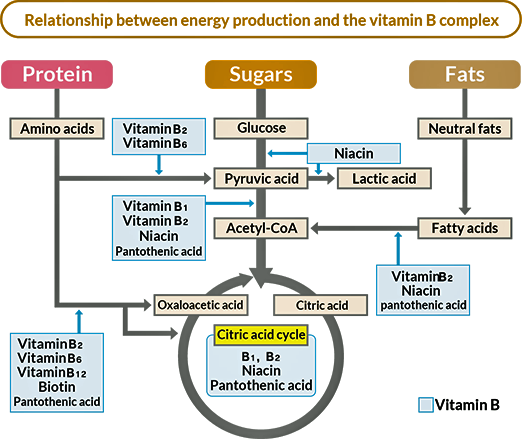
*) Step one: Carbs / glucose => Pyruvic acid => Acetyl CoA
Vitamins B to produce pyruvic acid and acetyl CoA
https://pmc.ncbi.nlm.nih.gov/articles/PMC7019700/
Which vitamin converts glucose to pyruvate?
=> B3 (NAD)
Which vitamins convert pyruvate to acetyl CoA?
=> B1 B2 (FAD) B3 B5 (pantothenic acid)
Briefly, macronutrients are oxidized (step one) into acetyl-CoA through several pathways including glycolysis, which produces pyruvate from glucose, and vitamins B1, B2, B3, B5 and C play important roles.*) Step two: Acetyl CoA => Citric Acid Circle (Krebs circle)
Which vitamins are required to pass through Acetyl CoA to Citric Acid Circle?
=> B1 B2 B3 B5.
=> + other B vitamins (B6 B8 B12) and Fe Mg
Then acetyl-CoA enters the citric acid cycle (step two), which generates energy as NADH and FADH2 through a series of eight oxidations that involve vitamins B1, B2, B3, B5, B6, B8 and B12 as well as iron and magnesium.*) Step three: Energy production
Finally, the electrons of NADH and FADH2 are transferred to the electron transport chain (step 3), where they provide energy used to generate ATP molecules; this step needs the input of vitamins B2, B3, B5 and of iron.
Source: https://pmc.ncbi.nlm.nih.gov/articles/PMC7019700/
Vitamins and Minerals for Energy, Fatigue and Cognition: A Narrative Review of the Biochemical and Clinical Evidence. 2020 doi: 10.3390/nu12010228 - Carbs => Pyruvic acid => Acetyl CoA: Mg, B1 B2 (FAD) B3 (NAD) + B5
-
@LucH - Excellent idea.


Hello! It looks like you're interested in this conversation, but you don't have an account yet.
Getting fed up of having to scroll through the same posts each visit? When you register for an account, you'll always come back to exactly where you were before, and choose to be notified of new replies (either via email, or push notification). You'll also be able to save bookmarks and upvote posts to show your appreciation to other community members.
With your input, this post could be even better 💗
Register Login