Lipofuscin accumulation in aging and neurodegeneration
-
Lipofuscin is the name given to a mix of modified proteins, lipids, and other compounds that accumulate with age in long-lived cells. The accumulation of lipofuscin has long been considered a form of damage by a minority of researchers; removal of lipofuscin was an early call to action for the Strategies for Engineered Negligible Senescence, for example. There were even a few early, unsuccessful efforts to provide technology demonstrations of approaches to break down lipofuscin, or at least some of its components. Unfortunately, getting rid of lipofuscin isn't a straightforward task. Chemically it is diverse, a mess of many very different molecules, and thus ill suited as a target for the enzyme, antibody, and small molecule development that dominates the field of medical biotechnology. Getting rid of one specific molecule is feasible, getting rid of a hundred very different molecules is much less feasible. Lipofuscin has been largely left alone in favor of easier goals.
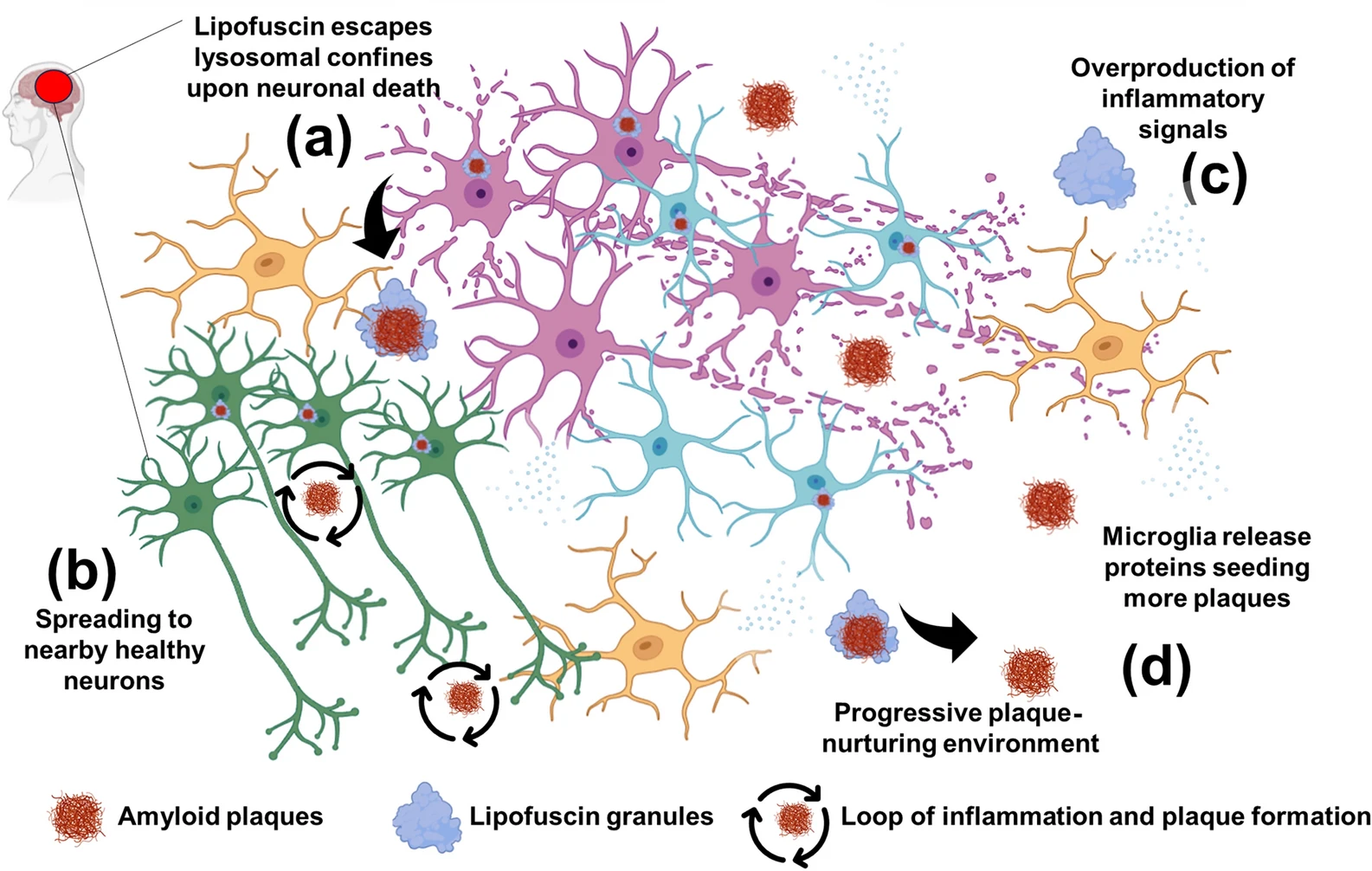
In this review, we propose a reconsideration of lipofuscin from the "aging marker" or "autofluorescence pigment" to an active player in neurodegeneration and AD pathology. This paradigm shift opens new research directions and therapeutic possibilities. Targeting lipofuscin and its clearance may allow interference of upstream of amyloid plaque formation, preserving proteostasis, reducing oxidative damage, and ultimately slowing or preventing neurodegeneration.
We examine the potential interplay between lipofuscin accumulation, lysosomal dysfunction, lipid peroxidation and amyloid-β pathology in AD. We explore how lipofuscin may influence amyloid-β aggregation, clearance, and toxicity and propose mechanisms by which lipofuscin modulates AD progression. Importantly, we summarize evidence demonstrating that lipofuscin is released extracellularly upon neuronal death, thus preparing a highly oxidized environment that results in toxicity and a cascade of events leading to plaque formation and amyloid-β pathology.
-
Dr. Peat has written about lipofuscin.
https://cse.google.com/cse?cx=005233684413389937395%3Ad5qfhqsz7oo&ie=UTF-8&q=Lipofuscin+#gsc.tab=0&gsc.q=Lipofuscin &gsc.page=2 -
@DavidPS said in Lipofuscin accumulation in aging and neurodegeneration:
Dr. Peat has written about lipofuscin.
Too many options (lazy). here I've got this info on my pC.
*) How the Oils In Your Diet Are Aging Your Skin.
Dr. Peat goes on to explain what this rancidity (oxidation process) does:
"The free radicals produced in this process react with parts of cells, such as molecules of DNA and protein, and may become attached to those molecules, causing abnormalities of structure and function."
https://raypeat.com/articles/articles/unsaturated-oils.shtmlEGCG Inhibited Lipofuscin Formation Based on Intercepting Amyloidogenic β-Sheet-Rich Structure Conversion
https://www.ncbi.nlm.nih.gov/pmc/articles/PMC4816542/
"Lipofuscin (LF) is formed during lipid peroxidation and sugar glycosylation by carbonyl-amino crosslinks with biomacrolecules, and accumulates slowly within postmitotic cells. The environmental pollution, modern dietary culture and lifestyle changes have been found to be the major sources of reactive carbonyl compounds in vivo. Irreversible carbonyl-amino crosslinks induced by carbonyl stress are essentially toxiferous for aging-related functional losses in modern society. Results show that (-)-epigallocatechin gallate (EGCG), the main polyphenol in green tea, can neutralize the carbonyl-amino cross-linking reaction and inhibit LF formation, but the underlying mechanism is unknown." -
 L LucH referenced this topic on
-
Comment
“Results show that epigallocatechin gallate (EGCG), the main polyphenol in green tea, can neutralize the carbonyl-amino cross-linking reaction and inhibit LF formation, but the underlying mechanism is unknown."
LF = lipofuscin.
Article
https://bioenergetic.forum/topic/9017/neuro-degeneration-a-multi-factorial-approach
=> I’d like to develop this approach. Not only from one side: multi-factorial.
When talking about neuro-degeneration we should take the whole context into consideration to avoid plaque.
After having read an article on the lack of B12 when bringing the RDA for aged people (> 40 yrs.) (1), I decided to write an article to show / to tell how I manage to optimize. Afterwards I submitted my plan to AI and ask it for comments.
=>The prevention of neurodegenerative and vascular disorders rests on two pillars: metabolic flexibility and membrane integrity.
See my "Metabolic Safety" Protocol if you want to go deeper.

Hello! It looks like you're interested in this conversation, but you don't have an account yet.
Getting fed up of having to scroll through the same posts each visit? When you register for an account, you'll always come back to exactly where you were before, and choose to be notified of new replies (either via email, or push notification). You'll also be able to save bookmarks and upvote posts to show your appreciation to other community members.
With your input, this post could be even better 💗
Register Login