Association between dietary niacin intake and atherosclerotic cardiovascular disease among American adults
-
I have been wondering for sometime if the medical industrial complex has been misleading us about the value of niacin. Basically, the motive would be similar to the motive used to belittle the value of aspirin. That is it is inexpensive and unpatentable and there are patented pharmaceuticals that will do the job. Has anyone read about vitamin B3 analogs that have an impact on ASCVD of this magnitude?
-
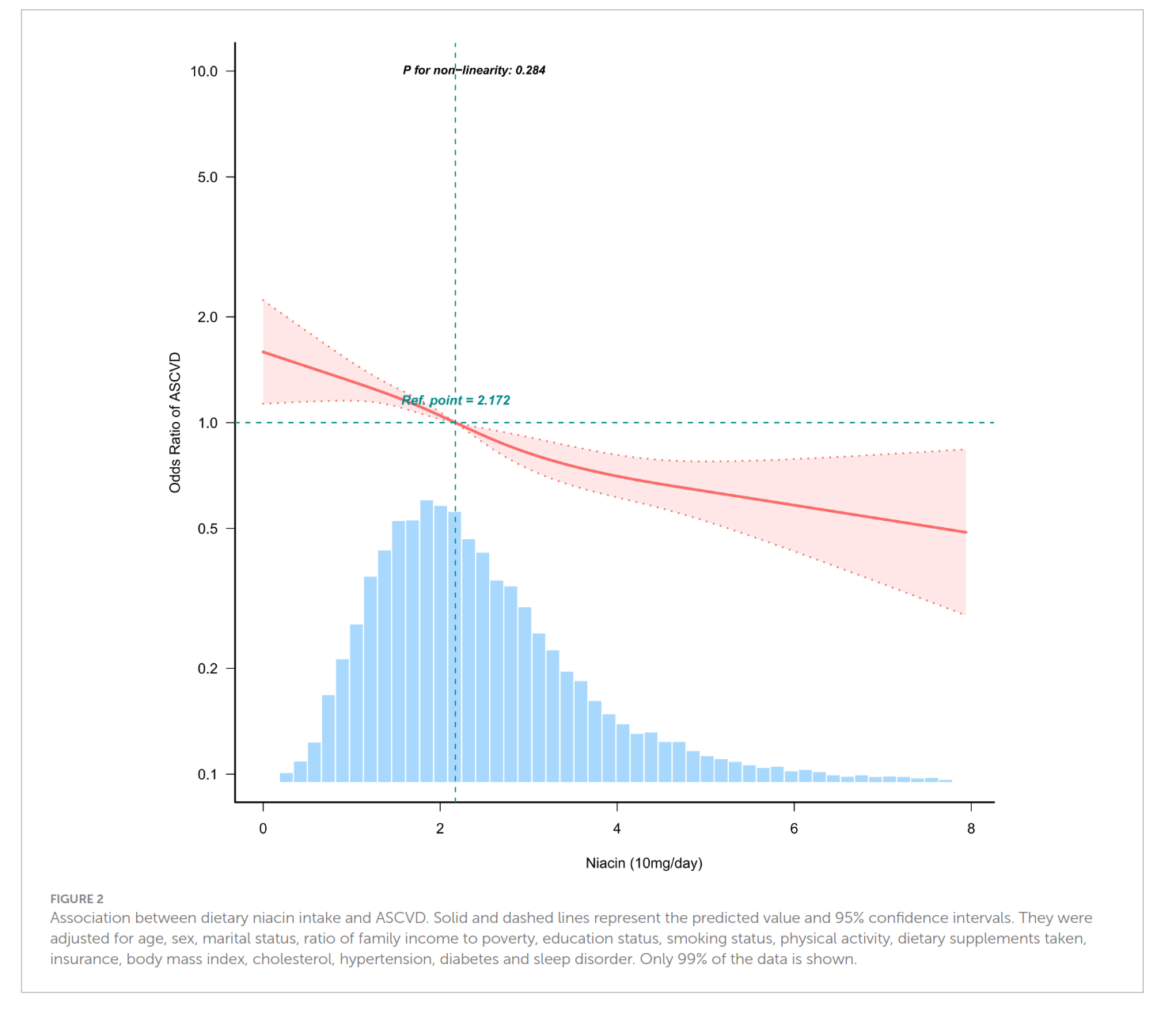
Crazy how the chart tops out at 80mg/d where the probability nears 0 and the odds ratio is around 0.5
What could it mean for those of us taking 500mg niacinamide every day?
-
@engineer I think these studies are useless. Obese people obviously intake more nutrients like niacin, and get diseases from excess calories and bodyweight.
-
@engineer - The B3 analogs are not interchangable and they are structurally dissimilar.

Abram Hoffer, M.D. pioneered the use of vitamin B3. He died in 2009 at the age of 91. During his life he claimed to be using B3 longer than anyone else. His standard dose of niacin was 3,000mg. If I remember correctely, 3,000mg of niacinamide is liver toxic.
His friend Linus Pauling (of vitamin C fame) also used B3 at Hoffer's suggestion. Linus died in 1994 at the age of 93. Big Pharma has not continued or funded further work on niacin: it was not in their financial interest.
DoctorYourself.com has a summary about B3 at Niacin Therapy as Used by Abram Hoffer, M.D.
-
@alfredoolivas - I searched the full text of the relevant text. It did not mention obseity.
-
@DavidPS The criteria was to be 20 years old, and have information about the participants's atherosclerotic cardiovascular disease, dietary niacin intake or covariates.
"Our research focuses on participants aged 20 years and older who completed an interview. Data analysis was conducted from July to September 2024. We excluded pregnant women or individuals with missing data on atherosclerotic cardiovascular disease, dietary niacin intake, or covariates. "
Perhaps covariates includes obesity, but I don't know.



Hello! It looks like you're interested in this conversation, but you don't have an account yet.
Getting fed up of having to scroll through the same posts each visit? When you register for an account, you'll always come back to exactly where you were before, and choose to be notified of new replies (either via email, or push notification). You'll also be able to save bookmarks and upvote posts to show your appreciation to other community members.
With your input, this post could be even better 💗
Register Login