The rationale for topical Losartan for hair loss.
-
TL:DR It can vasodilate and increase blood flow. It can stop TGF-b1
Hypothetical Formulation of Topical Losartan Liquid from Oral Tablets
Since this is a hypothetical scenario, I'll outline a high-level theoretical approach based on general compounding principles for similar drugs (like topical finasteride DIY methods) and adapted from formulations in scar treatment studies. Note that losartan is a prescription medication, and creating a homemade topical version from tablets is not approved, could be ineffective or unsafe due to impurities, improper dosing, skin irritation, or systemic absorption, and isn't recommended without professional oversight from a compounding pharmacist or doctor. Tablets contain fillers (e.g., microcrystalline cellulose, lactose, starch) that may not fully dissolve, leading to an unstable or gritty product.Theoretical BasisConcentration: Studies on topical losartan for conditions like keloids use around 5% losartan potassium (e.g., in ethosomal gels).
https://pmc.ncbi.nlm.nih.gov/articles/PMC10759551
For hair loss (theoretical, as no direct studies), a lower range like 1-5% might be considered to minimize risks, but this is speculative.
Solvents: Losartan potassium is soluble in water and alcohols. A common vehicle for topical solutions is a hydroalcoholic mix (e.g., ethanol for penetration and solubility, water for dilution). Propylene glycol (PG) is often added for better skin permeation and stability, similar to DIY topical androgen blockers.Ethanol helps dissolve the drug but can dry the skin; water balances it.
Ethosomal Aspect (from Studies): In keloid research, ethosomal gels incorporate losartan into vesicles made from lecithin (2-3%), high ethanol (20-40%), and water, then gelled with carbopol for viscosity.https://www.ijrpb.com/issues/Volume 4_Issue 2/ijrpb 4(2) 06 Mohan Krishna 2 72-74.pdf
This enhances penetration but requires pure ingredients, not tablets.
High-Level Formulation Steps (Theoretical, Not Actionable)Calculate Dosage: Determine the target concentration and volume (e.g., for 50 mL of 2% solution, you'd need theoretically 1 g of pure losartan potassium, equivalent to about 20 x 50 mg tablets, accounting for the salt form).
Prepare Powder: Crush tablets to a fine powder to expose the active ingredient.
Extraction/Solubilization: Mix the powder with a solvent blend, such as 70-80% ethanol (for dissolution and antimicrobial properties) and 20-30% distilled water or PG (for hydration and viscosity). Agitate to dissolve; heat gently if needed, but avoid to prevent degradation.
Filtration: Remove undissolved fillers (e.g., via coffee filter or fine mesh) to clarify the liquid.
Adjustment and Stabilization: Add preservatives if desired (though not typical in DIY), adjust pH (losartan is stable around neutral), and store in a dark bottle to protect from light.
Final Product: A clear to slightly cloudy liquid, applied sparingly to the scalp (e.g., 1-2 mL daily).Studies and Online MentionsKeloid Studies: A 5% losartan ethosomal gel (lecithin 3%, ethanol 30%, water balance, gelled with carbopol) showed promise for scar reduction via TGF-β inhibition, applied twice daily.
https://pmc.ncbi.nlm.nih.gov/articles/PMC10759551/
These use pure API, not tablets.
Compounding Pharmacies: Some offer 25 mg/mL topical losartan gels for conditions like hypertension or neuropathy, but recipes are proprietary and use bulk powder, not tablets.No public DIY recipes from tablets were found.
Online Discussions: Hair loss forums mention theoretical topical losartan but no specific DIY recipes from tablets; analogies are drawn to finasteride solutions (crush tablets, dissolve in ethanol/PG/water).My Opinion
Theoretically, it could work by adapting oral tablet extraction methods used for other drugs, leveraging ethanol-water for solubility and penetration to target local TGF-β1 in follicles. However, without lab testing, you'd risk contamination, inconsistent dosing, or side effects like hypotension if absorbed systemically. Stability might be short (e.g., 1-4 weeks refrigerated, per oral compounding analogs).It's far better to get a compounded version from a pharmacy—safer, purer, and tailored. If exploring for baldness, stick to proven treatments or await trials on losartan.
so the final mixture is
20x 100mg losartan tablets dissolved in
60ml ethanol, 20ml Propylene Glycol, 20ml waterfilter out the tablet residue with a nylon mesh filter
you have a 2% losartan topical mixture.
this should inhibit TGFB-1.
https://pubmed.ncbi.nlm.nih.gov/35074340/
https://pubmed.ncbi.nlm.nih.gov/35819289/
https://pubmed.ncbi.nlm.nih.gov/36877777/
https://pubmed.ncbi.nlm.nih.gov/38570181/
A 2020 patent (WO2020154304A1) describes using ARBs like losartan (including topical forms) to prevent and treat alopecia, based on their ability to modulate pathways involved in hair loss.
https://patents.google.com/patent/WO2020154304A1/en
It groups losartan with other blood pressure meds like ACE inhibitors for this purpose.
Topical losartan has been studied for skin fibrosis and scarring (e.g., keloids and corneal haze), where it inhibits TGF-β1 and reduces myofibroblast activity, which is analogous to hair follicle fibrosis in baldness.One study used 5% losartan potassium in ethosomal gel for keloids, showing efficacy via TGF-β suppression.
https://pmc.ncbi.nlm.nih.gov/articles/PMC10759551/
In other contexts, losartan reduces TGF-β1-mediated inflammation in conditions like cystic fibrosis models or dystrophic epidermolysis bullosa, supporting its anti-fibrotic potential.
https://pmc.ncbi.nlm.nih.gov/articles/PMC10759551/
Online discussions (e.g., forums and articles) mostly focus on oral losartan potentially causing hair loss, but the patent and scar-related studies are the main mentions of its possible benefits for hair via topical use.
https://link.springer.com/article/10.15252/emmm.201505061
Overall, the evidence is preclinical or indirect—no large-scale hair loss trials yet.
-
@wester130 What makes you say that losartan potassium is soluble in water? My research is saying that it's fairly insoluble.
-
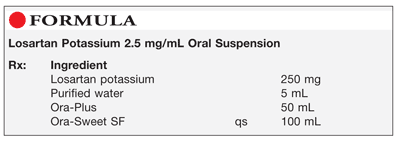
In experimental studies for oral liquid compositions, the following components were mentioned:
Active Agent: Losartan potassium.
Solvents/Vehicles: Water, propylene glycol, and glycerin.
Buffers/Stabilizers: Sodium phosphate buffer, sodium chloride, xylitol, and sweeteners.