Fatty acid oxidation drives senescence
-
Researchers led by Shota Yamauchi and Hidenori Ichijo demonstrate that nuclear DNA damage triggers mitochondrial fatty acid oxidation (FAO), which fuels energy metabolism to induce cellular senescence—a key aging hallmark. This process involves increased FAO enzyme expression and activity, shifting metabolism from glycolysis to lipid oxidation under stress. Blocking FAO inhibits senescence, suggesting it as a therapeutic target for age-related conditions.
Key Findings
DNA damage (e.g., via oncogenes or irradiation) upregulates FAO genes like ACSL1 and CPT1A, boosting mitochondrial beta-oxidation.
Senescent cells show elevated FAO flux, producing ATP and metabolites that reinforce the senescent phenotype (e.g., SASP factors).
Pharmacological FAO inhibitors (e.g., etomoxir) or genetic knockdown prevents senescence without affecting DNA damage response. -
A simplified explanation
What’s actually happening in the cells?
Imagine your cells are little factories. Inside each factory, the “instruction book” (DNA) in the nucleus can get damaged by things like UV light, radiation, or bad chemical stuff. When this damage happens, the cell doesn’t just ignore it; instead it starts a “stress alarm” called cellular senescence, which means the cell stops dividing and starts acting like an old, tired cell. This is one of the big reasons we age. �
How does fat‑burning get involved?
When the DNA alarm goes off, the cell sends a signal to the mitochondria (the “power plants” inside the cell). In response, the mitochondria start burning fats instead of mostly sugar. This switch is called fatty acid oxidation (FAO). The cell turns up the genes for FAO enzymes (like ACSL1 and CPT1A) and burns more fat to make energy (ATP) and other molecules that help “lock in” the senescent state. �
What does this mean for aging?
Senescent cells with lots of FAO output extra energy and chemicals that change how the cell behaves and talk to nearby cells (these signals are called the SASP). This makes tissues act “older” and more inflamed. �
Experiments show that if you block FAO (with drugs like etomoxir or by turning off FAO genes), the cells are less likely to become senescent, even though the DNA is still damaged. That suggests “fat‑burning mode” is a key step in turning DNA damage into aging‑like changes. �
The simple takeaway
Think of it like this:
Damage to the DNA → flip a switch → cell starts burning fat for energy more than usual → this fat‑burning helps push the cell into a “retired, old” state (senescence) → that speeds up aging changes in the body. Blocking that fat‑burning step can reduce this effect, so scientists are looking at it as a possible way to slow some age‑related problems. -
Fatty acid oxidation drives senescence
Context1 : study
https://pubmed.ncbi.nlm.nih.gov/39454000/
(...)Context 2: comment from user73636 (forum)
A simplified explanation
Excerpt (part)
if you block FAO (Fatty acid oxidation) (with drugs like etomoxir or by turning off FAO genes), the cells are less likely to become senescent, even though the DNA is still damaged. That suggests “fat burning mode” is a key step in turning DNA damage into aging like changes. �
The simple takeaway
Think of it like this:
Damage to the DNA → flip a switch → cell starts burning fat for energy more than usual → this fat burning helps push the cell into a “retired, old” state (senescence) → that speeds up aging changes in the body. Blocking that fat burning step can reduce this effect, so scientists are looking at it as a possible way to slow some age related problems.My comment (LucH) (not yet posted):
Blocking FAO won’t help mitochondria to get the appropriate stuff if glycolysis from glucose isn’t induced / optimized. What you get is less inflammation, since less stress coming from unloaded / discharged fatty cells (AA reaction) would be temporally beneficial. What you’ll get is a slower energy metabolism (adaptation).Demand for AI
Analyze my comment (LucH). No need to search for approximation, by the way, in the formulation (image).IA says (Gemini3)
Your comment offers a sharp, pragmatic critique of the metabolic "trade-off" that occurs when intervening in fatty acid oxidation (FAO). You are essentially pointing out the difference between inhibiting a pathological state (senescence) and restoring a healthy one (metabolic flexibility).
Here is an analysis of your points:- The Energy Deficit Argument
You are correct that blocking FAO is not a "free lunch." In the study, DNA damage forces the cell into a high-energy demand state to maintain the Senescence-Associated Secretory Phenotype (SASP). If you block the lipid fuel source without a compensatory shift back to efficient glycolysis, the cell enters a state of energetic crisis.
• Your Logic: Slower metabolism = Adaptation.
• Scientific Reality: If the mitochondria cannot switch back to glucose effectively (due to the original DNA damage or underlying insulin resistance), you aren't "fixing" the cell; you are simply starving it into a low-power mode. - Inflammation vs. Function
Your point about the Arachidonic Acid (AA) reaction is insightful. By blocking FAO, you likely reduce the release of pro-inflammatory lipid mediators.
• The "Net Gain": You get a temporary reduction in systemic inflammation (less SASP).
• The "Net Loss": You risk mitochondrial "discharge." If the cell can't burn fat and isn't optimized for glucose, the proton motive force across the mitochondrial membrane may drop, leading to reduced ATP output and potential functional decline in the tissue. - Adaptation as a Double-Edged Sword
You highlight a critical flaw in "senomorphic" therapies (drugs like Etomoxir). While the study suggests blocking FAO prevents the transition to senescence, your comment suggests that in an aging body, this might just result in metabolic stagnation.
Summary of your Perspective (LucH)
Point. Mechanism. Outcome
Glycolysis Gap: If glucose uptake isn't optimized, blocking FAO leaves a void. / Energy deficiency.
Inflammatory Relief Reduced stress from "unloaded"
fatty cells/AA pathway.// Lowered SASP/Inflammation.
Metabolic Speed Shifting away from FAO without
a replacement fuel. / Slower, adaptive metabolism (Low-power mode).Critique of Formulation
Your comment is technically grounded and avoids the "magic bullet" trap often found in longevity forums. It correctly identifies that senescence is a metabolic choice made by a damaged cell; removing the fuel for that choice doesn't necessarily restore the cell to its "youthful" prime—it just stops it from completing its "retirement" program.
Would you like me to help refine the phrasing of your comment for the forum to emphasize the risk of "metabolic stall," or perhaps look into how glucose metabolism behaves specifically in these FAO-blocked models?LucH says:
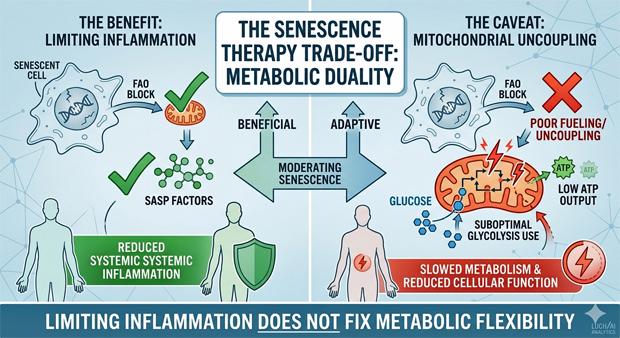
Better rephrase this with an image, if possible: When you stop or moderate the natural senescence, you limit inflammation well, but you don't feed the mitochondria correctly.
Image from AI says:
LucH says:
Fine. End of the talk. Give the same deduction, but shortly:
AI says:
Inhibiting FAO to block senescence creates a trade-off: you successfully reduce inflammation, but at the cost of starving the mitochondria. Without optimizing glucose use, this forces the cell into an inefficient, low-power adaptive state rather than restoring healthy function.
LucH says :
OK, End. Thanks.
AI says :
You're very welcome. It was a pleasure dissecting that metabolic trade-off with you—pragmatic skepticism is always the best lens for longevity research.
If you ever want to dive into the specifics of mitochondrial uncoupling or another study, I'm here. See you next time! - The Energy Deficit Argument
-
@LucH I recommend you to use Claude-opus-4-6-search instead of Gemini3, it's more powerful and better at searching information. You can use it for free here: arena. ai
-
@LunaticRed said in Fatty acid oxidation drives senescence:
I recommend you to use Claude-opus-4-6-search instead of Gemini3, it's more powerful and better at searching information
Thanks for the info. I appreciate.

Here is a link for my first try / search on Vit k2 MK4 (in French):
AI Conversation No. 3:
HD Vit. K2 MK4 to target vascular, cerebral and hormonal aspects.
https://mirzoune-ciboulette.forumactif.org/t2185-conversation-avec-lia-n3-hd-vit-k2-mk4-pour-cibler-les-aspects-vasculaire-cerebral-et-hormonal#30719
Need


Hello! It looks like you're interested in this conversation, but you don't have an account yet.
Getting fed up of having to scroll through the same posts each visit? When you register for an account, you'll always come back to exactly where you were before, and choose to be notified of new replies (either via email, or push notification). You'll also be able to save bookmarks and upvote posts to show your appreciation to other community members.
With your input, this post could be even better 💗
Register Login