Pramipexole log
-
This is my log for pramipexole.
What is it? Pramipexole is a non-ergoline dopamine agonist (DA) similar to lisuride and metergoline, two ergoline DAs more well known within the Peatosphere. They all lower prolactin, but interestingly, when used for a while (14+ days), pramipexole appears to increase serotonin:
So we'll have to see what happens.
Day -1:
I'm still waiting for the package with the pramipexole to arrive.
-
Update:
I have received an email from Georgi about why it increases serotonin:
Pramipexole is actually known to the Peat community and Peat was asked about pramipexole several times, and he cautioned against using it. It seems that this drug desensitizes the 5-HT1A receptor, which is a so-called "autoreceptor" and its activation decreases firing of 5-HT neurons and overall 5-HT tone in the brain. So, a desensitized 5-HT1A would mean increased serotonin tone/release and thus firing of the 5-HT neurons. This may be one reason Peat cautioned against using it. It also has several unpleasant side effects such as increased compulsive sexual behavior, which medicine claims is due to dopamine overload, but recent studies have shown that the culprit is serotonin. So, pramipexole seems to have a strong serotonergic effect in addition to its dopamine agonism, which seems to be missing in other dopamine agonists such as bromocriptine and the rest of the ergot derivatives.
https://haidut.me/?p=2895
https://pmc.ncbi.nlm.nih.gov/articles/PMC3297071/
"...The hippocampus and prefrontal cortex (PFC), structures manifesting volume decreases in depressed individuals, are also affected in rodents with chronic stress.20–24 It is not surprising that one of the common pathways for antidepressant response is an increase in the gene expression of neurotrophic/neuroprotective factors in the PFC and hippocampus.25,26 Previous work documented that prolonged administration of PPX in rats induced a desensitization of somatodendritic D2 autoreceptors in the ventral tegmental area (VTA), allowing the firing of DA neurons to normalize, and of 5-HT1A receptors in the dorsal raphe (DR) that enabled the spontaneous firing rate of 5-HT neurons to increase above control levels.27 Considering the effectiveness of PPX in the treatment of MDD, the importance of both DA and 5-HT systems in the pathophysiology of depression, and the DA innervation of the PFC and the 5-HT innervation of the hippocampus, the assessment of the net effect of chronic PPX administration on DA and 5-HT neuronal tone in the PFC and hippocampus, respectively, was deemed relevant to understand its antidepressant action.""...Similarly to PPX, the increase in the spontaneous discharge of DR 5-HT neurons produced by subchronic administration of the atypical antipsychotic aripiprazole has been found to be due to activation of the D2-like receptors and desensitization of 5-HT1A autoreceptors.62 "
Let's see what happens with a microdose.
-
Day 0:
I tried ~0.5mL (1mg) about 30 minutes ago. Nothing interesting to report yet.
-
Update:
After taking a 2 hour nap (I didn't get much sleep) I vomited in the toilet, but at least I hadn't eaten anything for 5 hours. Clearly there's something in the bottle's clear liquid! Aside from the vomiting and POSSIBLY the sleepiness, I'm feeling absolutely nada.
Tomorrow I'm going to tone things down with 0.125mg or 0.25mg instead of 1mg.
-
@engineer 1mg was not a microdose, I was gonna mention XD
-
Last update for today:
I'm not feeling "high dopamine" symptoms. All the pramipexole seems to be doing is making me sleepy and nauseous.
@alfredoolivas is this supposed to happen with DAs?
-
@engineer The high dopamine state usually occurs with high noradrenaline, as well as a rise in serotonin that concurs with endogenous rises of dopamine and from drugs like cocaine.
-
@engineer Nausea happens from DA agonists too. I don't know why. D2 antagonists can reduce nausea.
-
By inhibiting endogenous dopamine production via D2 agonsim, it reduces dopamines downstream conversion into noradrenaline & adrenaline, making you tired
-
@alfredoolivas said in Pramipexole log:
By inhibiting endogenous dopamine production via D2 agonsim, it reduces dopamines downstream conversion into noradrenaline & adrenaline, making you tired
Could this still happen with a microdose like 0.125mg? If it does then seems like the DAs are pretty terrible and bromantane/selegiline is the only real option.
-
@engineer with that dose less so. Other DA agonists such as cabergoline can increase NA. Bromocriptine lowers it.
Some love them, others get no effect from them. I did get cool results from caber, it was euphoric at the start, it just made me insulin resistant. That could be why you feel tired too from a 1mg dose of prami which is quite high.
-
@alfredoolivas I asked AI about this and don't like what it said:
From a pharmacological and clinical research perspective, administering pramipexole at 0.125 mg/day occupies an interesting physiological space.
To provide accurate context, it is worth noting that while 0.125 mg/day is a very small amount, it is not strictly a "microdose" in the sense of being sub-therapeutic. It is the standard, commercially available starting dose for clinical titration (used to mitigate side effects like severe nausea and orthostatic hypotension) and is actively used as a therapeutic maintenance dose for mild Restless Legs Syndrome (RLS).
However, because pramipexole exhibits a biphasic, dose-dependent mechanism of action, a dose of 0.125 mg/day yields highly specific neurochemical effects that differ drastically from the higher doses (1.5 mg to 4.5 mg/day) used to treat Parkinson's disease.
Here is a breakdown of the possible effects and mechanisms of action at this specific dosage:
- The Presynaptic Autoreceptor Effect
Pramipexole is a non-ergoline dopamine agonist with a highly selective affinity for the D2 receptor subfamily, specifically demonstrating a 7- to 10-fold greater affinity for D3 receptors over D2 receptors.
At a low dose of 0.125 mg, pramipexole preferentially targets presynaptic autoreceptors rather than postsynaptic receptors.
Negative Feedback Loop: By stimulating these presynaptic autoreceptors, the drug tricks the brain into registering an abundance of dopamine. In response, the brain downregulates the endogenous synthesis and synaptic release of dopamine.
Transient Hypodopaminergic State: Paradoxically, administering this low dose of a dopamine agonist can temporarily decrease overall dopaminergic tone. In animal models, low doses of pramipexole are frequently associated with transient locomotor hypoactivity and sedation.
- Autoreceptor Desensitization (Chronic Administration)
If the 0.125 mg/day dose is sustained over a prolonged period, researchers observe a shift in neuropharmacodynamics.
Receptor Downregulation: Chronic stimulation desensitizes the somatodendritic D2 and D3 autoreceptors.
Neurotransmitter Rebound: Once these inhibitory autoreceptors desensitize, the firing rate of dopaminergic neurons normalizes or increases. Research also indicates this allows for a normalization of 5-HT1A (serotonin) autoreceptors, leading to a net enhancement in both dopamine and serotonin neurotransmission in the forebrain. This mechanism is the primary hypothesis for pramipexole's off-label efficacy in treating treatment-resistant and bipolar depression.
- Behavioral and Cognitive Processing
Because D3 receptors are heavily concentrated in the mesolimbic pathways (which govern mood, reward, and behavior) rather than the striatum (which governs motor control), low-dose pramipexole significantly impacts emotional and reward processing.
Blunted Reward Processing: Acute low doses have been shown in human fMRI studies to diminish the neural response to both rewarding and aversive stimuli in the ventromedial prefrontal cortex and striatum.
Impulse Control: While severe impulse control disorders (compulsive gambling, hypersexuality, overeating) are heavily correlated with the higher doses used in Parkinson's, the intense D3-binding profile of pramipexole means researchers still monitor for mild shifts in impulsivity and motivation even at 0.125 mg.
-
Physiological and Motor Effects
Motor Control: At 0.125 mg/day, the dose is generally sub-therapeutic for restoring significant motor function in Parkinson's disease, as it does not adequately occupy the postsynaptic D2 receptors in the striatum. However, it is often highly effective for restoring the descending dopaminergic inhibitory pathways in the spinal cord that alleviate RLS.
Adverse Effects: Even at this lowest clinical dose, a drug-naive subject may experience nausea (due to dopamine receptors in the chemoreceptor trigger zone), somnolence or sudden "sleep attacks," and mild orthostatic hypotension.
It would be terrible to have bottles of pramipexole laying around doing nothing, unless Gemini is wrong here?
-
@engineer Maybe it’s a reminder to try things before going all in XD
88mcg / 0.088mg is the dose used to treat restless leg syndrome, so its not sub therapeutic.
-
Took 0.125mg (2 drops) about an hour ago
So far nothing interesting, not even sleepiness
-
Update:
Zero nausea and neutral energy feelings maybe also thanks to taking TyroMix again (I didn't yesterday) and drinking some Coca Cola.
-
Update
Nothing interesting of note yet
-
Update
I took 0.25mg (4 drops) 5 hours ago, an upgrade from the 0.125mg done until now
It made me slightly tired and maybe not perform as well in the gym
It seems to be suppressing prolactin but not to a major degree
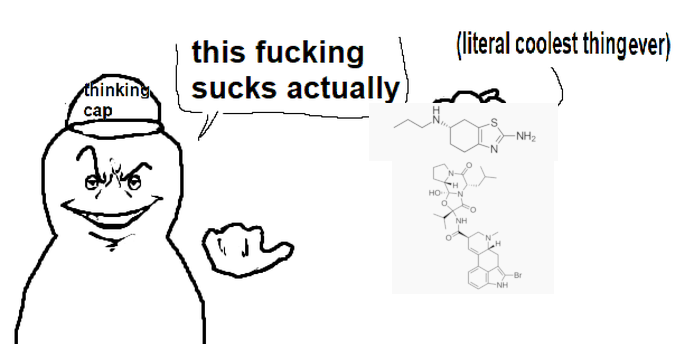
SO FAR it's exactly the meme below
-
Update
Took 0.25mg again but am not feeling the same amount of sleepiness as yesterday
I'm getting used to it
Edit: I did get sleepy an hour ago but a 20 minute nap fixed it; therefore, it was likely due to not getting enough sleep.
-
Update
I'm trying 0.375mg (6 drops) now but am splitting it across 3 drops morning, 3 drops night.
So far not much of a difference but it could take a couple days for the half lives to even out
-
Update
I did 4 drops (0.25mg) last night and another 4 drops this morning. So far, it's not even CLOSE to what this person and a few others have reported:
https://www.reddit.com/r/masturbation/comments/1my2drs/ropinirole_is_a_hell_of_a_drug_nonstop/
So, I've been taking this drug [ropinirole] that stimulates the release of dopamine. Other people have had major trouble with it, but I've been okay with it because suddenly loving masturbating again after a long time has been really cool. I get naked every day, get out the lube, cue up some female friendly, lesbian or bi porn (Shout out to Malena Morgan! You're a fucking girl on girl sexpert and I've cummed to you so many times.) and then I smear myself from ass to tits with lube or petrolatum and rub and prod for at least 8 hours per 24 hour period. This has been going on for at least three weeks. I woke up this morning at 4 and started rubbing and fingering myself. I did have sex last weekend. I was at a party, and some 23 year old kid, a friend of one of my good friend's son, was kind of drunk and REALLY horny. He started hitting on me hard, which I thought was weird and suspicious, but he let me feel his dick, and it was rock hard. He was cute and young with a decent sized dick, so I wasn't going to pass this up. I took him back to my place, and we went at it for 2 to 3 hours. I sucked his dick, and he stuck it in my pussy and my ass. I let him do whatever he wanted as long as it wasn't violent or painful. When he had to come, I told him to come in me, and I held his ass and pulled him deeper as he blew his load. Then he wanted to kiss for about 10 minutes, which was nice. The next morning, he was hard again, and I let him fuck me, of course. It was really good, and I told him he can come back anytime. Now I'm going to lube up and try to get to that point where the orgasms hit like a skipping stone hitting water.


Hello! It looks like you're interested in this conversation, but you don't have an account yet.
Getting fed up of having to scroll through the same posts each visit? When you register for an account, you'll always come back to exactly where you were before, and choose to be notified of new replies (either via email, or push notification). You'll also be able to save bookmarks and upvote posts to show your appreciation to other community members.
With your input, this post could be even better 💗
Register Login