Essential Fatty Acids (Omega-3 & Omega-6) are direct building blocks for the skin's lipid bilayers, reducing transepidermal water loss (TEWL).
-
Transepidermal water loss (TEWL), dehydration, and metabolic acidosis are clinically connected, most commonly in the context of severe burn injuries or major skin barrier damage. A breakdown of the skin causes water to passively evaporate, which reduces blood volume, lowers tissue perfusion, and leads to acidic blood.
Changes in Transepidermal Water Loss and Skin Hydration according to Expression of Aquaporin-3 in Psoriasis
https://pubmed.ncbi.nlm.nih.gov/22577267/The repair of impaired epidermal barrier function in rats by the cutaneous application of linoleic acid
https://onlinelibrary.wiley.com/doi/abs/10.1111/j.1365-2133.1976.tb04336.xAnti-Inflammatory and Skin Barrier Repair Effects of Topical Application of Some Plant Oils
https://doi.org/10.3390/ijms19010070Changes in transepidermal water loss and the composition of epidermal lecithin after applications of pure fatty acid triglycerides to the skin of essential fatty acid-deficient rats.
https://doi.org/10.1111/j.1365-2133.1976.tb07012.xKrill oil supplementation improves transepidermal water loss, hydration and elasticity of the skin in healthy adults: Results from two randomized, double-blind, placebo-controlled, dose-finding pilot studies
https://pubmed.ncbi.nlm.nih.gov/39169540/Diet and skin barrier: The role of dietary interventions on skin barrier function.
https://doi.org/10.5826/dpc.1101a132The role of linoleic acid in skin and hair health: A review.
https://www.mdpi.com/1422-0067/26/1/246Feeding the Skin Barrier: The Impact of Macro‐ and Micronutrients on Skin Barrier Function
https://pmc.ncbi.nlm.nih.gov/articles/PMC12626168/Skin pH–dependent Staphylococcus aureus abundance as predictor for increasing atopic dermatitis severity
https://onlinelibrary.wiley.com/doi/full/10.1111/all.14461https://linktr.ee/AlphaZance
-
Mead acid (Omega-9) cannot build fully functional skin lipid bilayers and acts as a biochemical SOS signal. When your body experiences an Essential Fatty Acid Deficiency (EFAD), it tries to compensate by substituting missing omega-6 linoleic acid with de novo synthesized omega-9 Mead acid. [1, 2, 3]
However, this biological substitution fails to restore proper barrier physics, causing the stratum corneum to become leaky, brittle, and hyperproliferative. [3]The Molecular Mismatch: Why Mead Acid Fails
The structural failure of a skin lipid bilayer built with Mead acid comes down to a precise molecular mismatch:
- The Missing Geometry: Linoleic acid (omega-6) has a specific shape and chain length optimized to interlock tightly within acylceramides. This tight packing creates a highly ordered, impermeable orthorhombic crystalline phase.
- The Fluid Kink: Mead acid (omega-9) features three double bonds that introduce a different structural "kink" into the fatty acid tail. It is physically incapable of packing tightly with neighboring ceramides and cholesterol. [2, 4, 5]
- Disrupted Periodicity: Instead of forming neat, tightly packed lamellar sheets (bilayers), Mead acid forces the lipid matrix into a disorganized, more fluid liquid-crystalline phase. [6]
The Consequences of a "Mead Acid Barrier"
When Mead acid replaces linoleic acid in the skin's lipid matrix, the downstream clinical outcomes are highly predictable: [1, 7]
[Linoleic Acid Depletion]
│
▼
[Compensatory Mead Acid Synthesis]
│
▼
[Disorganized, Fluid Lipid Bilayers]
│
├─► High Transepidermal Water Loss (TEWL) ──► Chronic Dryness & Scaling
└─► Compromised Structural Integrity ──► Epidermal Hyperproliferation- Spike in Transepidermal Water Loss (TEWL): Because the Mead acid-substituted lipid bilayers are structurally loose, water easily slips through the intercellular spaces. The skin suffers from severe, unquenchable dehydration regardless of topical humectant use. [3, 7, 8]
- Epidermal Hyperproliferation: Healthy bilayers signal the skin that its shield is intact. The disorganized Mead acid barrier constantly signals a breach, forcing the epidermis to rapidly produce more keratinocytes. This creates the hallmark thick, scaly, and peeling skin seen in EFAD. [3, 8, 9, 10]
- The Triene-to-Tetraene Ratio: In laboratory diagnostics, a high ratio of trienes (Mead acid) to tetraenes (arachidonic acid)—specifically a Holman Index > 0.2—is the definitive biochemical marker used to diagnose systemic essential fatty acid deficiency. [8, 11]
The Therapeutic Divergence
While Mead acid is a poor structural surrogate for your skin's mechanical barrier, emerging research shows it acts as an endogenous anti-inflammatory agent. Topically, Mead acid has been shown to downregulate p38 MAPK pathways and activate PPAR-α, which can actually suppress irritant contact dermatitis or retinoid-induced skin irritation. [2, 12, 13]
However, to truly repair the mechanical, waterproof barrier of the skin, Mead acid must be replaced by reintroducing true omega-6 linoleic acid via systemic nutrition or targeted topical formulations. [14]
Would you like to review:- The exact biochemical pathway where oleic acid converts into Mead acid?
- The optimal topical ratio of linoleic acid to cholesterol for barrier correction?
- How to calculate the triene-to-tetraene ratio from a lipid panel?
[1] https://www.sciencedirect.com
[2] https://pmc.ncbi.nlm.nih.gov
[3] https://lpi.oregonstate.edu
[4] https://www.instagram.com
[5] https://pmc.ncbi.nlm.nih.gov
[6] https://www.sciencedirect.com
[7] https://www.nbflanes.com
[8] https://aspenjournals.onlinelibrary.wiley.com
[9] https://www.shankara.in
[10] https://pmc.ncbi.nlm.nih.gov
[11] https://www.jaad.org
[12] https://pubmed.ncbi.nlm.nih.gov
[13] https://pmc.ncbi.nlm.nih.gov
[14] https://curology.com -
@AlphaZance hi, have you read the burr experiment?
-
It’s impossible to eat a decent diet without getting some PUFA.
There is a tremendous prejudice in the literature favoring the “essential” fatty acids.
Omega 6 encourages sunburn and sun damage in my observation. The lower the PUFA, the better my skin seems to be.
I think Dr. Peat was correct, but I appreciate other views too, so thank you.
-
It’s impossible to eat a decent diet without getting some PUFA.
There is a tremendous prejudice in the literature favoring the “essential” fatty acids.
Omega 6 encourages sunburn and sun damage in my observation. The lower the PUFA, the better my skin seems to be.
I think Dr. Peat was correct, but I appreciate other views too, so thank you.
HI, have you read on Rpf the differents reports of skin worsening on low pufa diet? Dry skin sometimes extremly dry skin is mentionned, and some people improve it by consuming straight seeds oil. Low pufa diet don't necessary lead to skin problems, yet in some cases it can be associated to it and seed oil and/or higher mufa/pufa intake can improve the condition
-
@user1 yes I have read them. I’m not sure what the reason is, or what combination leads to extremely dry skin, but I suspect PUFA makes things worse in the longer run.
-
@user1 yes I have read them. I’m not sure what the reason is, or what combination leads to extremely dry skin, but I suspect PUFA makes things worse in the longer run.
If you stay in the sun with higher propency to burning and skin damage, yes on the long run it might be worst, if you avoid sun exposure it might not. Been wondering if it's possible people with higher mufa/pufa intake either have higher skin moisture and/or sebum at baseline, and at lower temperature set point, and people that are truly more saturated have lower skin moisture and/or sebum at baseline or might need higher temperature set point or sun exposure to be more moisturized
-
Krill oil supplementation improves transepidermal water loss, hydration and elasticity of the skin in healthy adults
Useful omega 6 for skin repair or omega 3 to dampen an immune response
Excerpt from my post: Immunosuppressive effects of omega-3
How can unrefined / unadulterated omega-3 be successfully supplied without increasing oxidative risks through peroxidation? That is the crux of the problem. (1)
Useful omega-6 for skin repair
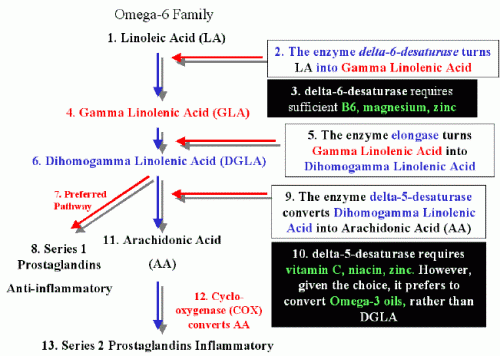
Yes, hydration and elasticity of the skin in healthy adults is observed when taking evening primrose oil for men or borage oil for women, incredibly rich in gamma-linolenic acid (GLA), which the body metabolizes into dihomo-gamma-linolenic acid (DGLA) to produce powerful anti-inflammatory prostaglandins. This makes it highly effective for soothing dry, irritated skin, reducing fine lines, and restoring the skin's moisture barrier. Dixit AI.
Not sure the best pathway will be reached, but it could be attempted. Too long to explain here. See the figure: LA => GLA => DGLA => AA or PG-2
Studies on the beneficial effects of omega-3s
No one disputes the benefits of an omega-3 regimen against inflammation or in case of an excessive immune response, particularly with EPA, very functional.
Okay, omega-3s are immuno-modulators. However, this applies either in the short term (cure) or when the diet is balanced (specifically, with an omega-3 to omega-6 ratio ranging from 1:1 to 1:4, or at a maximum of 1:10 at some time if limited in time). The US ratio is usually at 1/20 (with food manufactured, or with livestock fed partly on corn meal and soy, instead of grazing for nine months out of twelve).
Anything exceeding the body's requirements will be stored.
At that point, the eicosanoids exert a hormonal effect. It becomes a ticking time bomb (driven by what is known as the arachidonic acid cascade).
What is meant by intake exceeding physiological needs?
The requirements are very weak. And not specifically every day. Omega-3s (ALA) are conditionally essential. This means the body can do without them if the necessary cofactors are present (2). As for omega-6s, AA and DHA are the essential ones—though the amount of DHA required is truly very modest (125–250 mg). It is worth remembering that we are "surrounded" by omega-6s (LA).
When needs are over-estimated
However, if the body's needs are exceeded (leading to storage), or if EPA intake is prolonged to counteract inflammation—using as much as 3g of EPA! (for instance, in cases of osteoarthritis, as seen in several studies)—a delayed thyroid problem will arise. At that point, we are no longer talking about modulation, but rather a suppressive effect.
To be continued on this link, with references and explanations over “fatty acids for dummies”)
Anti-thyroid effects of omega-3 –
Immunosuppressive effects of omega-3
https://mirzoune-ciboulette.forumactif.org/t2207-english-corner-anti-thyroid-effects-of-omega-3#30866 -
"Concentrated" or "triple strength" fish oils are available. You can get the daily recommended intake of DHA and EPA with just one gram PUFA pill a day.
-




Hello! It looks like you're interested in this conversation, but you don't have an account yet.
Getting fed up of having to scroll through the same posts each visit? When you register for an account, you'll always come back to exactly where you were before, and choose to be notified of new replies (either via email, or push notification). You'll also be able to save bookmarks and upvote posts to show your appreciation to other community members.
With your input, this post could be even better 💗
Register Login