Omega-3 is toxic to the brain and inhibits recovery after traumatic injury (TBI), may cause Alzheimer’s
-
One of the few studies that is willing to call a spade a spade. Despite the lack of benefits (and in some cases proven harm) of omega-3 supplementation in human clinical trials, doctors continue to recommend omega-3, either as isolated supplement or in the form of oil from fatty fish, especially for its purported “brain benefits”. The fact that both EPA and DHA are highly susceptible to peroxidation somehow escapes the discussion, even though omega-3 supplementation is among the most reliable dietary methods for raising endogenous levels of the toxic and carcinogenic peroxidation byproducts malondialdehyde and 4-hydroxy-nonenal (4-HNE). Be that as it may, the study below found that adding fish oil (FO) to the diet of animals resulted in delayed recovery from TBI, as well as worse (compared to the control group) biomarkers of vascular recovery and cognitive performance. The authors call for urgent re-evaluation of the public health recommendations concerning FO/omega-3 as “brain protective” food additive. It is worth pointing out that the FO addition to the diet was at “…under physiologically relevant dietary conditions”, which means that eating cold-water fatty fish just 2-3 times weekly, as often recommended for brain health, would be enough to reproduce the study design. It is also worth noting, that the study found only the EPA omega-3 to have the harmful effects. However, this was largely due to the fact that DHA simply did not accumulate in measurable amounts in brain tissue. In all likelihood, and as per Ray’s comment as well, DHA peroxidized so rapidly post-digestion that it did not even reach the bloodstream in intact form. As such, post-TBI, EPA got robustly mobilized from brain fat stores and into the brain circulation, while the other major omega-3 – DHA – was simply missing. Had it been present in the brain as easily as EPA, the biochemical effects and pathways of DHA overlap almost perfectly with those of EPA, and as such it is reasonable to expect the same negative effects on the brain. Also, the study only looked at fatty acid mobilization from brain cells after TBI. It did not look at damage that “safely” stored EPA may do even without injury and mobilization. The fact that EPA (and DHA) is so easily oxidized and turned into toxic aldehydes regardless of where that omega-3 located, should not be overlooked, as over time EPA peroxidation even while stored inside brain cells would still make it toxic to the brain. As an initial corroboration of that hypothesis, the study found that the brains of mice fed FO has much higher levels of the toxic tau protein, which is one of the core symptoms of Alzheimer Disease (AD).
https://doi.org/10.1016/j.celrep.2026.117135
“…Long-chain n-3 PUFAs, particularly EPA and DHA, are widely regarded as neuroprotective dietary components. While DHA plays a well-established role in promoting membrane fluidity, synaptic resilience, and neurodevelopmental resilience,79 the role of EPA in the injured brain remains less defined. Unlike DHA, EPA is minimally incorporated into neuronal membranes and has been associated with adverse cognitive and synaptic outcomes in preclinical models.40,80 In this study, we directly challenge the prevailing assumption that all n-3 PUFAs confer uniform benefit across physiological states. Instead, our data reveal that sustained cerebral accumulation of EPA, under physiologically relevant dietary conditions, constitutes a latent metabolic liability that becomes unmasked in the context of repetitive mild TBI. This vulnerability appears to manifest through impaired vascular repair, endothelial stress, and maladaptive remodeling within the NVU, processes that may fundamentally redefine the cerebrovascular impact of dietary PUFAs and underscore the need for precision-guided strategies that account for context-dependent lipid metabolism in brain injury and disease.”
https://www.sciencealert.com/popular-supplement-could-have-an-unexpected-downside-study-finds
“…Fish oil supplements have long been linked to a variety of brain benefits, but 2026 research suggests that one of the omega-3 fatty acids these supplements contain could interfere with the brain’s repair processes. A study in mice affected by mild traumatic head injuries showed that animals fed diets containing the omega-3 fatty acid EPA (eicosapentaenoic acid) performed worse on spatial memory and learning tasks after the injuries. Rather than omega-3s aiding recovery as previous research has suggested, it seems EPA might actually get in the way of blood vessel repair, as it reprograms their metabolic activity.”
“…One of the most significant findings from the study is that EPA, and not DHA, accumulated in the brains of mice fed these supplements. This fits with what we know about DHA being more readily built into brain cell membranes than EPA. What’s more, the researchers found that in mice, the destabilizing effects of EPA on blood vessels led to the build-up of toxic tau proteins linked to brain degeneration. A further analysis of human brain tissue from individuals affected by chronic traumatic encephalopathy (CTE), associated with repeated head injuries like those tested in the mice, showed a similar kind of metabolic disruption and blood vessel damage. The researchers speculate that fish oil supplements containing EPA may increase the risk of CTE if, by impairing cellular recovery, they exacerbate the effects of mild concussions that can easily go unchecked.”
-
@haidut This is huge: postmortem human studies confirmed animal model findings.
This is from the paper showing all the PUFAs were highly elevated while saturated FAs were not much so in injured (CTE) brain tissues.
Figure 6C from the paper: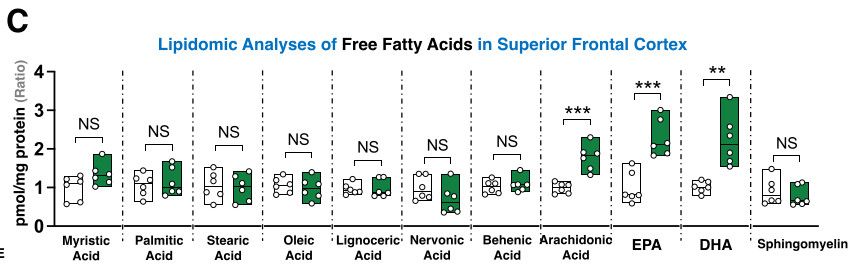
From page 11 of the paper:
We analyzed superior frontal cortex tissue from six neuropathologically confirmed CTE cases with a history of repetitive TBI (all < 75 years old) and six age- and sex-matched neurologically healthy controls (Figure 6A). Lipidomic profiling via HPLC-MS/MS revealed marked enrichment of PUFAs in CTE brains, including ∼150% elevations in EPA and DHA and an 80% increase in arachidonic acid (AA) relative to controls (Figure 6C). Importantly, these differences were independent of body mass index (Figure 6B), suggesting intrinsic brain-specific alterations in fatty acid metabolism. -
@Lejeboca so the injured brains were loaded with EPA and DHA. Ray Peat argued in The Great Fish Oil Experiment that low levels of these oils usually get read as a deficiency, when "it is usually their presence, rather than their deficiency, that created the disposition for the disease." Does the paper say anything about how much fish those six guys ate? I'm wondering if it came from diet or if it just piles up in damaged tissue.

Hello! It looks like you're interested in this conversation, but you don't have an account yet.
Getting fed up of having to scroll through the same posts each visit? When you register for an account, you'll always come back to exactly where you were before, and choose to be notified of new replies (either via email, or push notification). You'll also be able to save bookmarks and upvote posts to show your appreciation to other community members.
With your input, this post could be even better 💗
Register Login