Is lutein a Magic Bullet for cognition?
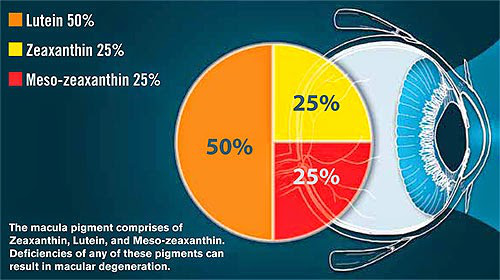
-
-
@DavidPS and others
Remind that when eating spinach, you need a lot of calcium and citrates because it's very high in oxalates. +/ 600 mg for 100 gr.
The body can only manage 50 mg per day; 150-200 mg is often taken but what is higher than 50 mg is taken away in urine (citrate) and in stools (calcium).
I never take more than 200-250 mg Ca element. When I eat spinach, I mix it with my meal (potato, spinach or broccoli, 1 egg (or egg yolk), a small onion lightly cooked, and spices) + 4 oz. beef (100-110 g).
I take then once 1000 mg citrate calcium tablet (big one) if I haven't got enough calcium for the day (1200 instead of 850 mg Ca) or I take 2 doses (2.5 g x 2) potassium citrate powder.
The optimal minimal ratio Ca / Ox is 1/3. So in theory 200 mg Ca per 100 gr spinach (600 mg oxalates).
Mind for lithiasis if you don't manage well. And when you don't balance well with other minerals, if deficit in base, you're going to excite PTH and bone remodeling.
Edit: 200 mg Ca element is not the same as 200 mg calcium citrate. There is +/ 30 % Ca element in Ca citrate.
Note: Calcium to magnesium ratios <1.7 and >2.8 can be detrimental, and optimal ratios may be ∼2.0 for bone mineral density.
Taking calcium alone does not stop or even slow bone loss and does not prevent osteoporosis according to recent studies. Need for Mg element 480 mg target. -
Useful info
Interactions between vitamins A, D, E, and K
http://www.westonaprice.org/health-topics/abcs-of-nutrition/nutritional-adjuncts-to-the-fat-soluble-vitamins/
Summary
• Vitamins A, D, and K2 interact synergistically to support immune health, provide for adequate growth, support strong bones and teeth, and protect soft tissues from calcification.
• Magnesium is required for the production of all proteins, including those that interact with vitamins A and D.
• Vitamins A and D support the absorption of zinc and zinc supports the absorption of all the fat-soluble vitamins.
• Many of the proteins involved in vitamin A metabolism and the receptors for both vitamins A and D only function correctly in the presence of zinc.
• Dietary fat is necessary for the absorption of fat-soluble vitamins.
• Vitamin K2 activates proteins by adding carbon dioxide to them. We can increase carbon dioxide production by consuming carbohydrates, exercising, and maintaining robust thyroid status.
• The fat-soluble vitamins thus interact not only with each other, but with other nutrients and metabolic factors as well. This level of complexity should urge us to exercise caution when interpreting scientific research, and to cooperate with the wisdom of nature by obtaining vitamins through nutrient-dense foods.
Throughout the twentieth century, we viewed the fat-soluble vitamins in isolation from one another. Researchers relegated vitamin K to blood coagulation, and ignored vitamin K2 entirely because it is present in such small quantities in the diet. Vitamins A and D each fell in and out of favour, the popularity of one always rising at the expense of the other. Ignoring the forest to study one tree at a time, the concept of synergy eluded us.
In order to truly understand the fat-soluble vitamins, however, we must understand that vitamins A, D, and K cooperate synergistically not only with each other, but also with essential minerals like magnesium and zinc, with dietary fat, and with key metabolic factors like carbon dioxide and thyroid hormone.
Link: Bone remodeling and modeling (role of cells osteoclasts for resorption; cells osteoblasts have the role to remodel new bones to repair damage)
Youtube Video -
Useful info
Interaction between fat-soluble vitamins A D K
Key ideas
Nutritionists talk about vitamin K as if there were only one type!
We know the role of vitamin K1 (phytomenadione) for its role in coagulation. It is mainly found in green vegetables.
Vitamin K2 (menaquinone) is less well known and has no RDA recommended by health authorities!
We can convert K1 into K2 but it is random and notoriously insufficient.
K2 plays a key role in the activation of hormones that regulate calcium metabolism: osteocalcin, which is involved in the mineralization of bone matrix, and matrix Gla protein (MGP), which protects soft tissues against calcification.
The role of vitamin K2 is not limited to these functions alone. Here, it is much more than a co-factor because vitamin K2 is the substance that allows dependent proteins A and D to activate/come to life. While vitamins A and D act as signaling molecules, telling cells to produce certain proteins, vitamin K2 activates these proteins, giving them the physical ability to bind calcium.
If more details wanted:
https://mirzoune-ciboulette.forumactif.org/t127-interaction-entre-les-vitamines-liposolubles#889
See second post for the original article in English. -
I have an old Jarrow supplement, with Lutein and Zeaxanthin, which I'm thinking of giving to my dad for his old eyes. Would the general consensus be to stay away from supplements and attempt to get these things from food? I'm concerned about the oxalates (as @luch points out) in spinach, as well as the cost; and I don't think my dad would eat kale.
"To desire action is to desire limitation" — G. K. Chesterton
"The true step of health and improvement is slow." — Novalis -
@Mossy said in Is lutein a Magic Bullet for cognition?:
I have an old Jarrow supplement, with Lutein and Zeaxanthin
What I do:
I’ll take a supplement as antioxidant to dampen possible inflammation, having the capacity to cross the retina barrier, as astaxanthin. 2 x 4 mg daily, with a meal with some fat.
Lutein and Zeaxanthin are more specific for eye retina. In cure 2 or 3 weeks. Then stop a month. Begin again once only if you’ve seen improvement.
Useful info :
La lutéine est prédominante dans le cerveau
https://mirzoune-ciboulette.forumactif.org/t1702-vous-voyez-flou-des-taches-apparaissent#25944
Type de caroténoïdes et efficacité antioxydante (AO)
Carotenoid type and antioxidant efficacy (AO)
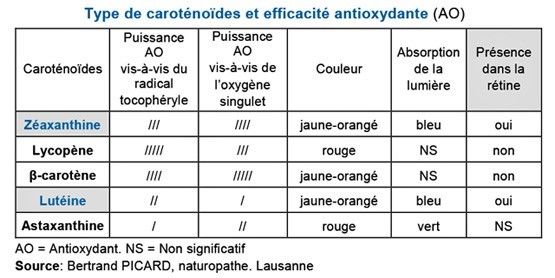
You won't get enough lutein in the eye (retina) unless you eat 2 eggs every other day, which I won't do, except as a cure (2-3 weeks), every 3 months.
NB: When my eyes prick, I take a mix for 3-4 days 2x 500 UI, with fat (MUFA and PUFA required as carriers).
Need a supplement if there is a problem, as attack phase (2 weeks).
NO milk / cheese when taking polyphenols, unless there're packed with a amino acid (glycine). 2 hours before or after a meal containing HD Fe and Ca (meat / cheese).LucH
My website: Chez Mirzoune et Ciboulette -
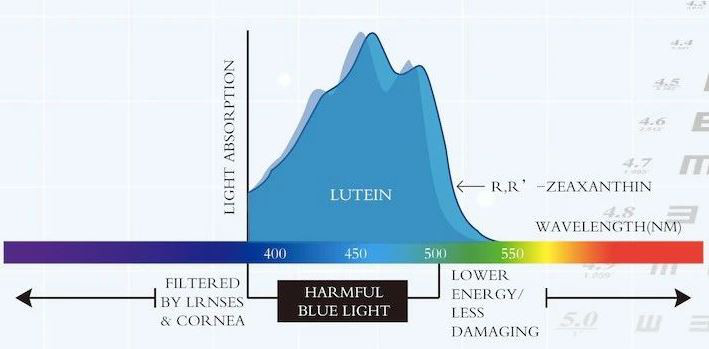
@Mossy - Getting enough lutein is very important for eyesight. As shown in one of the images from the opening post, its presence in the body blocks the harmful blue light. In this world full of LEDs, blocking blue light is becoming increasingly important.
Some chicken feed is fortified with marigold derrived lutein so that the eggs contain higher levels lutein in the yoke. You can eliminate the middle chicken by taking a marigold containing supplement. Jarrow makes one; check the label on you bottle.
Here is an interesting article from Battleforblindness.org
Lutein and Zeaxanthin: Shielding Your Eyes from Blue Light and Vision Loss
A mind is like a parachute. It doesn’t work if it is not open. 👀
☂️ -
@LucH Really appreciate this detail and plan.
So, do you not cycle the astaxanthin like the others — no break?
"To desire action is to desire limitation" — G. K. Chesterton
"The true step of health and improvement is slow." — Novalis -
@DavidPS Great info, thank you! I have read that some egg producers will add marigold simply to have more vibrant looking yokes. What a great side effect that we get more lutein.
-
@Mossy said in Is lutein a Magic Bullet for cognition?:
So, do you not cycle the astaxanthin like the others — no break?
Yes, I do a break. As I said: I take it when I feel I need it (tired eyes that prick).
Otherwise, a cure every 3 months should be OK. How long: 7-10 days should be fine if no problem.
With a problem (inflammation in the eye), as long as required / as long the inflammation is there. But then we have to take into account the ground (detox pathway via kidneys : Cyp450), not to overload).
If there are other associations (anti-inflammatory meds, heart meds, etc.)...
I can't give a pertinent advice without knowing how he would manage the whole thing. -
@LucH I understand, there is no way for you to assess the unique situation of my father; I was just curious if you cycled this like the others. I appreciate the additional information.
-
 D DavidPS referenced this topic on


Hello! It looks like you're interested in this conversation, but you don't have an account yet.
Getting fed up of having to scroll through the same posts each visit? When you register for an account, you'll always come back to exactly where you were before, and choose to be notified of new replies (either via email, or push notification). You'll also be able to save bookmarks and upvote posts to show your appreciation to other community members.
With your input, this post could be even better 💗
Register Login