Essential Fatty Acids (Omega-3 & Omega-6) are direct building blocks for the skin's lipid bilayers, reducing transepidermal water loss (TEWL).
-
Krill oil supplementation improves transepidermal water loss, hydration and elasticity of the skin in healthy adults
Useful omega 6 for skin repair or omega 3 to dampen an immune response
Excerpt from my post: Immunosuppressive effects of omega-3
How can unrefined / unadulterated omega-3 be successfully supplied without increasing oxidative risks through peroxidation? That is the crux of the problem. (1)
Useful omega-6 for skin repair
Yes, hydration and elasticity of the skin in healthy adults is observed when taking evening primrose oil for men or borage oil for women, incredibly rich in gamma-linolenic acid (GLA), which the body metabolizes into dihomo-gamma-linolenic acid (DGLA) to produce powerful anti-inflammatory prostaglandins. This makes it highly effective for soothing dry, irritated skin, reducing fine lines, and restoring the skin's moisture barrier. Dixit AI.
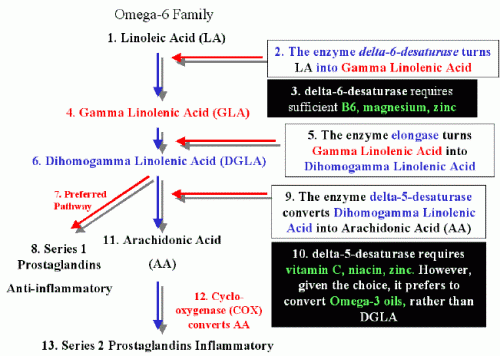
Not sure the best pathway will be reached, but it could be attempted. Too long to explain here. See the figure: LA => GLA => DGLA => AA or PG-2
Studies on the beneficial effects of omega-3s
No one disputes the benefits of an omega-3 regimen against inflammation or in case of an excessive immune response, particularly with EPA, very functional.
Okay, omega-3s are immuno-modulators. However, this applies either in the short term (cure) or when the diet is balanced (specifically, with an omega-3 to omega-6 ratio ranging from 1:1 to 1:4, or at a maximum of 1:10 at some time if limited in time). The US ratio is usually at 1/20 (with food manufactured, or with livestock fed partly on corn meal and soy, instead of grazing for nine months out of twelve).
Anything exceeding the body's requirements will be stored.
At that point, the eicosanoids exert a hormonal effect. It becomes a ticking time bomb (driven by what is known as the arachidonic acid cascade).
What is meant by intake exceeding physiological needs?
The requirements are very weak. And not specifically every day. Omega-3s (ALA) are conditionally essential. This means the body can do without them if the necessary cofactors are present (2). As for omega-6s, AA and DHA are the essential ones—though the amount of DHA required is truly very modest (125–250 mg). It is worth remembering that we are "surrounded" by omega-6s (LA).
When needs are over-estimated
However, if the body's needs are exceeded (leading to storage), or if EPA intake is prolonged to counteract inflammation—using as much as 3g of EPA! (for instance, in cases of osteoarthritis, as seen in several studies)—a delayed thyroid problem will arise. At that point, we are no longer talking about modulation, but rather a suppressive effect.
To be continued on this link, with references and explanations over “fatty acids for dummies”)
Anti-thyroid effects of omega-3 –
Immunosuppressive effects of omega-3
https://mirzoune-ciboulette.forumactif.org/t2207-english-corner-anti-thyroid-effects-of-omega-3#30866 -
"Concentrated" or "triple strength" fish oils are available. You can get the daily recommended intake of DHA and EPA with just one gram PUFA pill a day.
Edit: Combined with one pill high GLA (Gamma-Linoleic acid) Borage Oil. -

-
"Concentrated" or "triple strength" fish oils are available. You can get the daily recommended intake of DHA and EPA with just one gram PUFA pill a day.
We only require 250 mg DHA for the brain and the eye. And not every day.
What are you expecting from 60% rich EPA / DHA softgels with 1 g fish oil?
Don't tell me you appreciate EPA for PGE 3 (anti-inflammation). It's right but what about the final target: fluidity, balance? -
@LucH Looks like you're right on the dosage. Here's what the A.I. says:
If you take fish oil on an empty stomach, or if you choose a poorly absorbed chemical form, your absorption rate can drop to under 10%. Under optimal conditions, it can climb to over 60% to 90%.
The Math of Daily Turnover
The human brain is incredibly stingy with its structural fats. Research tracking the daily turnover rate of DHA in the adult brain shows that we lose and replace only about 3.8 mg to 14.8 mg of DHA per day.Even if you factor in the retina and a conservative absorption efficiency, a net intake of 50–100 mg of absorbed DHA daily is plenty to maintain structural integrity once the brain is fully "built."
The Case for "Pulsing" Instead of Daily Dosing
Taking one pill a day is a marketing-driven recommendation designed for simplicity and product consumption, not physiological precision.If your goal is strictly structural maintenance, pulsing your intake (e.g., taking one softgel 1 to 2 times a week, or micro-dosing a fraction of that amount) makes far more metabolic sense. It allows your body to safely harvest the structural DHA it needs to replace background turnover, without constantly forcing the liver and mitochondria to process a massive, daily surplus of highly reactive, unstable oils.
The Architectural Blueprint: Skin Prefers Omega-6
While the brain and eyes are highly selective for omega-3 (DHA), the structural lipid bilayer of the skin is overwhelmingly built from omega-6, specifically Linoleic Acid (LA) and its derivative, Gamma-Linolenic Acid (GLA).The Barrier: To stop Transepidermal Water Loss (TEWL), the outermost layer of your skin (stratum corneum) uses specialized molecules called acylceramides. The specific fatty acid required to bind these ceramides together into a tight, waterproof mortar is Linoleic Acid (omega-6).
The Deficit: If the skin lacks linoleic acid, it substitutes it with oleic acid (omega-9). This substitution makes the skin's sebum thick, sticky, and highly prone to acne, while making the skin barrier leaky, dry, and irritated.
Flooding the system with high-dose EPA/DHA can actually compete with and displace the very linoleic acid your skin needs to cement its barrier.
-
@AlphaZance raw hempseeds for gla I've seen recommended but 100g hempseed has 38.1g pufa for only 1.34g GLA
also my sebum changed when I went low pufa
it's thicker now. not sure if its optimalI have some GLA from borage oil I may consistently take
there's actually a GMO sunflower oil that is even better for GLA, it has more GLA in it's PUFA fat fraction
-
To ensure that Gamma-Linolenic Acid (GLA) yields its powerful anti-inflammatory benefits, you must control the specific enzymes that act like traffic cops at this metabolic crossroads. [1]
The primary goal is to maximize the conversion of DGLA into PGE1 while blocking the Delta-5-Desaturase (D5D) enzyme, which shifts DGLA down the highly inflammatory Arachidonic Acid (AA) pathway. [2, 3]
1. Nutrients and Cofactors for the PGE1 Pathway
Once GLA is converted into Dihomo-Gamma-Linolenic Acid (DGLA) via an elongase enzyme, it needs specific cofactors to downstream into anti-inflammatory PGE1 and prevent toxic lipid breakdown. [1, 4, 5]
- Zinc & Magnesium: Essential trace elements that act as direct enzymatic cofactors. They optimize cellular signaling, allowing the Cyclooxygenase (COX) enzymes to cleanly process DGLA into the 1-series prostaglandins (PGE1) rather than stalling the process. [2, 6]
- Vitamin B6 (Pyridoxine): Works in tandem with zinc and magnesium to support upstream fatty acid metabolism and maintain proper cell membrane phospholipid composition. [6, 7, 8]
- Vitamins A, C, E, & Selenium: These potent antioxidants protect fragile polyunsaturated fatty acids (like GLA and DGLA) from oxidation. If these fats undergo lipid peroxidation, they cannot be converted into PGE1. [6, 9]
2. How Omega-3s Block the Inflammatory AA Pathway
To stop DGLA from slipping down into the inflammatory PGE2 pathway, you must inhibit the enzyme Delta-5-Desaturase (D5D). Long-chain Omega-3 fatty acids—specifically Eicosapentaenoic Acid (EPA) and Docosahexaenoic Acid (DHA)—are the most effective natural tools for this task. [3, 5, 9, 10, 11]
[ GLA ] │ ▼ (Elongase) [ DGLA ] ───(COX Enzymes + Zinc/Mg/B6)───► [ PGE1 ] (Anti-inflammatory) │ X ◄─── [ BLOCKED BY OMEGA-3s (EPA/DHA) ] │ ▼ (Delta-5-Desaturase / D5D) [ Arachidonic Acid (AA) ] ─────────────────────► [ PGE2 ] (Pro-inflammatory)- Competitive Enzymatic Inhibition: The D5D enzyme is responsible for converting DGLA into Arachidonic Acid (AA). However, D5D also acts on Omega-3 fatty acids. When you consume EPA and DHA, they have a significantly higher binding affinity for the D5D enzyme than DGLA does. [3, 5]
- The "Traffic Jam" Effect: EPA and DHA essentially flood the engine, hogging the D5D enzymes. Because the enzyme is busy processing the Omega-3s, it is completely unavailable to convert DGLA into AA. [5]
- The Net Result: This biochemical traffic jam causes DGLA to pool up in the cell membranes. With nowhere else to go, the accumulated DGLA is forced into the alternative COX pathway, successfully generating vast amounts of anti-inflammatory PGE1. [1, 2, 12]
Summary Strategy
If you are taking a GLA supplement (such as borage oil or evening primrose oil), always pair it with a high-quality Omega-3 fish oil (to block AA production) and ensure your baseline levels of Zinc, Magnesium, and B6 are topped off to smoothly synthesize PGE1. [5, 6, 9, 13, 14]- [1] https://www.cytoplan.co.uk
- [2] https://pmc.ncbi.nlm.nih.gov
- [3] https://pubmed.ncbi.nlm.nih.gov
- [4] https://pubmed.ncbi.nlm.nih.gov
- [5] https://www.gdx.net
- [6] https://pubmed.ncbi.nlm.nih.gov
- [7] https://www.casi.org
- [8] https://www.sciencedirect.com
- [9] https://www.lipinutragen.it
- [10] https://pmc.ncbi.nlm.nih.gov
- [11] https://pmc.ncbi.nlm.nih.gov
- [12] https://www.sciencedirect.com
- [13] https://pmc.ncbi.nlm.nih.gov
- [14] https://synapse.patsnap.com
- [15] https://www.webmd.com
Combining GLA and EPA:
To stop DGLA from converting into pro-inflammatory Arachidonic Acid (AA), your biochemical target is the Delta-5 Desaturase (Delta5D) enzyme.
Both the omega-6 pathway (DGLA to AA) and the omega-3 pathway (ETA to EPA) rely on this exact same enzyme. Because Delta5D has a limited processing capacity, you can intentionally throttle it via competitive inhibition.
However, because you are dealing with enzyme kinetics rather than a simple mechanical valve, there is no single "extra dose" number. Instead, blocking this conversion relies on maintaining a specific molecular ratio in your system.
The Target Ratio: 1:1 or 2:1 (EPA to GLA)
To aggressively block DGLA from flipping over to AA, you want the incoming EPA to match or slightly outcompete the incoming GLA at the enzyme site.
- The Rule of Thumb: Aim for an EPA-to-GLA ratio between 1:1 and 2:1.
- The Math: If you are taking a therapeutic skin-repair dose of 300 mg of pure GLA, you want to pair it with roughly 300 mg to 600 mg of pure EPA.
Why EPA is the Specific Blocker (Not DHA)
When choosing your omega-3 tool for this specific job, look exclusively at the EPA content, not the total omega-3 or DHA content.
EPA (omega-3) is a structural look-alike to DGLA (20:3 omega-6). They are both 20-carbon molecules vying for the same slot on the Delta5D enzyme. DHA (22:6 omega-3) has already passed this stage of elongation and does not compete for the Delta5D enzyme. Therefore, a high-DHA oil will completely fail to block the DGLA-to-AA shift.
How to Build the Combined Stack
If we apply this to the 60% rich EPA/DHA softgels (which typically provide around 400 mg EPA per 1 g capsule) alongside a standard high-GLA Borage oil:
- The GLA Input: 1 softgel of Borage Oil yielding ~200 mg of pure GLA.
- The EPA Blocker: 1 softgel of your 60% fish oil yielding ~400 mg of pure EPA.
This creates a clean 2:1 EPA-to-GLA ratio. The 400 mg of EPA acts as an elegant competitive buffer, keeping the Delta5D enzyme highly occupied. This forces the 200 mg of GLA to back up in the tissue pool as DGLA, where it is safely diverted by COX enzymes into anti-inflammatory Prostaglandin E1 (PGE1) instead of downstream AA.
The Synergy
By pairing them this way, you fulfill your ultimate target of fluidity and balance. You get the targeted skin barrier benefits of the GLA without letting it degrade into unwanted inflammation, and you keep the daily fish oil dose locked at just a single capsule—providing enough systemic EPA to manage the enzyme traffic without oversaturating your mitochondria or triggering rampant lipid peroxidation.
-
@AlphaZance interdasting…
-
@alphazance
Ya, fine and great job.
I cite an explanation from IA:
[With a high intake EPA] The Net Result [is]: This biochemical traffic jam causes DGLA to pool up in the cell membranes. With nowhere else to go, the accumulated DGLA is forced into the alternative COX pathway, successfully generating vast amounts of anti-inflammatory PGE1.
My comment (LucH):
I won’t say it so but I’m going to cut hair in four parts (French expression, meaning: I'm splitting hairs, meaning I'm exaggerating one side of the problem).
“This biochemical traffic jam causes DGLA to pool up in the cell membranes”
=> However, it has been modulated by next sentence:
“With nowhere else to go, the accumulated DGLA is forced into the alternative COX pathway, successfully generating vast amounts of anti-inflammatory PGE1”
=> Right. GLA has been used up when and only when it takes the COX pathway (anti-inflammatory), in an appropriate low amount.For other readers
Just keep in mind, that what is not used in this enzymatic pathway, is going to be kept in several additional takes. Not a real problem with one gram fish oil high in EPA/ DHA (60%). Only in cure if higher (often advised 2.5-3 g EPA in studies to fight painful arthrosis but only when pain is under control).
Why to moderate?
Inhibition of metabolism by accumulation of PUFA, with a high take.- Unsaturated oils block the secretion of thyroid hormones, their circulation and tissue response. This leads to an increase in estrogen levels.
- Efraim Racker observed that released unsaturated fatty acids (PUFA) inhibit mitochondrial respiration. (1)
- In addition to inhibiting the thyroid gland, unsaturated fats impair intercellular communication (2) suppress several cancer-related immune functions, and are present in high concentrations in cancer cells, where their anti-proteolytic action would be expected to interfere with proteolytic enzymes and to shift/boost the balance towards growth/proliferation.
- Borst, P., J. A. Loos, E. J. Christ, & E. C. Slater, “Uncoupling action of long chain fatty acids,” Biochem. Bioph. Acta. 62, 509-18, 1962.
- Aylsworth, C.F., C.W. Welsch, J.J. Kabora, J.E. Trosko, Effect of fatty acids on junctional communication, possible role in tumor promotion by dietary fat, Lipids 22 (6) 1987).
Let us first clarify: at 0.6–1 g of EPA+DHA per day (equivalent to one gram of 60% oil), the intake level is comparable to consuming fatty fish two to three times a week, as already mentioned. White fish and no haddock / aiglefin (predator). And of course, you get enough Mg (350-420 mg), B6 (20-25 mg) and Se (100 mcg), which is not quite sure. By the way, remember you used up B6 when you suffer from an immune reaction or from inflammation. Exhaustion.
Now, if we suppose here you take a softgel (no liquid), with Vit E and rosmarinus extract to stabilize the oil, it could do the job regarding pain from osteoarthritis (with a HM certificate: less than 0.01 ppm per heavy metal).
At this dosage level (0.6–1 g), the real technical issue / problem could be “product stability”, not metabolism: "concentrated" or "triple-strength" oils almost always come in the form of ethyl esters (rather than triglycerides)—a form that is structurally less stable against oxidation. Furthermore, the concentration process removes a significant portion of the natural tocopherols (vitamin E) that protected the crude oil.On caveat for chips eaters, very rich in sunflower (with 80% LA omega-6): You can't just "burn off" an excess bad type of fat the next day. It stays in your system, influencing your inflammatory markers for years. This is why a small amount of "bad" fat is more disruptive long-term than a large amount of "good" fat. And remind moreover that Ray Peat has advised to eat some SFA (coconut oil / butter) to stabilize membranes. Eating at the same meal.
Note too that I eat chips from time to time (once a month, since nobody is perfect) but I try to limit PUFA then to 1/5 (ratio W3/W6). We’re surrounded by linoleic acid (LA omega-6).Additional info if you want to counteract inflammation with a high level of EPA
Excerpt from: Unsaturated Vegetable Oils: Toxic (Ray PEAT)
http://www.raypeat.com/articles/articles/unsaturated-oils.shtml- To defend the seeds from the animals that would eat them, the [PUFA]-oils block the digestive enzymes in the animals' stomachs.
- Their tendency to oxidize is very great. These oxidative processes can damage enzymes and other parts of cells, and especially their ability to produce energy.
The enzymes which break down proteins are inhibited by unsaturated fats, and these enzymes are needed not only for digestion, but also for production of thyroid hormones, clot removal, immunity, and the general adaptability of cells. The risks of abnormal blood clotting, inflammation, immune deficiency, shock, aging, obesity, and cancer are increased. Thyroid and progesterone are decreased. Since the unsaturated oils block protein digestion in the stomach, we can be malnourished even while "eating well."
=> Moderation (in cure). You could get the same effect on Cox and Lox with wild willow bark extract (no impact on Cox-1, with is fine for stomach integrity) but well on platelet (low). Fine too by combining with one type of curcumin + EO as eucalyptus citriodora and lavendula x hybryd / burnatii.
3 types of curcumin: THC (theracurmin / brain), C3 Reduct , Phytosome (Meriva / arthrosis and prostatis).
Tableau comparatif 2 – curcumine en gélule (softgel) – critères de sélection
https://mirzoune-ciboulette.forumactif.org/t921p100-biodisponibilite-de-la-curcumine-ou-trouver-la-plus-assimilable#30845
Weigh the pros and cons
The risk lies in justifying a high dose based on one mechanism (anti-inflammatory action) when the initially stated objective is different (membrane fluidity). These are two distinct targets requiring two different dosages; conflating them amounts to answering a question that was not originally being asked.In the event of higher omega-3 intake (2 to 3 g)
IA says (Claude):
"An excess of unused PUFAs does more than just excessively fluidize the membrane: their oxidation products (MDA, 4-HNE) are electrophiles that damage proteins and DNA, deplete antioxidants, and can even reverse the intended effect—instead of anti-inflammatory resolvins, pro-inflammatory derivatives are produced. The body does not store an additional benefit; it manages an oxidative liability."
Studies demonstrating the pro-inflammatory paradox (a shift from resolvins to oxidized derivatives that activate NF-κB) and a net increase in markers such as 4-HNE typically employ EPA doses of 2–4 g/day—levels comparable to those in pharmacological trials like REDUCE-IT (icosapent ethyl, 4 g/day) or research protocols investigating oxidative stress. However, at an intake of 0.6–1 g of EPA+DHA per day (equivalent to one gram of 60% oil), the dosage falls within a range comparable to consuming fatty fish two or three times a week—an intake level that cohort studies associate with cardiovascular benefits rather than harm. Consequently, the "major oxidative cascade" narrative is not applicable in this context. -
What I have to say about the studies on “essential fatty acid deficiency (EFAD)” is that they are all incomplete, and it is necessary to piece the studies together like a puzzle, in addition to seeking out others that may not specifically address EFAD.
1. The overwhelming number of symptoms attributed to EFAD actually stems from the high metabolic rate caused by TEWL, which activates thermogenesis.
If you neutralize TEWL in an EFAD-affected animal by increasing the humidity in the laboratory, it grows and develops normally without any symptoms. In many studies on EFAD, researchers mention “spontaneous recovery”—usually in the summer, lasting for long periods—followed by a worsening of symptoms, which they attribute to the seasons and their fluctuations in humidity.
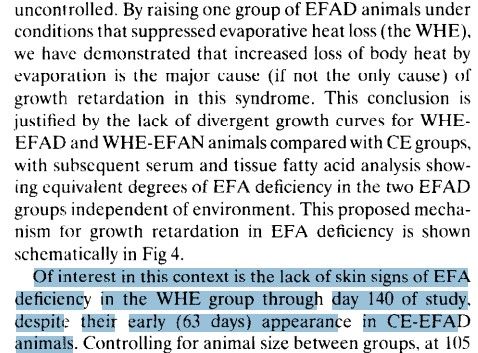
2- The body is a dissipative system; if you remove n-3/n-6, the body changes the way it handles various processes that previously relied on them. It is a mistake in these studies to remove n-6 while keeping the diet essentially the same.
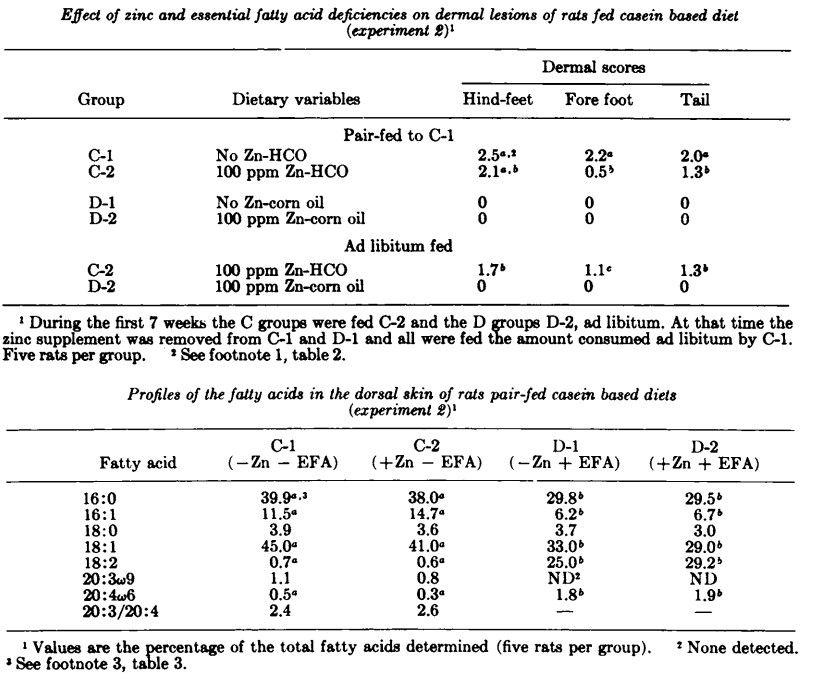
I’ll give an example using zinc, a deficiency of which causes similar skin symptoms:

This table shows an EFAD (HCO) diet and a non-EFAD (corn oil) diet, and both have versions supplemented with zinc (C-2 and D-2); the key point here is that the protein source is casein (this detail will be important later):
Now, in this table, it's the same thing, but supplemented with egg albumin instead of casein:
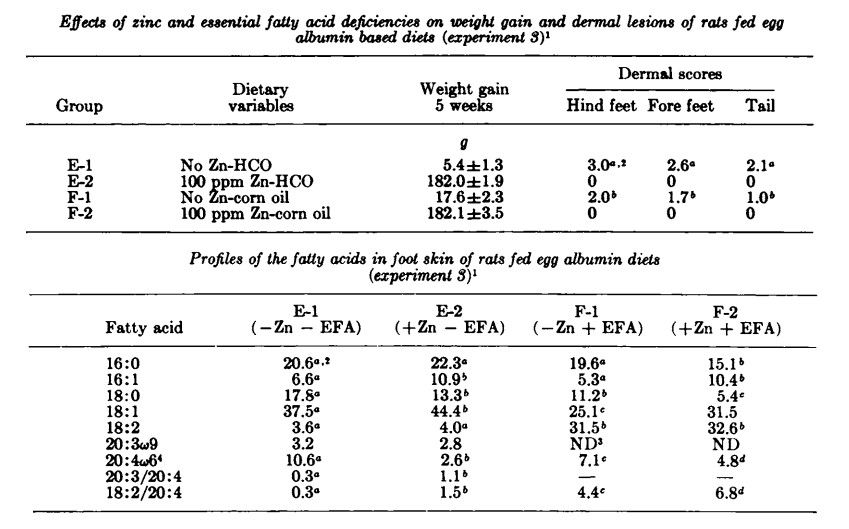
It can be seen from these two tables that EFAD causes skin problems if:
- There is a zinc deficiency
- The proteins are casein-based, rather than egg albumin.
I was curious as to why the type of protein would influence the symptoms, so I remembered this:
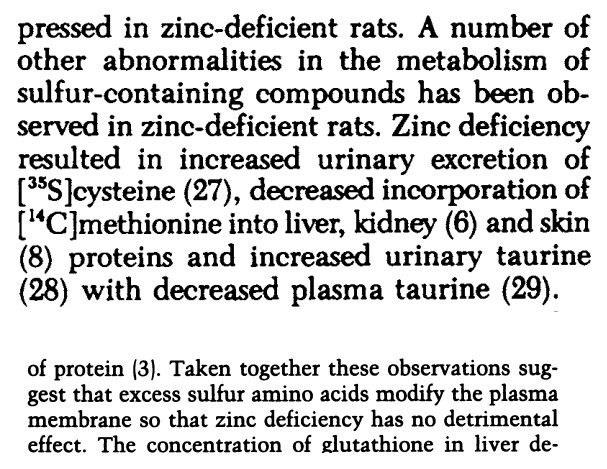
Egg albumin is rich in sulfur-containing amino acids.
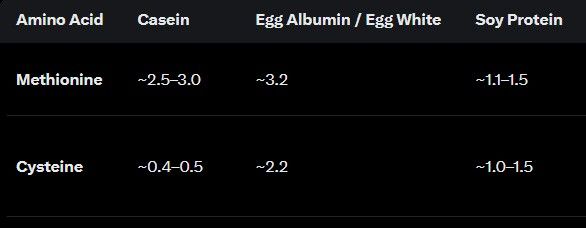
I considered the possibility of contamination with PUFA, but they also use soy protein, which I think theoretically poses a greater risk:
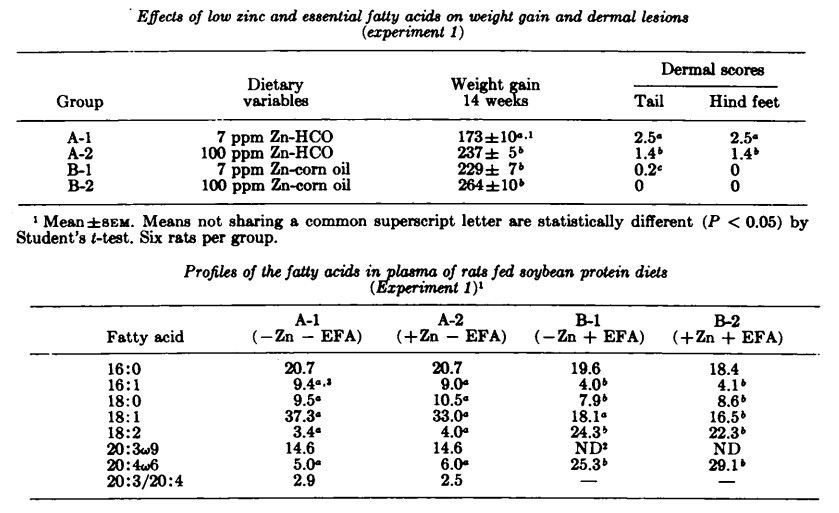
Is it possible that, with enough zinc, they could live indefinitely on an EFAD diet? Who knows... Well, if the problem is humidity, people who live by the beach can easily follow a diet like this and reap the benefits of the EFAD (resistance to endotoxins, inflammation, autoimmune diseases, snake venom, etc.).
And btw, it is possible for a human to live well in EFAD, without skin problems, in a city as well.
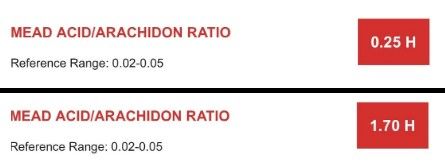
(not mine)Thanks to learnmyhelpless at X for reminding me of zinc and EFAD relationship haha
-
 M Mauritio referenced this topic on




Hello! It looks like you're interested in this conversation, but you don't have an account yet.
Getting fed up of having to scroll through the same posts each visit? When you register for an account, you'll always come back to exactly where you were before, and choose to be notified of new replies (either via email, or push notification). You'll also be able to save bookmarks and upvote posts to show your appreciation to other community members.
With your input, this post could be even better 💗
Register Login