Potassium, the hidden ally of your blood sugar levels, is an important cofactor for energy metabolism
-
Potassium, the hidden ally of your blood sugar levels, is an important cofactor for energy metabolism (to let glucose entry into cells).
Potassium, a behind-the-scenes player in carpooling and storage: Efficiency of glucose uptake
Target point
Potassium acts via the Na⁺/K⁺-ATPase pump, found on the surface of all cells, which continuously exchanges intracellular sodium for extracellular potassium.
This pump is directly stimulated by insulin, in parallel—though not at the same site or via the same mechanism—with the translocation of the GLUT4 transporter, which enables glucose to entry into the cell. In other words, insulin triggers both potassium uptake (via Na⁺/K⁺-ATPase) and glucose uptake (via GLUT4), but through two parallel pathways rather than through direct coupling to the same receptor.1. Potassium Charges the "Cellular Battery"
Every healthy cell acts like a tiny battery. To work correctly, it must keep most potassium inside the cell and most sodium outside the cell. Low potassium hyperpolarizes the beta cell (pancreas), which reduces insulin secretion.
• This situation (potassium rather inside, sodium rather outside the cell) creates an electrical charge across the cell membrane (called the resting membrane potential).
• When you eat a bowl of pasta or rice, your pancreas releases insulin.
Note: Potassium is not really the fuel for an electrical battery. We have to go back into the tyrosine kinase pathway.
Tyrosine kinase activation => Mitochondrial ATP production => Na+/K+ exchange with cofactors. So we aren't really talking about a battery but the energy level will slow down, like a battery could do, when insulin can’t do the job correctly because of a lack. Here potassium and magnesium.2. The Direct Link to GLUT4 (The Glucose Gates)
Insulin signals the cell to deploy specialized transport vehicles called GLUT4 receptors.
• Adequate potassium increases the efficiency of glucose uptake. When potassium is abundant, the cell can clear glucose out of the blood with far less insulin, protecting the pancreas from overworking.3. Preventing the "Stalled Starch" Backlog
Once glucose successfully enters a muscle or liver cell, it must be instantly converted into energy or stored as glycogen in muscles (and in liver after a night shift). As established by biological rules, the body requires about 19.5 mg of potassium for every single gram of glycogen it stores.
• Potassium (K⁺) is a required cofactor for pyruvate kinase, one of the key enzymes in glycolysis (the pathway that breaks glucose down for energy). Without enough potassium, that enzyme step slows or stalls.
Where potassium/glucose do interact for real
Insulin drives glucose into cells (via GLUT4 transporters) and separately drives potassium into cells (by activating the Na⁺/K⁺-ATPase pump). These happen in parallel through the action / influence of insulin. Insulin enhances a fluent metabolism of energy then.
Mind when stopping a fast: progressiveness when feeding back is highly recommended. This is seen as a “refeeding syndrome”: reintroducing carbs after starvation spikes insulin, which shoves both glucose and potassium into cells at once, but then blood potassium could crash. Some pints of salt in water could help during a fast to avoid some side-effects.
• The Post Angle: Potassium ensures a smooth, one-way traffic flow. It enhances glucose out of the blood and immediately packs it away into the energy pathway or storage, keeping the blood “clean” and blood sugar stable.The tyrosine kinase pathway / cascade
When insulin signal transduction fails—or when critical cofactors are missing—the whole system experiences a brownout. The metabolic engine cannot produce the power required to maintain the gradient, and the cellular voltage drops. Like a battery could do when lacking oil, but not on the same way, of course.
Schema detailing how Tyrosine Kinase activation, Mitochondrial ATP, Potassium (K+), and Magnesium (Mg2+) merge into one continuous energy pipeline.
Figure:
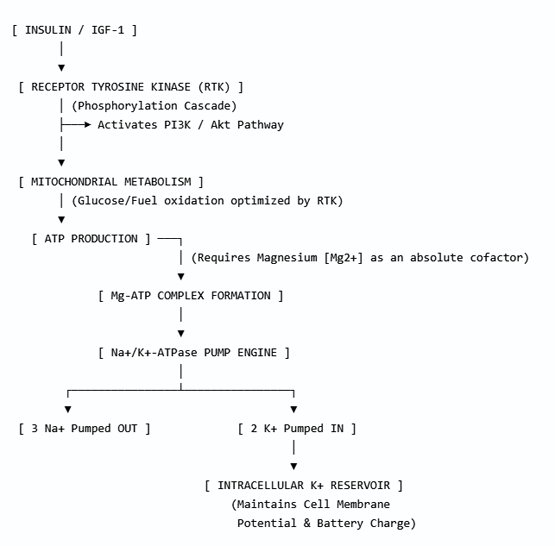
*) The Start of the Chain (as contributors to dysregulation)
If there is a lack of Insulin => RTK Failure
RTK = Receptor for Tyrosine Kinase (enzyme).
Phosphorylation cascade simple definition
A chain reaction inside a cell where one protein kinase enzyme activates another by adding a phosphate group, passing a signal down a line to change cell behavior. [1] A protein kinase is thus an enzyme that adds a phosphate group to target proteins, acting as a molecular switch to turn cell activities on or off.- If there is a lack of insulin, tyrosine kinase domains do not phosphorylate efficiently. Mitochondria don't get the optimal signal or fuel (glucose) to step up ATP production. As a physiological outcome, the energy pipeline slows at the source. ATP generation drops, leaving the pump underpowered.
NB: This doesn't hold universally. Neurons, red blood cells, and the liver use insulin-independent glucose transporters (GLUT1, GLUT3), so they keep taking up glucose even without insulin. - When there is a lack of magnesium (Mg2+) the Na+/K+ pump cannot use raw ATP. Fuel (glucose) can only become ATP when it is complexed with magnesium (Mg-ATP). Magnesium also physically stabilizes the pump's active state. Even if mitochondria make ATP, the pump cannot burn it. The engine stalls, and the cellular "battery" drains immediately.
- Without enough external potassium to exchange, the pump fails to allow an adequate bio-chemical-electrical environment. That the beginning of a falling disruptive energy level, impacting several other enzymatic cellular pathways: When energy level degrades, slowing down cellular repair, nerve conduction, and enzymatic function, a lot of problems will appear…
Sources
• Horn, R.S., Walaas, O., Walaas, E. (1973). The influence of sodium, potassium and lithium on the response of glycogen synthetase I to insulin and epinephrine in the isolated rat diaphragm. Biochim Biophys Acta, 313, 296-309.
• Hundal, H.S., Klip, A. (1993). Regulation of Glucose Transporters and the Na/K-ATPase by Insulin in Skeletal Muscle.
• Villar-Palasi, C., Guinovart, J.J. (1997). The role of glucose 6-phosphate in the control of glycogen synthase. FASEB J, 11, 544.
• Sweadner, K.J., et al. Regulation of the Na+/K+-ATPase by insulin: why and how? PubMed 9609121.
• Kreitzman, S.N., Coxon, A.Y., Szaz, K.F. (1992). Glycogen storage: illusions of easy weight loss, excessive weight regain, and distortions in estimates of body composition. Am J Clin Nutr, 56(1 Suppl), 292S-293S. (ratio de ~0,45 mmol K⁺/g glycogène, 3-4 g eau/g glycogène) - If there is a lack of insulin, tyrosine kinase domains do not phosphorylate efficiently. Mitochondria don't get the optimal signal or fuel (glucose) to step up ATP production. As a physiological outcome, the energy pipeline slows at the source. ATP generation drops, leaving the pump underpowered.

Hello! It looks like you're interested in this conversation, but you don't have an account yet.
Getting fed up of having to scroll through the same posts each visit? When you register for an account, you'll always come back to exactly where you were before, and choose to be notified of new replies (either via email, or push notification). You'll also be able to save bookmarks and upvote posts to show your appreciation to other community members.
With your input, this post could be even better 💗
Register Login