Obscure Health 2: Isochroma
-
Obscure Health 2: Isochroma
This essay is the second part of a series examining individuals and collectives associated with obscure health. Part 1: Area-1255.
>> FULL ESSAY <<
German version: Isochroma: Protokoll eines unbewohnbaren Lebens
Isochroma: Protocol of an Uninhabitable Life
Isochroma was the username of Jason Lalancette (c. 1977–2016) of Victoria, British Columbia, one of the most persistent self-experimenters of the early nootropics web. Without medical training, a laboratory or funding, he spent years attempting to restore what he experienced as a profoundly dysfunctional body and mind. His experiments ranged from high-dose piracetam, other racetams, methylene blue and fish oil to experimental research chemicals, testosterone and other androgens, and eventually artificial light — "measured in LUMENS instead of MILLIGRAMS."
His central distinction was between "Depletors" and "Replenishers": interventions that exhausted the organism and those he believed restored its capacity to function. Piracetam, for him, was less a cognitive enhancer than a condition for ordinary life. At his peak, he reported taking up to 32.5 grams daily; interruptions in supply could return him to a state he considered nearly unlivable. He maintained an international racetam price list, updated almost daily, and helped connect manufacturers, suppliers and users. His involvement with Sunifiram even brought him into correspondence with its academic inventor, Professor Fulvio Gualtieri, who later documented the compound's journey from university research into the online nootropics market.
His endocrine experiments followed a similar logic. Confronted with low testosterone, persistent physical limitations and what he understood as premature aging, he documented hormonal self-treatment on Longecity and T-Nation. Later, he constructed high-output artificial lighting systems, treating illumination as a physiological intervention affecting sleep, mood and everyday functioning. By his own account, some of these experiments profoundly altered his perception, irritability, sleep and ability to function.
I first encountered Isochroma years ago while searching for nootropics. His combination of precise dosages, elaborate physiological theories and extraordinary certainty led to almost a year of archival research across Longecity, T-Nation, Bluelight, Reddit, Doom9, AVSForum and his abandoned websites. The resulting essay examines not only his substances and protocols but also the boundary between attempting to restore a body and turning that body into an increasingly elaborate experimental apparatus.
The full essay is about 18,000 words, divided into three chapters and a coda. Since this is a health forum, only Chapter II, "The Body as Experimental Apparatus," is reproduced below, split across four sections:
- Longecity — Piracetam, racetams, supply chains, price lists and Sunifiram's academic origins.
- What a Substance Can Become — Stacks, methylene blue, fish oil, research chemicals and Depletors versus Replenishers.
- Endocrine Offensive — Testosterone, androgens, hypogonadism and hormonal self-treatment.
- The Second Sun — Artificial daylight, illumination as a dose and altered sleep.
Chapters I and III explore his earlier technical work, biography and political writing; the Coda examines his legacy and how I discovered him. All chapters, images and sources are available in the full essay.
-
II: The Body as Experimental Apparatus
Longecity
On July 6, 2008, Isochroma appeared on Longecity with a resource. He announced a page he had already built: a collection of piracetam quotations from different forums, intended, as he put it, to get "people onto this amazing molecule". His first post was already archival work. Between 2008 and 2013, Longecity became the main arena of his medical self-research. The forum was full of experience reports, conjectures, hopes and poorly separated effects. Isochroma wrote there with the impatience of a man who had already sorted out on his own body much of what others were still speculating about.

At 9:30 p.m., after a spoonful of piracetam, Isochroma noted that he was not stimulated but simply no longer tired: "It is EAZIER than ever before to write well, to think well, and to speak richly." At 9:45 p.m. he declared tiredness the banished ghost of his previous years and resolved to keep his brain saturated with the molecule for the rest of his life: "Tiredness, the ghost that haunted me for so many years, has finally been banished to the darkness where it deserves to remain forever more, and there it shall :)" In the same post he carried the effect forward through genomic redesign to digitization in "frictionless halls of optically multiplexed nanotubules". In the next contribution he wrote of "more life to the seconds, minutes and hours of both waking and sleeping consciousness." One could live longer, but also live better inside the days already given. In August he wrote: "Working all day a mile a minute, with that wonderful CLARITY, POWER & SPEED!"
The collection did not remain confined to Longecity. On Shroomery, an account registered only the day before explained that it was compiling a page of positive piracetam experiences and reports of enhancement of MDMA, psychedelics and cannabis; every quotation was linked to its original post. Directly beneath stood
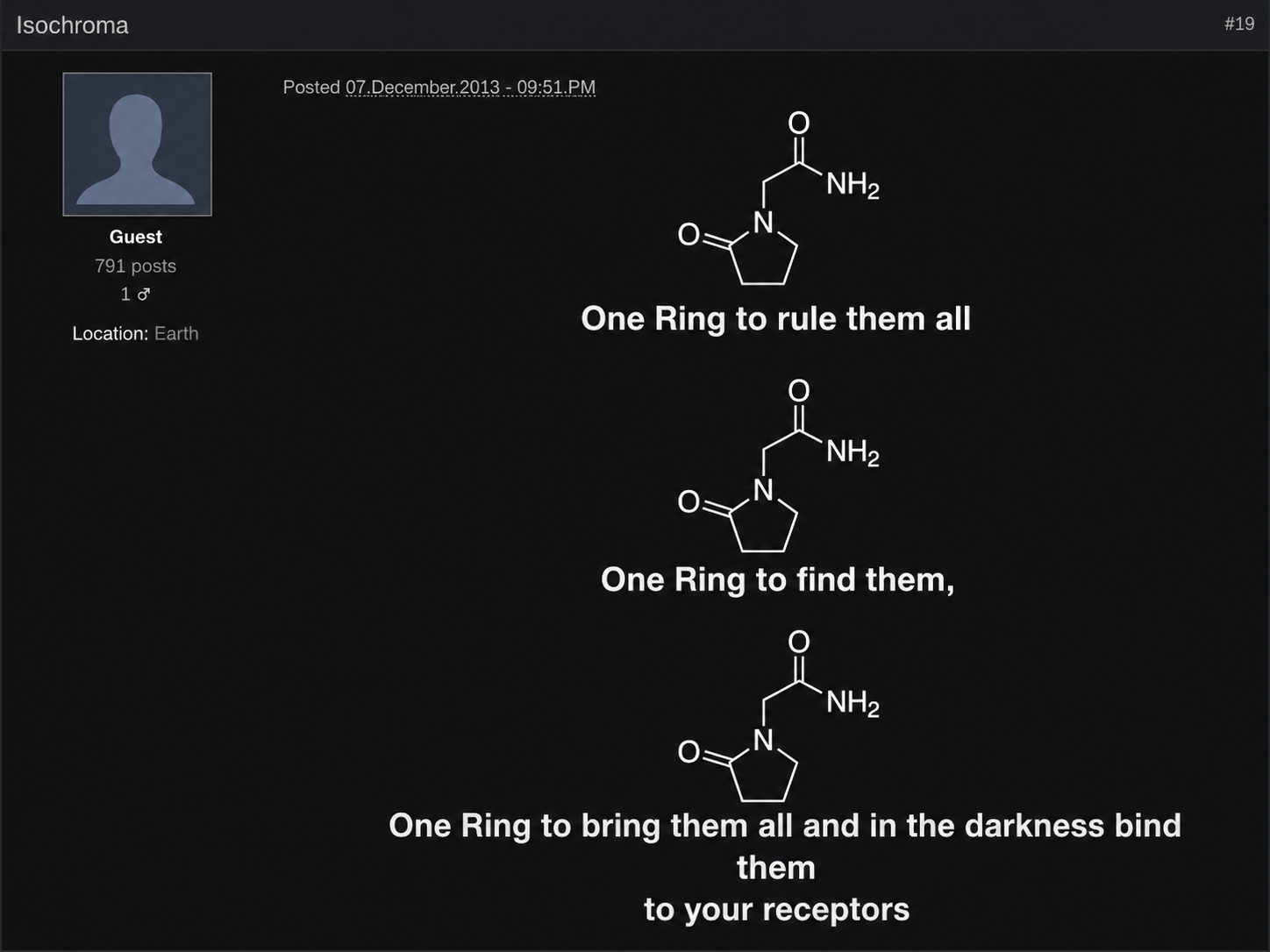
isochroma.com/Testfiles/Piracetam!/Piracetam!.htm, showing an update date from that same day. Here the alias leads directly back to his own domain. A smaller fragment from the Piracetam thread on Drugs-Forum preserves a post by Isochroma recommending raw egg yolks as a choline source and warning of possible imbalances from isolated choline or lecithin supplementation. For years,isochroma.comserved as archive, distributor and return path at once: first for video compression and ChromaSubs, now for piracetam.On Longecity itself, his early language had not yet been cast into the later, clinically compressed idiom of stack protocols. In July 2009 he titled a long piracetam post The Wings of Freedom. At thirty he wrote: "It's the feeling of everything beginning. […] Like standing on the start line of the most amazing race." The brain becomes a seaplane gathering speed, its wheels lifting from the water until, once friction vanishes, only air resistance remains: "The real magic is when the energy-sucking, wearing force of friction drops away." Four months later he described the change as "one building block per day". He measured the change by his own output: long blog posts and forum contributions now appeared every few days instead of every few months. As late as 2013, the Ring formula from the display forum resurfaced in his writing about the molecule. In the thread Piracetam — the god particle, Isochroma placed "One Ring to rule them all" beneath three piracetam structures and extended the line by three words: "to your receptors."
In parallel, Bluelight served as a second language laboratory. Isochroma's account was registered on June 18, 2008, when the site still used the bluelight.ru domain; the profile, now carried forward on bluelight.org, contains 48 posts. The third person in which he described some of his experiments was not a stylistic quirk: he did not want to rewrite the same text twice, because another forum prohibited self-incrimination; insufficient disguise had already earned him a point there. His enthusiasm for piracetam reached the municipal level on Bluelight as well. The government should put it in the drinking water, he wrote, since it was nontoxic and better than fluoride at preventing "mental caries". In the June 2009 thread "microDose DXM & Cannabis", he logged an experiment with 15 mg DXM, 3 g piracetam and cannabis. The later receptor language was still absent. Instead he recorded the form of consciousness, reduced mental noise, increased colour saturation and the return of his "ultradreams": spatially consistent dream environments, saturated colours, clear recall after waking. In the following days, the small DXM dose became a "dream synthesizer"; anime served as a perceptual test for colour, beauty, emotionality and the temporal unfolding of individual images. Around the same time he was active on BrainMeta. In the archived Smart Drug Resources subforum, he is listed on August 3, 2009 as the last poster in the thread Oxiracetam vendors; the post itself has not survived. In 2011 he linked from Longecity to his own BrainMeta text on Piracetam Hydrazide and mentioned further contributions he had published there.
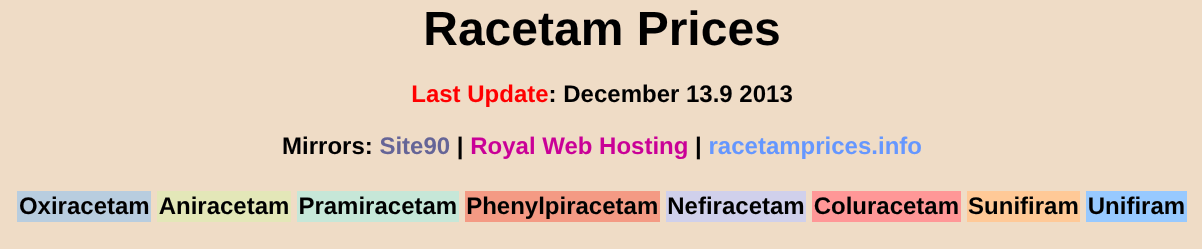
His most sober achievement was the racetam price list at racetamprices.info. It translated what had begun as a private supplier list into publicly maintained infrastructure for comparing price and supply. The list covered nine substances — Piracetam, Oxiracetam, Aniracetam, Pramiracetam, Phenylpiracetam, Nefiracetam, Coluracetam, Sunifiram and Unifiram — hundreds of suppliers worldwide, payment methods in seven gradations, bank transfer in five status levels, prices per kilogram, date, shipping costs and redundant hosting across three locations. Its preface stated: "It should be noted that the list is put up as a community service, and accordingly no suppliers pay for listing." Isochroma later wrote: "I have put thousands of hours of work into the list and update it on a near daily basis." The date also served as a version number: "December 18.7" meant the seventh uploaded version on December 18, 2012. It had originally been his private supplier list, which he placed online for others. Behind the later list lay a personal experience of supply failure. In 2008, shortly after he began piracetam, supply disappeared for two and a half weeks; by his own account, Isochroma fell back into the state he had just escaped. A year later he wrote: "Just like prisoners count the bars on their cell, I count the hours between doses. It's a life sentence, with me as the judge, jury, warden and prisoner all wrapped into one." After that he bought by the kilogram, maintained several suppliers and made his private supplier list public. Even the early Sunifiram research ran across several forums: in 2008 Isochroma linked from Longecity to a parallel Sunifiram thread on the 1Fast400 forum. Posts of his own under the name Isochroma have not yet been verified there.
On March 3, 2013, Isochroma wrote that he had spent almost all of February in a homeless shelter and had only been able to move part of his belongings into new accommodation. The first things he had retrieved from the old apartment under police escort, by his account, were piracetam and pramiracetam. The legal proceedings were continuing; in the event of what he considered an unjust imprisonment, he announced a hunger strike. In the same post he updated the racetam price list and asked for volunteers who could continue it once or twice a week if the case became a "total loss" for him. Even while his own situation was unstable, he was thinking about maintenance of the infrastructure without its current operator. In another post that month he explained the price list through his dependence on affordable, reliable access to racetams: without it he would fall back into dysfunction, depression and, as he himself put it, "the inevitable suicide which happens when life becomes unlivable". The scale of the list was literally the measure of his suffering. "The Cure", he called it in the same thread, was a race against time. It was the "water of life", while he moved as a dying man across an endless sea of dunes; Piracetam, Aniracetam, Oxiracetam and Pramiracetam were puddles, never the lake or river. At the end he asked about other sick people: those making do with crude stimulants, unaware that a possible cure existed or unable to afford it. He explained the mechanism himself: greater market transparency should reduce search costs and information asymmetry and thereby force prices toward convergence. His HTML page was meant to do exactly that in practice.
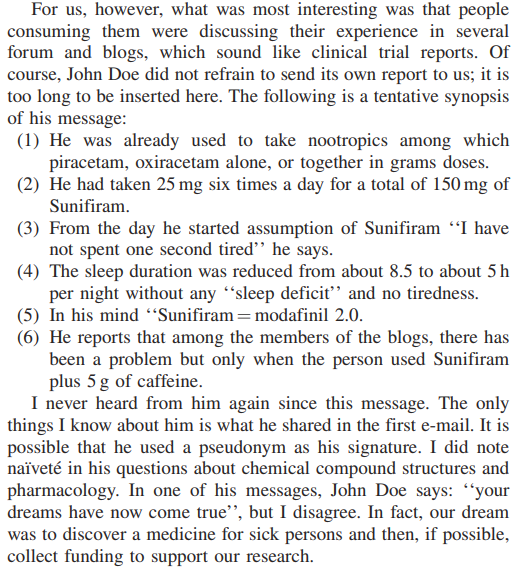
The list was maintained and updated for years, while the Coluracetam archive became a community standard. As early as March 2012, before the later online market for Sunifiram had formed, Isochroma wrote to Prof. Fulvio Gualtieri in Florence. That connection can now be reconstructed from the other side. In his review Unifi nootropics from the lab to the web: a story of academic (and industrial) shortcomings, Gualtieri published excerpts from correspondence with a man identified only as "John Doe" to protect his identity. The overlaps are specific enough that Doe was, with high probability, Isochroma: on March 21, 2012 he was 34 years old, was treating what he understood as a "premature aging syndrome" first with piracetam and then oxiracetam, had located six suppliers for DM235, wanted to order 1 g and asked whether he would be the first human to try the compound. For a planned dose of 1 to 5 mg, however, he owned only a scale accurate to 100 mg; he considered dilution or estimating a few crystals. Gualtieri did not initially realize that Doe intended to take the molecule himself. Once he understood, he explicitly warned him of the possible consequences. Doe said he would postpone the purchase, then wrote again a few days later that he would order 1 g of Sunifiram. Gualtieri warned him a second time: neither pharmacokinetics nor toxicology of the experimental compound were known. It was not Isochroma's first attempt to write back to the origin of a molecule. In July 2009 he had already written to UCB, the Belgian pharmaceutical company that had developed piracetam, with a personal letter thanking Dr Corneliu Giurgea for the invention; the letter went unanswered.
Those missing data were not a passing qualification. Gualtieri's group had initially patented the new nootropic series in Italy and then across Europe and offered it to several pharmaceutical companies because the academic laboratory could neither extend preclinical development nor move the compounds into clinical trials. The approaches led nowhere at the time; apart from poor fit with companies' research programs, potential partners demanded pharmacokinetic, metabolic and toxicological data that the Florence group could not produce itself. As its budget shrank, the group allowed the patent applications to lapse and turned to other subjects. Later interested parties appeared only after the results had been published and the patents abandoned. The conventional development pathway was therefore largely over by the time the compound began a second career outside the laboratory.
About a year after Doe's first message, Gualtieri learned from him that Sunifiram was now available on the American online market and cheaply in bulk from a Chinese manufacturer. The researchers searched online themselves and found dozens of suppliers, purity documents and experience reports; Sunifiram was being sold beside pharmaceuticals that had undergone clinical trials even though it had never itself been clinically tested in humans. Unifiram was initially less widespread because Sunifiram, Gualtieri noted, was substantially easier to synthesize. His heading for the following section was "'Clinical trials' online". What struck him most were consumer discussions in forums and blogs that "sound like clinical trial reports". Doe himself sent an experience report so long that Gualtieri only summarized it: 25 mg Sunifiram six times daily, 150 mg total; according to Doe, tiredness had disappeared since starting, and sleep had shortened from about 8.5 hours to around five without perceived sleep deficit. These are the same dosing and sleep values Isochroma publicly documented in 2013. Gualtieri also noted a certain "naïveté" in Doe's questions about chemical structures and pharmacology.
On Longecity, Isochroma described the same transition triumphantly. His message to Gualtieri began: "Your dream has now come true." Small quantities were now available to individuals. When a user named Q became the first person on the forum to try Sunifiram the next day, Isochroma exulted: "Q did it! Yes, he did it!!! […] You just made history. One small step for Q, one giant leap for mankind." In September 2013 he described his role on T-Nation himself: "I am involved in the research chemical scene and was involved in getting Sunifiram and Unifiram to market" — indirectly, by spreading data in forums and locating Chinese chemical suppliers; around six months later, he said, the first company sold Sunifiram. A possible prehistory to this procurement practice remains unproven. Matthew Ridgley Clark, with whom Lalancette had earlier run IsoChroma Video Compression, worked through Trade Pacific in international trade, technology transfer and Chinese manufacturing. Whether Lalancette acquired contacts or relevant knowledge from him is unknown; a few years later, direct inquiries to Chinese chemical companies were in any case part of his own working methods. The extent of his actual causal contribution to Sunifiram's market introduction cannot be established. Gualtieri's independent account nevertheless confirms the movement itself: in 2012 the anonymous correspondent was searching for suppliers; a year later he informed the inventors of a market whose existence they had not known. Doe wrote that their dreams had now come true. Gualtieri disagreed. Their dream had been a medicine for sick people and, if possible, funding for further research. Looking back, he distributed the failure across public research funding, the university and the pharmaceutical industry: under different institutional conditions, he wrote, perhaps "more of a medicine and less of a street drug" would have resulted.

Isochroma's own description of his role was more matter-of-fact. In a Coluracetam group-buy thread, he wrote: "My work is a free service to bind the world of makers with the world of takers and resellers." A day later, the blind spot in that brokerage became visible. When a reply to a quotation request arrived that he attributed to Pfizer, he considered doubts about purity scarcely reasonable even before the requested HPLC, GC-MS, LC-MS or NMR data had arrived, and compared his aim to Henry Ford's reduction of automobile prices. Whether the message really came from Pfizer cannot be resolved from the thread. What can be seen is that the institution's name briefly suspended the rigor of verification on which his project otherwise depended. How far this brokerage extended into trade is suggested by a later recollection in the Reddit thread "Isochroma's Story". The account appearing there as
new_star_nootropicsreported having sent Isochroma between roughly $3,000 and $5,000 worth of free products over the years. Another comment speaks of near-daily messages, hundreds of emails and a continuous flow of ideas about molecules and mechanisms of action. This is not an independently audited business record, but it is an independent vendor recollection: Isochroma appears less as an ordinary customer than as a relentless source of ideas whose correspondence remained memorable years later. -
What a Substance Can Become
Even before his Longecity work began, Isochroma had treated a psychoactive substance as a problem of administration. In November 2007, the same rare username appeared on Rollitup. "Filament Vaporizer!" documents a vaporizer assembled from halogen filaments, power resistors, batteries and a CD spindle. Isochroma did not want to heat tiny quantities of cannabis oil with the usual "sledgehammer approach", but only with the amount of energy actually required. He published solvents, resistance values, risks, costs, service life and a parts list, built several versions and considered commercial production. "Unfortunately here in BC, bud is so cheap that it has really retarded the development of better ways of getting high." Only a fragment survives of a second Rollitup project, "Micro HID: The Grow Rocket". What is striking in this construction log is what is missing: an equally precise protocol of cannabis consumption. Resistance, battery, energy demand, solvent, cost and lifetime are calculated; the amounts in the surviving texts are more often called "a drop", "a tiny bit o'bud" or a "bowl". On Bluelight he would later combine 15 to 30 mg DXM, 3,000 mg piracetam and half a bowl of cannabis; on Longecity he called "good old cannabis" part of his sleep regimen. With 5F-AKB48 he became more exact again: molecule, receptor profile, cost, delivery, sleep effect, later withdrawal. Cannabis itself never became a system of its own like racetams, androgens or light. It is the quiet substance in a body of work that otherwise turns almost everything into protocol.
The term pharmanaut captures something real but remains too narrow. In his protocols, substances are not primarily sorted by potency or popularity but by their function in the organism as a whole. His basic distinction between Depletors and Replenishers began with a simple test: "the depletor will cause a 'crash' after its effects wear off, while the replenisher will leave one at normal or improved." Caffeine, amphetamines and alcohol borrowed energy in advance; piracetam, fish oil, Methylene Blue and light were supposed to restore function. For the long-term course, Isochroma used the image of a well: stimulants pump water out faster, while Replenishers increase the spring's inflow. In the first case the stream rises briefly while the water level falls; in the second the level rises slowly. Biochemically, the distinction is crude. For Isochroma's practice, it was nevertheless useful. His question was less how far a healthy baseline could be enhanced than what was missing for thought, writing and everyday life to function at all. At age 35, his testosterone measured 340 ng/dl; in the survey he cited, the average for his age group was 650 ng/dl. His body weight remained around 62 kg at a height of 1.88 m, despite regular cycling and high caloric intake; over years he described a bodily baseline substantially outside what he himself considered functionally adequate. According to the later biographical reconstruction, his doctor died in 2009; in the following years, self-medication became increasingly central. The surviving material also documents refusals of treatment by physicians, strong ideas of bodily self-jurisdiction and a practical search for interventions that improved his ability to function. The development cannot be reduced to a single cause. What matters for the later protocols is that Isochroma was not optimizing from a healthy baseline but from longstanding functional limitations as he described them.
Piracetam itself is treated as a pacemaker without which the other systems of his existence do not coordinate. Peak: up to 32.5 g daily in five doses, with the final dose immediately before sleep, taken with the discipline of someone who knows the cost of each missed interval. In one Longecity post, he describes fish oil as "total afterburner for the piracetam jet engine". He tested 14 g, 21 g and 28 g daily and recorded side effects such as prolonged bleeding time. He dosed Methylene Blue according to the colour of his urine. He described the method himself: "Correct dosing of Methylene BLUE is decided by your URINE COLOUR which as dosing increases shall transition in due course from YELLOW to GREEN then AQUAMARINE and finally when you reach the Elite Dose level: pure DEEP BLUE clear as the North Sky." In an earlier account of Methylene Blue use, a higher raw error rate while typing counted as a sign that old routines were breaking: "it's awesome to be making new mistakes and new memories along with them." The new errors were, for him, tied to new corrections and memories. Another instrument, developed across years, was the edge test: "the other standard self-test I have developed after working with new racetams for so many years is the edge test." Isochroma examined chrome surfaces, narrow lines, door cracks and other high-contrast transitions. He distinguished the ordinary edge effect from a fine-edge effect on double-sided edges; Sunifiram sharpened them "much like some of the really smart image-sharpening algorithms like WarpSharp". The vocabulary of video processing had become a test procedure for altered perception. In the same post he introduced a category for which he had no unit: "Aniracetam, Coluracetam and Sunifiram are the only racetams that have a heart." What he meant was a friendly, peaceful texture of consciousness, prosocial but, by his account, more than that. Even this heart he translated into optical language: its intensity related to the other qualities as luminance relates to colour.
In the long-term piracetam thread, Isochroma called the substance a "destabilizing force that pushes me off-balance". High doses over long periods made him, by his own observation, more irritable and impatient; his anger increased. Since starting it he rode his bicycle faster, harder and closer to traffic. The fact that he had not yet had an accident he attributed to increased perception and cognition: "So there is compensation."
On July 11, 2013, he logged an experiment with a substance sold as methoxetamine. His daily stack included six doses of 25 mg Sunifiram and six of 500 mg Oxiracetam. In the morning he took 8 mg MXE, and at night 83 mg total within three hours. Coordination and thought remained, by his account, almost unchanged; he noticed no analgesia either. To test it, he stuck a sewing needle into his finger. Isochroma turned this into a warning: Sunifiram might neutralize the NMDA blockade of general anaesthetics; in emergency surgery he might die awake on the table. The fear had a personal reference point: three years earlier, he said, he had already arrived at hospital in shock for an appendectomy. The cited enflurane paper suggested only that inhibition of NMDA transmission might contribute to the anaesthetic state. Isochroma instead guaranteed a reduction in effect of more than 90 percent. Another user suggested stopping Sunifiram for a few days and repeating the experiment. Isochroma replied: "I need Sunifiram for its daytime nootropic activity so the MXE is headed for the toilet."
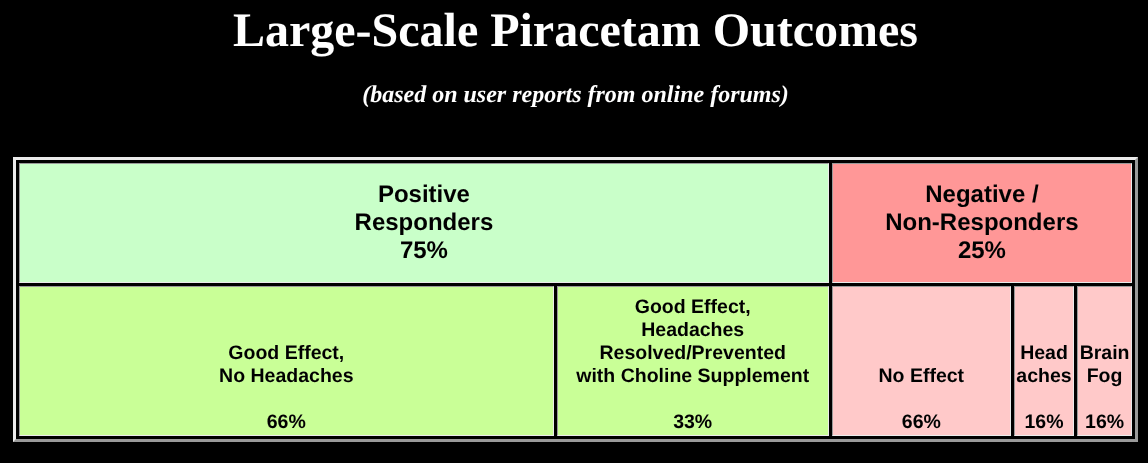
From an analysis of his own survey, with 73.95 percent positive responders, 17.7 percent reporting no effect and 8.3 percent negative reactions, Isochroma developed a non-responder phenotype model in 2009. Discrete genetic configurations of cholinergic feedback were supposed to explain the variance; he proposed nicotine response as a proxy for piracetam response. "The empiricist must make use of what data is available, however." A global numerical simulation was remote from his practice. He worked with surveys, individual reports and observed response groups. For pharmacologically produced self-certainty, he had his own expression: brain gloat. He meant "very inflated, pristinely excellent internal representations of self-image", which he described as a "symptom complex" with different "isoforms". In the same post he declared the state a reliable indicator of his functional level; another user objected that he might be measuring not intelligence but a drug-altered self-assessment. Isochroma identified a possible measurement error and incorporated it into the measuring instrument at the same time. In the same thread he wrote: "Sickos like me are the best guinea-pigs for testing these drugs. My life is disposable since it's already ruined." The pronounced collapses, he thought, made real effects easier to see: "I can tell within two days if given any new nootropic how much real power it has to salvage the mind from Hell." At the same time, he declared his own life disposable.
A rare line of influence runs from a lost forum post to a compound that was actually sold. In 2011, Isochroma referred to his own BrainMeta text about Piracetam Hydrazide, a little-studied older derivative to which he attributed greater potency and additional effects than piracetam. Three years later, a co-founder and co-owner of Ceretropic said that a thread by Isochroma-reborn had brought the molecule to his attention. According to his account, he mentally added a phenyl group, showed the design to his co-founder and proposed the phenylated variant to a supplier. The supplier synthesized it; Ceretropic then offered it as Phenylpiracetam Hydrazide, explicitly without animal or human studies. The originating BrainMeta text has disappeared. The chain from that post to custom synthesis survived in the later discussion. It shows how far Isochroma's demand for protocols that could travel might extend. He attacked the anecdotal style of the community with a sharpness that some read as arrogance. He wanted logs rather than impressions. An experience report was to become comparable, repeatable and transmissible, all the way to a molecular idea that somebody else could synthesize. Whether comparability already amounted to reliable measurement remained unresolved.
Endocrine Offensive
If Longecity was Isochroma's main medical arena, T-Nation offered a different stage: a forum of iron, sweat, anabolic myth and the collective management of male body projects. In 2013 he appeared there with a self-experiment that barely resembled the forum's usual culture. Testosterone appeared as a repair instrument for longstanding symptoms he attributed to hormonal deficiency. Muscle gain was secondary. Given his already documented severe underweight, his disability income and the absence of any recognizable strength-training biography, Isochroma fit the typical T-Nation profile poorly. He described his metabolism with gallows humour: "My DNA programs my body to BURN BABY BURN - literally. I wish I was kidding." He documented Dianabol as a self-designed hormone-replacement intervention. Responses ranged from curiosity to bewilderment. The thread is titled "Insufflation (Snorting) Dbol — Trip Report". Across several days, Isochroma logged a self-experiment with intranasal Dianabol administration: onset timed to the minute, comparison of oral and nasal routes, discussion of first-pass metabolism, then the LogP value of 3.51 as an explanation for the prolonged duration he believed he observed. Because of the molecule's lipophilicity he speculated about preferential diffusion along lipid-rich nerve pathways and elevated brain concentrations through direct nasal absorption, cited a PubMed study on intranasal testosterone and compared ten minutes to onset with sixty minutes for oral administration. For days, he treated himself as an experimental setup.
Dianabol was not his first attempt to intervene in the hormonal axis himself. In August 2013, Isochroma reported on T-Nation that six months earlier he had taken 50 mg clomiphene daily for a week. The trial, he said, changed none of his complaints and ended in a "suicidal depression of a kind never before encountered". After that self-report, the medically more conventional strategy of stimulating endogenous production was finished for him. He said libido was irrelevant to him; he needed physical energy and the reversal of exhaustion, muscle wasting and depression "for all my projects". After three weeks on the androgen, he said, Pramiracetam, Oxiracetam and Sunifiram had begun working so strongly again that part of his stack became unnecessary and he cancelled a Phenylpiracetam order he had already planned. From then on, he treated hormonal state as a condition of their efficacy. Seven milligrams corresponded to three microscoops and were taken early in the morning so that, in his model, the artificial androgen pulse would coincide with the natural testosterone rise. The same amount intranasally immediately felt like an overdose. He initially planned 2.5–3 mg but could no longer measure that on his scale. In the next trial he again weighed out 7 mg, scraped almost half back into the bag and estimated the now invisible remainder at four. The display stayed at zero. To distinguish absorption through the nasal mucosa from swallowed material, he spread the powder as evenly as possible between both nostrils, temporarily avoided swallowing, spat out saliva and postponed nootropics and vitamins. Ten minutes later came mental clarity and sharpness, followed by a complete inner silence of thought, glaring white on the monitor and unusually sharp vision. His legs became rubbery and electric, his palms wet, his body at once furnace-hot and feather-light. Dizziness, shaking, muscular tension and an apparently skipping heartbeat also entered the log. Instead of a brief peak he observed a long, uneven plateau with recurring heat waves and mental stimulation into the night.
The following morning, Isochroma sprang out of bed at 7:12. The effect had kept him awake until 1:30 a.m.; nevertheless he wrote of good sleep, more energy and greater clarity: "Like being awake before even waking up." While still in an experiment whose dose he himself had described as too high, he wrote: "Somebody else - especially someone with low T - has got to try this. It feels like I won some billion-dollar lottery. All the rest of the benefits are a sideshow compared to this. I'm having difficulty holding back tears." At night he went outside, as he often did, to sit under the stars in his rural surroundings, without streetlights or other artificial sources. That evening, by his account, he saw every star with perfect sharpness for the first time in twenty years: "The stars! THE STARS!" None of his previous combinations of nootropics, vitamins or nutrition had achieved it.
After another user objected, Isochroma partly withdrew the recommendation: on the safety of the nasal Dbol route, he said, he was going "out on a limb"; it was "beta" and suitable only for people who consciously accepted the risk.
On September 3, Isochroma gave the experiment a doctrine of its own. "This is going to sound like a manifesto, and maybe it is", he wrote, distinguishing ART, Androgen Replacement Therapy, from ordinary TRT. ART was meant to keep open the full field of androgens, doses, timing and routes of administration, and to find for each case the combination that activated underactive androgen receptors in body and brain without unnecessarily suppressing the remaining endogenous production. Circadian timing, fertility and individual tolerability became design parameters. Soon afterward he renamed the program HEART, Health Enhancing Androgen Replacement Therapy: "It's got to be full of love and life and consideration for the patient and the self too if it's self-treatment." He hoped to move HRT practice "from the 19th century to the 20th and maybe - Lord willing - to the 21st". When one user told him to shut up, he replied: "I am here to help those who were left behind by the medical establishment find their way to a cure. The only fight I'm involved in is the fight for health and life."
"Theory and practice are two different animals, PatrickM500. I am living the practice while you are speaking the theory.", Isochroma wrote on Longecity. A doctor had refused treatment despite his low testosterone values and symptom reports. Isochroma then declared self-treatment a right and the individual patient a necessary data point: "It's now up to individuals to be the data points, just like it is with the Racetams which were abandoned long ago." The law, he said, was irrelevant to medicine. On Rizon he set up
#ARTTherapy, which he described as a "resource for real-time questions/answers/consultations in a private setting". He even published fixed daily attendance times: briefly in the morning after booting his computer, later generally from the afternoon until around 9:30 p.m.; Tuesdays were exceptions. The announcement survives, not the chat log itself. Whether this became a shared treatment practice cannot be established from the post. In his formulation, anyone who remained sick after a medical refusal out of fear of legal consequences was choosing decline: "Sickness is a choice."A month later, the bathroom cupboards that had waited since April were clean: "the washroom cupboards are now cleaned as of this morning". He had rebuilt his lighting system, planned new projects "at a dizzying pace" and wrote that even using muscles that had previously hurt had become pleasurable again. In an experience report from September 4, Isochroma said that tiny, month-old residues of the synthetic cannabinoid 5F-AKB48 suddenly produced an unusually strong effect on the Shulgin scale after he switched to nasal Dianabol. The interpretation that the changed androgen state was responsible remained his own. In the darkness of the fields and woods he heard the "universal chorus", the "song of a trillion eternities in holiness": "If I had a religion then I would say that God sang me a song but I don't so I won't." Immediately afterward: "Now that I've gotten that out of the way I will explain how it relates to ART." From testosterone deficiency he now also inferred a lack of estrogenic "Yin force", whose return was supposed to reconnect mind and feeling. In the thirty-day report he set the change against the weather: "Over the last hour today clouds which totally covered the sky in grey completely vanished, leaving a brilliant Sun shining in the vast, wide blue sky of my rural valley. Exactly like my life over the last month — not a trace of the darkness and grey remain. It all burned away under the hot brilliance of a Dianabol star."
Users in the thread objected: one called the theory "junk science"; another pointed out that an individual report is not general evidence and that a method working in a man with roughly half-normal testosterone, extreme underweight and chronic immunopathology does not automatically generalize to other people.
Isochroma wanted to transfer the procurement pattern tested with Sunifiram to xenoandrogens: molecules that were supposed to activate androgen receptors without suppressing endogenous testosterone production to the same extent. He wanted to compare structures, contact Chinese suppliers about custom syntheses and have test molecules made. Virtually nothing was known about their long-term effects; a few sentences later he spoke of patent values in the billions and a "gigaprofit window" before possible regulation. Another design proposed a stable, highly potent androgen dissolved in edible ink whose microdoses could be printed onto paper by an inkjet printer. The sketch ended: "Nobody has that one patented yet. I wonder if it would work." As far as can be seen, it remained a sketch. He logged closely but did not always mark the point at which the peculiarities of his own body limited generalization. He later continued the insufflated route on Reddit with Oxiracetam, IDRA-21 and a dated RAD140 log.
Two later outposts appear on Steroid.com. An account created in October 2013 made two posts in total and, given alias, period and subject matter, belonged with high probability to the same author. In May 2014, in a thread about oral steroids and hepatotoxicity, it placed curcumin above UDCA and probably TUDCA on the basis of a short rat study; in July 2015, it read a testosterone increase still measurable after four weeks of boron as evidence that negative feedback through the HPTA had not compensated for the effect. In both cases he read small animal studies further than they could bear: once in liver protection, once in hormonal feedback. The endocrine eschatology of the thread remained tied to a particular starting point: a testosterone level far below his own target and a body that responded to intervention differently from the forum's average reader.
-
The Second Sun
"The PHOTONIC DRUG is the best Nootropic: it's measured in LUMENS instead of MILLIGRAMS." With this formula, Isochroma treated light not as mood but as dose. Lumens, colour temperature and CRI became parameters of an environment that was continuously administered. Elsewhere he wrote: "Yes, more lights! Light is Life and Life is Light." Body and brain, he argued, were built for permanently brilliant white light. This quarrel with light had not begun in his living space. On Doom9 he had already traced the point at which decoders and renderers or graphics drivers clipped luminance and colour information; on AVSForum he simultaneously observed and archived the development of self-emissive OLED displays. By 2008 he was arguing in the same logic on a cannabis forum about CFL lighting for plants: 23 W at 5,000 K for vegetative growth, 26 W at 2,700 K for flowering, T4 rather than T5 tubes because of higher intensity, and the distinction between lumen output measured in an integrating sphere before reflector losses and the light actually arriving at the target surface. What there still appeared as a question of complete video signal or plant-appropriate light output later became the question of whether a dwelling also supplied its occupants with an incomplete daylight signal.
In May 2009, a new Reef Central user named Isochroma opened the thread "Metal Halide Safety?". He was considering an unshielded 20,000 K lamp and did not ask whether it was dangerous in general, but about specific modes of failure: had other users seen the outer glass envelope shatter or the inner arc tube explode? Which lamp type, ballast and burning orientation were involved? Replies distinguished single-ended and double-ended lamps and warned that particular types lacked UV shielding. There is no direct link to his domain; alias, timing and subject make the attribution highly probable. In any case, the post shows that the later metal-halide escalation did not arise from ignorance of material risk. Explosion, UV radiation and circuit conditions had already been queried as technical parameters.

"This is how a city should look at night!" In the Lighting-Gallery thread The Beauty of Mercury Vapor Streetlighting, Isochroma placed a night scene from the 1991 anime You're Under Arrest beside a photograph of Tokyo from space. The blue-green clarity of older Japanese mercury-vapour streetlights seemed to him akin to moonlight and starlight; the orange of sodium lighting, by contrast, dry and depleted. Later he wrote: "Sodium is ugly. It looks just like it tastes in my food: salty, dehydrating, dried-up." Anime from the 1980s and 1990s became an image archive of a disappearing lighting world.
Twelve 6,500 K CFLs totalling 276 W and 19,200 lm formed the Compact Fluorescent Spiral Galaxy Version 12 documented on Lighting-Gallery. Joined through Y-splitters, they formed an approximately spherical source and ran for eight hours a day in his bedroom. Isochroma did not want broad, diffuse brightness but a "DENSE, SUNLIKE source": divergent rays, deep shadows and the spatial plasticity of a small sun. He called the construction a "tiny quasi-spherical metaemitter" that, like an organism made of redundant cells, could grow and shrink. In the evening he switched the Galaxy off; a red 7 W Christmas bulb and a shielded incandescent remained. By January 2010 he had expanded the Galaxy to sixteen lamps, 368 W and 25,600 lm. When Isochroma published the Naturalistic Synthetic Light Environment in 2011, he was not merely proposing a future plan. He was turning an apparatus already tested in his bedroom into a general theory of habitable brightness. He calculated the minimum for circadian efficacy as 385 W of 6,500 K CFL light in a 16 × 14 foot room. The earlier Spiral Galaxy thus became the prototype of a threshold that almost no ordinary home reached and that he nevertheless treated as a minimum condition of functional perception. Another documented installation used four 42 W CFLs, two 23 W CFLs, two 30 W LEDs and several smaller units, all linked through Y-splitter trees; two of the CFLs were shifted to 12,000 K with blue transparent film.
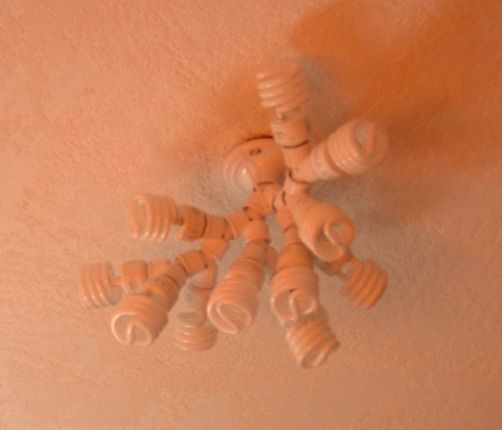
In a winter Reddit comment, Isochroma sat at 9:17 p.m. beneath the "Power of God", a 220 W cluster of 6,500 and 7,500 K lamps: "It's been pitch-black outside for three hours but it's Summertime in my room. Summer forever. All eternity. My Circadian system lives on the Equator and my body lives on the 49th Parallel. Better living through Lumens." The artificial day ran for twelve hours. In the evening came the complete reversal: all CFLs off, only a red LED left on, the display channels driven to gamma zero through a self-written Nvidia script, driver version 84.21 and no later one because later versions no longer allowed blue and green channels to be completely suppressed, LCD brightness at zero because of the backlight leak a panel still emitted at black. "I can feel the effects of my lighting switched off in minutes." Three to four hours later he went to bed and fell asleep immediately. The protocol followed the photobiology of the suprachiasmatic nucleus and intrinsically photosensitive retinal ganglion cells and was at least partly testable against iPRGC research. Later research on light and human circadian rhythms did not confirm the protocol as a whole, but did confirm the importance of the parameters he persistently controlled: intensity, spectrum, timing and duration.
As the number of lamps increased, the splitter tree developed problems of weight and mutual shading. Eventually, the structure would become a "giant heatmaking mercury-bomb waiting to fall on my head". Isochroma wanted to replace the "piecemeal monstrosity" with a "real Mercury Bomb": a 1,000 W metal-halide lamp at 10,000 K whose arc tube burned at around 900 °C and contained 168 mg of mercury. He himself described the fact that such lamps could occasionally explode and fill a room with mercury vapour. Isochroma also loved the material: "I love old Vacuum-tube technology. Especially the beautiful Mercury Gas in Glass ones." He described spiral fluorescent tubes and short, thick metal-halide arc tubes in which droplets of mercury rolled with a ringing sound. LEDs, by contrast, appeared to him as short-lived plastic goods. "Those who want Ultimate Light must every day all day take the Ultimate Risk", he wrote. Since everyone had to die anyway, he asked whether the risk might not be worth the strongest nootropic lighting effect. His higher ideal was the sulfur lamp — "unaffordable and nearly unavailable and noisy due to its motor" — while metal halide remained attainable. He had cited the safety data himself.

Hello! It looks like you're interested in this conversation, but you don't have an account yet.
Getting fed up of having to scroll through the same posts each visit? When you register for an account, you'll always come back to exactly where you were before, and choose to be notified of new replies (either via email, or push notification). You'll also be able to save bookmarks and upvote posts to show your appreciation to other community members.
With your input, this post could be even better 💗
Register Login