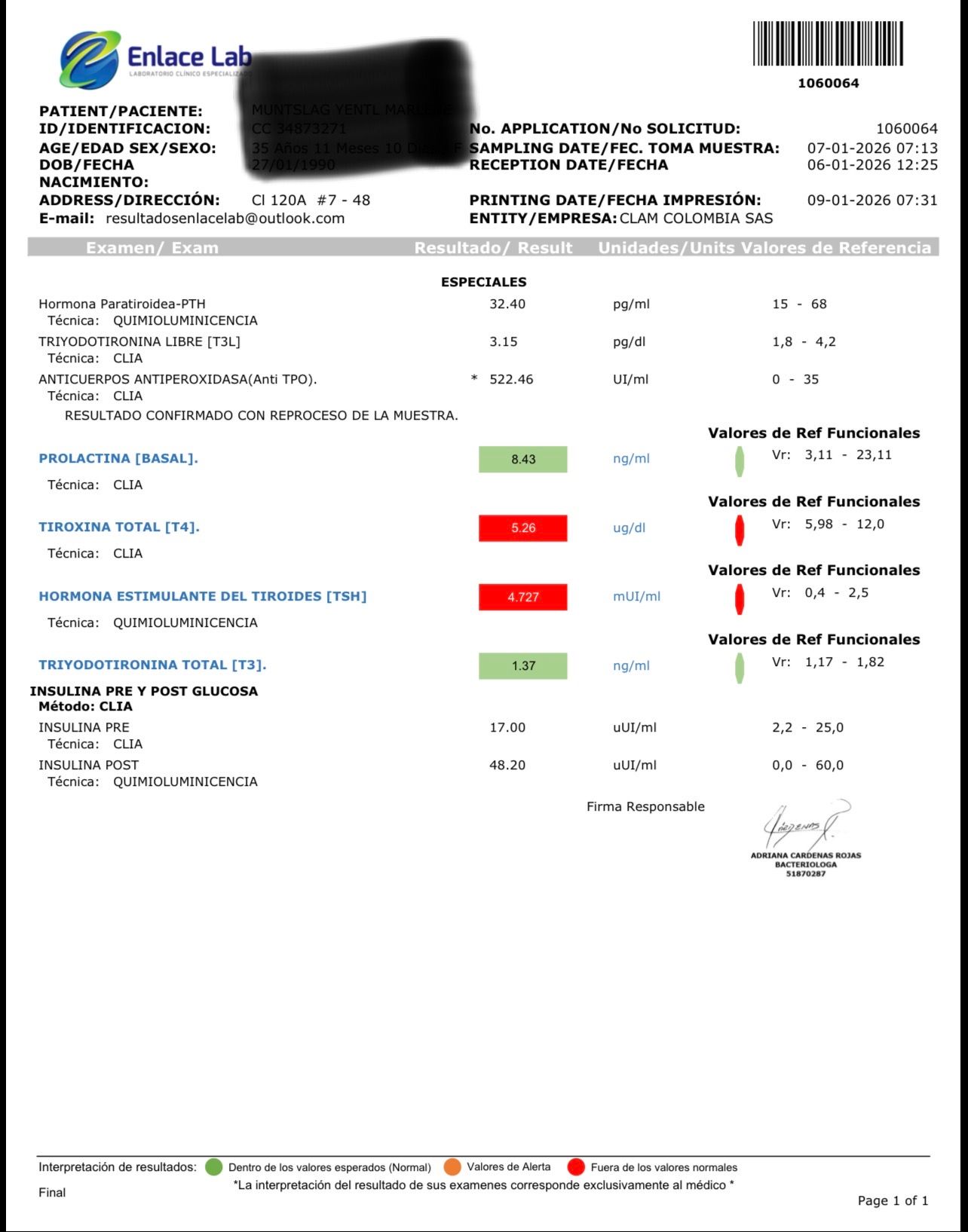
What do these numbers mean?
-
This is my daughters who has loss of energy. She lives in Colombia and does take some T3
Any help is appreciated.Thank you.
-
@happyhanneke said in What do these numbers mean?:
Any help is appreciated.
Hi, I'm going to focus on the possibilities. No certainties. To try and get a clearer picture.
Re-written with help of IA (to be more concise and organized, I've cut out the unnecessary parts. Too long). Hope it could help.- There’re a lot of antibodies (Anti-TPO 522.46 UI/ml). Need a test for 2 kinds of defective genes.
=> Internal medicine (endocrinologist). Usually 3 months delay when everything is fine. - Altered communication between the thyroid and the brain (hypothesis):
- TSH signaling problem: A TSH level of 4.727 (close to the upper limit) indicates that communication between the hypothalamus/pituitary gland and the thyroid is disrupted. Normally, an elevated TSH level signals the brain to stimulate the thyroid gland to produce more hormones. However, in this case, the brain did not receive this signal optimally, resulting in a high level of T4 production. T4 is a reserve hormone (not functional).
- Possible hypotheses for this dysfunction:
a) Lack of cofactors necessary for the conversion of T4 to T3: For example, selenium is essential for DIO-3 (type 3 deiodinase), an enzyme that regulates the conversion of T4 to T3. If the conversion does not occur correctly, T4 accumulates and active T3 remains within normal limits, but this is not optimal. It is therefore crucial to check selenium levels.
b) Presence of heavy metals or environmental toxins: Contaminants such as chlorine, fluoride, or bromine (often present in water, hygiene products, and processed foods) can interfere with thyroid function by blocking thyroid receptors and disrupting the conversion of T4 to T3. The presence of these elements should be checked.
A test to detect heavy metals in the blood or urine could rule out this hypothesis.
c) Thyroid gland or receptor problem: Thyroid receptors on target cells can be altered by toxins or chronic inflammatory diseases, making the signal less effective.
- Nutrients and factors involved:
- Iodine deficiency: Iodine is essential for the production of thyroid hormones. If you live far from the sea and your diet is low in fish or seafood, your iodine intake may be insufficient.
- Zinc deficiency: Zinc plays a key role in thyroid metabolism and the immune system. In meat products.
- Vitamin D deficiency: Vitamin D is crucial for immune balance, and a deficiency could worsen an autoimmune disease. It would be wise to also measure vitamin D levels (> 35-45 ng/ml) and optimize magnesium intake (350-420 mg).
Conclusion
The goal here is to narrow down the hypotheses to the most probable ones:- Hashimoto's thyroiditis: The high probability of an autoimmune disease, confirmed by elevated anti-TPO antibodies.
- Dysfunction in the conversion of T4 to T3: Possibly linked to a lack of cofactors (selenium, zinc, iodine, vitamin D) or the influence of environmental toxins (chlorine, fluorine, bromine).
- Assess the presence of toxins and nutritional deficiencies: This will allow for a better understanding of the underlying cause and more precise medical management, focusing on the true possible causes. We proceed by elimination …
useful info:
Taking T3 and T4 synthetic supplement improves metabolism for a while
https://mirzoune-ciboulette.forumactif.org/t2108-english-corner-taking-t3-and-t4-synthetic-supplement-improves-metabolism-for-a-while#30193 - There’re a lot of antibodies (Anti-TPO 522.46 UI/ml). Need a test for 2 kinds of defective genes.
-
@LucH Thank you so much!!
The doctor did a scan of the thyroid as well and she's diagnosed with hashimoto's.
This just happened today. Now to see what to do about this. It's new to me.
Thanks again. -
@happyhanneke said in What do these numbers mean?:
Now to see what to do about this. It's new to me.
Thanks again.Happy it could help. here is more info.
Hi,
Another clue
One clue: Jean Seignalet, French immunologist, thought that this auto-immune illness could have been enhanced by a xenopathogen, an antibacterial peptide coming from a bacteria or food, passing along the intestines. This peptide is then presented by HLA-DR to T CD+ lymphocytes. An autoimmune reaction happens and inflammation is then going to dampen and attack the thyroid function.
About Hashimoto’s
Jeffrey Dash, MD, wrote a chapter in the book “The Thyroid Madness II” – Chapter 7 – “The Hashimoto’s Autoimmune Thyroid Disease”. Pay attention to the title of the book (two books) when buying it.
In this chapter, there are six parts, the last one being devoted to a protocol.
Some excerpts (summary) of the book.Part one
• Selenium is particularly important for thyroid function, especially in protecting against hydrogen peroxide (H2O2).
• H2O2 is a byproduct of hormone conversion, for example, the conversion of T4 to T3.
• We use selenium-dependent enzymes: Glutathione peroxidase neutralizes H2O2, and iodothyronine deiodinase converts T4 to T3.
• A good treatment protocol for Hashimoto's begins with the following laboratory tests: TSH, free T3 (fT3), free T4 (fT4), thyroperoxidase antibodies (TPO), thyroglobulin antibodies (Tgb), serum selenium level, and urinary iodine level.
• Hashimoto's patients may experience fluctuations between hypothyroidism and hyperthyroidism.Part Two
• Hashimoto's is an autoimmune disease. If the process is stopped early enough and some thyroid function is maintained, the patient can go into remission, provided they avoid pathogens (gluten).
• Selenium deficiency exacerbates the frequency of the disease.
• The belief that iodine is a trigger or aggravating factor in autoimmune disease is still widespread.
• Pathogenic foreign organisms (viruses, bacteria, yeast, and protozoan infections) such as Yersinia, Giardia lamblia, and/or rotavirus can cause a weakening of the body's internal environment (dysbiosis), leading to an immune system reaction (molecular mimicry).
• The immune system reacts in two possible ways to TSH receptors: If it is stimulated, it will be Graves' syndrome (hyperthyroidism); if it is suppressed, it will be Hashimoto's syndrome (hypothyroidism). The two types of antibodies can coexist and become predominant in turn.Part Three
• One of the main functions of thyroid cells is the absorption of iodine from the bloodstream.
• In autoimmune disease, the enzyme thyroperoxidase cannot function at its normal rate and metabolizes iodine poorly or not at all.
• Since iodine metabolism is already reduced in Hashimoto's thyroiditis, these patients are more sensitive to the inhibitory effect of iodine supplementation on thyroid hormone production. Sensitive does not mean that controlled iodine intake is unnecessary! Iodine is necessary to inhibit the formation of hydrogen peroxide (Chaikoff effect). Dietary iodine intake, at a low level, under strict control, and in a modulated (variable) manner, will limit the oxidation and coupling of iodine to thyroglobulin due to the reduced availability of H2O2 at the apical membrane. (It's very technical, editor's note).
Comment (LucH):
Do not take an iodine supplement (150-225 mg of fucus/seaweed caps) if you haven't already reloaded with selenium. Begin with 200 mcg of selenium per day for 2 weeks. Once stabilized, and if you’re on a low iodine intake (150-225 mcg caps), adjust the frequency of iodine intake according to how you feel—this may mean stopping temporarily, or reducing to every other day, or even every third day.
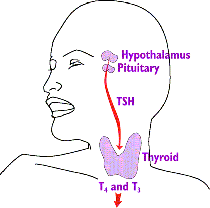
Remember, there needs to be proper communication between the brain (hypothalamus) and the pituitary gland, which signals the thyroid. A delay of 10-15 days is necessary for your body to adapt and regulate enzyme production accordingly.
Figure: Thyroid communication
Part Four
• Etiology of Hashimoto's Disease
• Iodine intake has no effect on antibody levels. Therefore, iodine is not a trigger for Hashimoto's thyroiditis.
• Medical literature is conflicting regarding iodine intake, but this should no longer be a concern if you understand the following and adjust the treatment according to your body's reactions.
• Iodine supplementation should be discontinued at the first sign of adverse effects. Suspended, not stopped. Adjust the dosage!
• Selenium levels should be tested, and selenium supplementation should be started before taking iodine tablets!
• Dr. Meng found that TSH suppression with thyroxine (T4), in combination with a low dose of iodine, had the most favorable effect on thyroid antibodies. This has proven accurate in the clinical practice of Dr. Jeffrey Dach, MD. 225 mcg of iodine per day (titrated, therefore).
• Dr. Jeffrey Dach also suppresses/lowers TSH with a natural thyroid extract (NTE) supplement. Dosage is introduced gradually!
Note: Do not begin this treatment before understanding how to modulate hypo- and hyperthyroid reactions.
• Dr. Jeffrey Dach's protocol includes a gluten sensitivity test. He recommends a gluten-free diet. He also tests vitamin D3 levels.Part Five
• Thyroid function can vary and baffle most unfamiliar physicians, especially when tests come back false negative!
• In medical jargon, this is called "Hashimoto's Toxicology": This ranges from a "thyroid storm" to psychiatric symptoms, such as neuropsychiatric disorders, sensory neuropathies, cervical neuropathies, etc.Part Six
• Treatment Protocol Description
• How to Reduce Antibody Levels
a. Selenium Supplementation
b. Thyroid Medication
c. Gluten Sensitivity Testing and a Gluten-Free DietUseful link: (In French, translator needed)
https://mirzoune-ciboulette.forumactif.org/t119-the-thyroid-madness#817 (beginning of the book)
https://mirzoune-ciboulette.forumactif.org/t119-the-thyroid-madness#1077 (chapter 7: Selenium and Hashimoto)
More details on my forum. Note: I’m not a medical doctor, not suffering from the thyroid, but have managed nearly a burn out 20 years ago. As thyroid is a head-chief controller for energy, I read a lot from studies and trustful medical sources, though there is no medical consensus about iodine intake!
I’m a former teacher. Retired.Additional info (from Jeffrey Dash)
LINK TO WHEAT CONSUMPTION, LEAKY GUT AND MOLECULAR MIMICRY
Although selenium deficiency is a predisposing factor, wheat gluten consumption is the other major culprit. In genetically predisposed individuals, wheat gluten consumption will cause Leaky Gut, with leakage of bacterial antigens into the bloodstream. Much of this work has been published by Allesio Fansano MD. (186-192)
Via a mechanism called molecular mimicry, the immune system then attacks the thyroid gland, explaining the underlying causation of autoimmune thyroid disease, Hashimoto’s, and Graves disease. (9) Yersinia is one such bacterial organism that has been implicated. (10) In addition, there is a high correlation between Hashimoto’s Thyroiditis and Celiac Disease, an autoimmune disease caused by wheat gluten ingestion in genetically predisposed individuals. (11) (16,17) Testing for the anti-gliadin antibody is commonly used. Obviously, elimination of wheat gluten from the diet is necessary and in many cases, curative, for the autoimmune thyroid patient. I have found this to be the case in actual clinical practice.NB: Hope it can help. I know there is no consensus about iodine intake among the medical practice (...). Be progressive and pay attention to the details ... It takes time to get well-informed.

-
My elevated anti-TPO antibodies went away after I followed a low iodine diet for a few months. It's possible the true root cause was my dental infection, or something else. I don't know. But the low iodine diet was definitely a useful treatment at the time. I don't restrict iodine anymore now, and the antibodies are still gone last time I checked.
My experience:
https://bioenergetic.forum/topic/3760/bloodwork-shows-elevated-tpoab-hashimoto-s-diseaseThread I made about excess iodine:
https://bioenergetic.forum/topic/3927/iodine-too-much -
@Insr said in What do these numbers mean?:
My elevated anti-TPO antibodies went away after I followed a low iodine diet for a few months. It's possible the true root cause was my dental infection, or something else.
2 remarks:
- Iodine is able to to kill most viruses or to weaken them so that the immune system can reach the virus. Iodine is well-known for is powerful anti-bacterial power.
So, if you had a dental infection, or HPV or a dysbiosis, it's logical your body was trying to get rid of LPS (destroyed membrane of a virus). LPS in excess overloads the liver and triggers then the immune system (seen as toxins).
A gradual approach is required. Too long to explain here in details.
Let's say: you must begin very low (150 mcg) and progressively (with staples 12-15 days). NIS symporters have to be re-accustomed not to get side-effects. If you take 12.5 mg (12 500 mcg, like from iodoral or lugol), at the beginning, you'll get problems, for sure! - If you've taken iodine, without taking selenium before, you can't neutralize excess ROS. You've got then a Wolff-Chaikoff effect (transitory effect). I repeat. It's a transitory effect. Metabolism protection. You have to manage / adapt to circumstances.
- Iodine is able to to kill most viruses or to weaken them so that the immune system can reach the virus. Iodine is well-known for is powerful anti-bacterial power.
-
Useful info on LPS toxins (in French, translator required)
Excerpts
Comprendre les endotoxines LPS – Comment moduler la réaction immune
Understanding LPS endotoxins – How to inhibit LPS endotoxins
https://mirzoune-ciboulette.forumactif.org/t2003-inhiber-les-endotoxines-lps#29343
https://mirzoune-ciboulette.forumactif.org/t1161-effets-protecteurs-du-cholesterol-sur-les-endotoxines?highlight=endotoxines (with RP comments and forumer’s comments)- Carpooling for the transfer of LPS endotoxins.
- How to mitigate the reactive response to LPS toxins.
- Beneficial substances, antagonists of TRL4 molecules, thus blocking LPS-induced signaling (neutralizing the inflammatory response).
- Favorable context (thyroid and cholesterol conversion, Vit A D & E, riboflavin, niacinamide, butyrate, other protective factors against cell excitation, like red light therapy or appropriate levels of carbs and fats). With studies to justify.
- Understanding the dual role of LBP, keeping host infection under control.
=> Mechanism of action of LBP (The lipopolysaccharide binding protein)
LBP has a dual role in immune responses based on its concentration: at low concentrations, it enhances the immune response by transferring LPS (lipopolysaccharide) to receptors like CD14 and TLR4, which triggers an inflammatory cascade. Conversely, at high concentrations, LBP may inhibit LPS-induced stimulation, helping to dampen excessive inflammation and promote LPS clearance, thus acting as a regulator of the host's innate defense.

Hello! It looks like you're interested in this conversation, but you don't have an account yet.
Getting fed up of having to scroll through the same posts each visit? When you register for an account, you'll always come back to exactly where you were before, and choose to be notified of new replies (either via email, or push notification). You'll also be able to save bookmarks and upvote posts to show your appreciation to other community members.
With your input, this post could be even better 💗
Register Login