Split dosing NDT still not working for me. Please help
-
Every time I take some NDT in the late afternoon or even early afternoon like the most recent experiment, my sleep get messed up.
I was taking for couple of months 90mg Armor in the am before breakfast, I thought it was helping but temp and HR were not in the optimal range.
For the past 10 days I tried 1 grain Armor before breakfast, and half grain with lunch at about 1/1:30pm. I don't get any stress reaction or any adrenaline reaction, my sleep onset did not delay either, I just sleep but when I wake up in the AM I feel like I did not sleep, the worse feeling. I believe I dream more as well.
I eat around 350 carbs per day, 160 protein, and often some snack before bed as well.
I dealing with SIBO, and not sure that has to do anything with this.
thoughts? I'm a better off afterall taking the full dose in the am?
thanks
-
I dealing with SIBO, and not sure that has to do anything with this.
Hi,
As long you suffer from SIBO, the inflammation and the nutrients are deprived (exhausted). Energy is derived to dampen side effects.
See Dr. D'Oro to learn how to deal with.
Only afterwards you'll see how to adapt synthetic T3 and T4.
But the improvement won't last if you don't bring useful nutrients for DIO enzymes (diodinase): Se, I, Mg, Zn (+ Fe and B co-enzymed).
Mind heavy metal toxicity (Hg, Arsenic in rice, chlorine in water, Fluorine in tooth pasta, Bromine in bread or in wheat flour). -
@LucH thanks.
I have been dealing now with SIBO for a couple of years, tried some antibiotics, natural as well.
I'm actually hoping optimizing thyroid function will get rid of SIBO, not the way around, since I believe SIBO to be a symptom of poor thyroid function
-
@GRay Taking thyroid dows not work if the cause of low metabolism or hypothyroidism has a primary cause that hasnt been identified.
In my case, it is endogenous carbon monoxide being produced from the recycling of heme by heme oxygenase enzyme (HO-1) in the spleen as it recycles hemolyzed red blood cells. Carbon monoxide inhibits the production of cytochrome c oxidase, which is needed by the electron transport chain to convert substrates to ATP.
I have a persistently high level of LDH in my blood test, which is hard to diagnose as to why, but in time I narrowed the cause to chronic hemolysis. But the rate of hemolysis is high enough to be a problem in lowering my metabolism to sub-clinical hypothyroidism (meaning it is slightly low that I may be considered normothyroid), but I only came to realize my hypothyroidism when I would wonder why my cholesterol always stays at 240, and the conversion of cholesterol to pregnenolone would be inhibited. My androgens would also be low.
So, no matter how much T3 I take, nothing changes with my metabolism even when I take T3, pregnenolone, and progesterone.
I am currently addressing the root cause by taking lead chelation agents (which I have done enough of using Emeramide) and taking antimicrobials (both targeting bacteria and fungi, not virus as I don't believe it exists) with the aim of eliminating non-apoptotic hemolysis). I am also taking boron to neutralize the effect of CO as well. And taking gelatin and msm (to the existing stores of cysteine and glutamate from meat intake) to provide substrates for the body to make glutathione which provides protection from hemolysis. As well as vitamin B2 to allow oxidized glutathione to be recycled to reduced glutathione.
But what I'm doing may not apply to your context. The root cause of your hypothyroidism may lie elsewhere.
-
I believe SIBO to be a symptom of poor thyroid function
I won't say it so. Thyroid is a part of the problem but not at the source. Why?
I’m trying to let you come to your own conclusion.
Facts:- There is interaction between the brain and the microbiome through the HPA axis (vagus nerve).
- When the energy level is weak (combined here with an inappropriate amount of nutrients, not well assimilated, due to inflamed junctions of the stomach border brush), the brain tells the machine to slow down. Species protection.
It can be a lack of nutrients, an enzymatic dysfunction or a long-lasting low-grade inflammation (hidden, or not well determined and thus not really perceived as such). Here only some clues. There are other possibilities, like a genetic defect / laziness. We are surrounded by outside foreign agents (HM, nanoparticles, etc.) …
The origin is often due to a lack of assimilation (accumulation of dysfunctions) or to an outside agent impacting the enzymatic pathway. Same result.
Jean Seignalet – famous French immunologist – said the “dysfunction” could be broadly classified as originating from:- Outside agents (unidentified external agent): Undigested, modified macro-molecules that cross a weakened intestinal barrier.
- A lack of assimilation: The body's inability to properly utilize or digest these unnatural, modern foodstuffs.
Thus this immunologist dealt with 3 types of pathology: - overburden system (encrassage)
- elimination defect
- auto-immune reaction
See Jacqueline Lagacée if any readers wish to delve deeper.
Impact of Excess Stress (High Cortisol) on Thyroid Function
Chronic stress elevates cortisol, which suppresses the hypothalamic–pituitary–thyroid (HPT) axis. High cortisol reduces TRH and TSH release, blunts TSH responsiveness, and inhibits conversion of T4 to active T3. This lowers available thyroid hormone activity despite normal T4 levels. Elevated cortisol also disrupts the normal feedback loop between thyroid hormones and the brain, leading to impaired regulation and symptoms of functional hypothyroidism.
Figure: Continuous stress impacts T3 and T4 functions
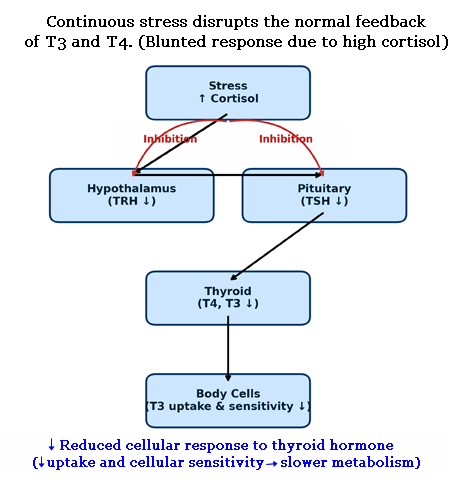
Description of the blunted metabolism
How high cortisol disrupts the HPT axis and feedback
• Suppression of TRH and TSH: High cortisol levels, through negative feedback on the hypothalamus and pituitary, suppress the release of corticotropin-releasing hormone (CRH) and adrenocorticotropic hormone (ACTH), which are the precursors to the HPT axis. Similarly, excess cortisol can also inhibit the release of TRH (thyrotropin-releasing hormone) from the hypothalamus and TSH (thyroid-stimulating hormone) from the pituitary.
• Reduced T3 production: High cortisol can inhibit the conversion of T4 to the more active T3, leading to a lower T3:T4 ratio. This creates a scenario where even if T4 levels are normal, the body's ability to use thyroid hormone is impaired.
• Blunted TSH response: The suppression of TSH by high cortisol means that the thyroid is not being adequately stimulated. This can result in low or inappropriately normal TSH levels, even when T3 and T4 levels are low, leading to an underdiagnosis of hypothyroidism.
• Interference with feedback loop: The normal negative feedback of T3 and T4 is a separate system that can be overridden by the stress response induced by high cortisol. Ultimately, the HPT axis is affected by both the "stress axis" and the "thyroid axis," and high cortisol can disrupt the negative feedback mechanisms that are crucial for the HPT axis to function correctly.
Body Cells – Reduced T3 Activity
High cortisol not only lowers T3 levels but also reduces T3 uptake and receptor sensitivity in target tissues. This means that even if some T3 is present, cells respond less effectively, leading to sluggish metabolism, fatigue, and other hypothyroid-like symptoms -
I'm not sure what you did. You said I took 90 milligrams of NDT, but how was your ramp up to this dosage? When I hear someone with these issues, I hear someone who hasn't ramped up. It could take three months, four months to ramp up to the correct dose. Maybe you did that, but I'm not sure from your description. Maybe you could respond.
-
@Ecstatic_Hamster why did u stop recommending lgs ndt?
-
@sunsunsun it isn't standardized, so you can't judge dose.
-
@Ecstatic_Hamster ic thx
-
I'm not sure what you did. You said I took 90 milligrams of NDT, but how was your ramp up to this dosage? When I hear someone with these issues, I hear someone who hasn't ramped up. It could take three months, four months to ramp up to the correct dose. Maybe you did that, but I'm not sure from your description. Maybe you could respond.
Thanks for taking the time to read.
By “ramp up,” do you mean whether I had issues while increasing the dose?
I’ve been on NDT for a while and increased back to 90 mg about 2+ months ago. I had no issues with the increase, no adrenaline reaction or anything like that.
Following Ray Peat/Danny Roddy, and considering the T3 component of NDT, multiple doses during the day make sense in theory. I also know many people in the Peat world dose it this way. But every time I take any NDT later in the day, my sleep seems to suffer.
This time I tried the second dose at lunch with food, and later tried it 1 hour before lunch. Taking it before lunch seemed less disruptive, but still not ideal. I fall asleep fine and I do sleep, but I wake up feeling like I didn’t really sleep. Interestingly, I have more energy from the morning onward, even though I feel unrested.
I had a similar experience in the past when I tried taking NDT before bed.
So after carefully evaluating this for about 3 weeks, tomorrow I’m going back to taking the full 90 mg in the morning before breakfast. The problem is that I already know 90 mg isn’t enough to bring my temps up, so I’m wondering if the next step would be increasing toward 2 grains, all in the morning, but I understand Ray Peat and Danny Roddy say this way will be too much T3 in one time, which will potentially make the liver excrete the T3 at a faster rate, therefore leaving me later in the evening hypothyroidism.
So here my dilemma, what to do here?
-
@GRay In my experience, ray was right about the T3 "limit" per meal. If stress is high, sometimes lowering that stress can sensitize you to the thyroid you're taking. I can take up to 12.5mg of t3 at a time with no real reaction but as soon as I take some aspirin or niacin amide with it, doses as low as 1mcg can have a profound relaxing and euphoric effect.
-
I'm not sure what you did. You said I took 90 milligrams of NDT, but how was your ramp up to this dosage? When I hear someone with these issues, I hear someone who hasn't ramped up. It could take three months, four months to ramp up to the correct dose. Maybe you did that, but I'm not sure from your description. Maybe you could respond.
Thanks for taking the time to read.
By “ramp up,” do you mean whether I had issues while increasing the dose?
I’ve been on NDT for a while and increased back to 90 mg about 2+ months ago. I had no issues with the increase, no adrenaline reaction or anything like that.
Following Ray Peat/Danny Roddy, and considering the T3 component of NDT, multiple doses during the day make sense in theory. I also know many people in the Peat world dose it this way. But every time I take any NDT later in the day, my sleep seems to suffer.
This time I tried the second dose at lunch with food, and later tried it 1 hour before lunch. Taking it before lunch seemed less disruptive, but still not ideal. I fall asleep fine and I do sleep, but I wake up feeling like I didn’t really sleep. Interestingly, I have more energy from the morning onward, even though I feel unrested.
I had a similar experience in the past when I tried taking NDT before bed.
So after carefully evaluating this for about 3 weeks, tomorrow I’m going back to taking the full 90 mg in the morning before breakfast. The problem is that I already know 90 mg isn’t enough to bring my temps up, so I’m wondering if the next step would be increasing toward 2 grains, all in the morning, but I understand Ray Peat and Danny Roddy say this way will be too much T3 in one time, which will potentially make the liver excrete the T3 at a faster rate, therefore leaving me later in the evening hypothyroidism.
So here my dilemma, what to do here?
some people do better taking the full dose at the same time, or maybe twice a day half the dose. I would pursue the slow increase myself, to get to normal temperatures, and especially that you are feeling better.
-
I'm not sure what you did. You said I took 90 milligrams of NDT, but how was your ramp up to this dosage? When I hear someone with these issues, I hear someone who hasn't ramped up. It could take three months, four months to ramp up to the correct dose. Maybe you did that, but I'm not sure from your description. Maybe you could respond.
Thanks for taking the time to read.
By “ramp up,” do you mean whether I had issues while increasing the dose?
I’ve been on NDT for a while and increased back to 90 mg about 2+ months ago. I had no issues with the increase, no adrenaline reaction or anything like that.
Following Ray Peat/Danny Roddy, and considering the T3 component of NDT, multiple doses during the day make sense in theory. I also know many people in the Peat world dose it this way. But every time I take any NDT later in the day, my sleep seems to suffer.
This time I tried the second dose at lunch with food, and later tried it 1 hour before lunch. Taking it before lunch seemed less disruptive, but still not ideal. I fall asleep fine and I do sleep, but I wake up feeling like I didn’t really sleep. Interestingly, I have more energy from the morning onward, even though I feel unrested.
I had a similar experience in the past when I tried taking NDT before bed.
So after carefully evaluating this for about 3 weeks, tomorrow I’m going back to taking the full 90 mg in the morning before breakfast. The problem is that I already know 90 mg isn’t enough to bring my temps up, so I’m wondering if the next step would be increasing toward 2 grains, all in the morning, but I understand Ray Peat and Danny Roddy say this way will be too much T3 in one time, which will potentially make the liver excrete the T3 at a faster rate, therefore leaving me later in the evening hypothyroidism.
So here my dilemma, what to do here?
some people do better taking the full dose at the same time, or maybe twice a day half the dose. I would pursue the slow increase myself, to get to normal temperatures, and especially that you are feeling better.
Thanks. So I guess I will try to increase my dose as one daily frequency. Also, I made a research how Broda Barns instructed his patients to take Armour, and this what I found:
“The entire dose is taken at breakfast time solely to form the habit and avoid divided doses later in the day…”
Perhaps I could try the two grains with breakfast instead of before at some point
-
@hcwilliams said:
@GRay In my experience, ray was right about the T3 "limit" per meal. If stress is high, sometimes lowering that stress can sensitize you to the thyroid you're taking. I can take up to 12.5mg of t3 at a time with no real reaction but as soon as I take some aspirin or niacin amide with it, doses as low as 1mcg can have a profound relaxing and euphoric effect.
That’s pretty much the max I tried all at once, 13.5mcg of T3 from Armor, on an empty stomach, not really much stress reaction, maybe I bit of an extra push, in a positive way I would say.
The thing with me, since it seems I can’t tolerate T3 in the afternoon, I will need to increase from here, going to 2 grains at the same time, 18mcg T3.
Were you taking Cytomel or NDT? the T3 in NDT has a smoother peak
-
@GRay Taking thyroid dows not work if the cause of low metabolism or hypothyroidism has a primary cause that hasnt been identified.
In my case, it is endogenous carbon monoxide being produced from the recycling of heme by heme oxygenase enzyme (HO-1) in the spleen as it recycles hemolyzed red blood cells. Carbon monoxide inhibits the production of cytochrome c oxidase, which is needed by the electron transport chain to convert substrates to ATP.
I have a persistently high level of LDH in my blood test, which is hard to diagnose as to why, but in time I narrowed the cause to chronic hemolysis. But the rate of hemolysis is high enough to be a problem in lowering my metabolism to sub-clinical hypothyroidism (meaning it is slightly low that I may be considered normothyroid), but I only came to realize my hypothyroidism when I would wonder why my cholesterol always stays at 240, and the conversion of cholesterol to pregnenolone would be inhibited. My androgens would also be low.
So, no matter how much T3 I take, nothing changes with my metabolism even when I take T3, pregnenolone, and progesterone.
I am currently addressing the root cause by taking lead chelation agents (which I have done enough of using Emeramide) and taking antimicrobials (both targeting bacteria and fungi, not virus as I don't believe it exists) with the aim of eliminating non-apoptotic hemolysis). I am also taking boron to neutralize the effect of CO as well. And taking gelatin and msm (to the existing stores of cysteine and glutamate from meat intake) to provide substrates for the body to make glutathione which provides protection from hemolysis. As well as vitamin B2 to allow oxidized glutathione to be recycled to reduced glutathione.
But what I'm doing may not apply to your context. The root cause of your hypothyroidism may lie elsewhere.
I understand, thanks for sharing. My frustration is about not being able to really split dosing of NDT during the day for a smoother T3 curve, but I think I'm going to just increase NDT using a one single daily dose and see if that works, cause taking NDT in the PM just disrupt my sleep quality actually.
-
GRay I should have clarified. Having "no reaction" from 12-13mcg t3 isn't necessarily a bad thing, but it's not moving in the right direction.
Taking significantly less, on a full stomach with nutritious food, with an anti stress agent (too many to list) might be an experiment worth taking a look into
-
@hcwilliams said:
GRay I should have clarified. Having "no reaction" from 12-13mcg t3 isn't necessarily a bad thing, but it's not moving in the right direction.
Taking significantly less, on a full stomach with nutritious food, with an anti stress agent (too many to list) might be an experiment worth taking a look into
I think I get enough of antistress agents through diet and supplements, I believe I just don't do well with taking NDT in the PM, perhaps straight T3 may be different.
Yesterday I took all my dose in the am before breakfast, and I already felt my sleep was more restorative this am when I woke up.
Broda Barns instructed his patient to take the full dose at breakfast time, I may just try that when going up to 2 grains
-
@GRay interesting. if it aint broke don't fix it
-
I heard on Bioenergetic helpline episode that someone had trouble sleeping with taking T4 actually before bed, perhaps what disrupt my sleep architecture is the T4 component of NDT when taken later in the day.
-
@GRay sounds like you're not taking T3 by itself. Have you tried taking just 1 or 2 mcg T3 every hour or two throughout the day, and then the Armour (T4+T3) at bedtime? That is one of the things Ray Peat suggested.
It might be that your body is having trouble converting T4 during the day while also providing the energy needed to function during waking hours. T3 usually works to provide the immediate energy needed during the day , while at night while sleeping more energy could be devoted to converting T4 to T3.
When the body works more efficiently during the day, it is more able to rest at night.



Hello! It looks like you're interested in this conversation, but you don't have an account yet.
Getting fed up of having to scroll through the same posts each visit? When you register for an account, you'll always come back to exactly where you were before, and choose to be notified of new replies (either via email, or push notification). You'll also be able to save bookmarks and upvote posts to show your appreciation to other community members.
With your input, this post could be even better 💗
Register Login