Essential Fatty Acids (Omega-3 & Omega-6) are direct building blocks for the skin's lipid bilayers, reducing transepidermal water loss (TEWL).
-
@ZackVegas
Did you read the two EFAD studies on human I cited above?Yes, I did. Which is why I made the possible exception for those with "some sort of major digestive disorder." Both of those case studies involved patients who had portions of their GI tract removed.
They were on Vitamin, Mineral and Amino rich regimen: fat-free, intravenous hyperalimentation fluids and fat regimen total parenteral nutrition (TPN).
Yes, they were, after surgery, and after the conditions that lead to the surgeries, and most certainly caused malnutrition and deficiencies of several vitamins, minerals, cofactors, and probably even macronutrient deficiencies.
Yet they developed skin conditions and reversed with EFA.
More like they developed skin conditions that were reversed with additional fats, either in TPN or applied topically. Yes, these fats did contain a high proportion of PUFA, but this does not mean that PUFA was "essential," even in these extreme cases. They might have seen similar improvements, or even better improvements, from fats like Coconut Oil, Beef Tallow, Shea Butter, Cocoa Butter, or even Olive Oil. As these were one person case studies, we don't have those other groups to compare them to.
The person (32-year-old man presented with history of anorexia) receiving TPN already having EFA and they had to increase the amount of fat he receives.
Yes, he did have anorexia. He had lost 30kg (or 66 pounds) in 3 months. He also had lymphoma, and underwent chemotherapy. Then, he underwent Billroth’s II operation, where they removed part of his stomach. Originally, the patient was receiving 340g of carbs, 80g of protein, and 50g of fat daily. This is only 2130 calories a day, basically the minimum you would expect for a sedentary man of 74kg. When you factor in the surgical recovery and this history of anorexia, this itself might already have been too little. Then, after three days, they cut the fat to only 3 days a week, instead of 7. Meaning he was only getting 1600 calories 4 days a week. When they went back to 50g of fat daily, the xerosis healed in 19 days.
So, maybe this could have been "EFA deficiency." Or, it could have been Saturated Fat deficiency. Or Monounsaturated fat deficiency. Or just a general fat deficiency. Or simply an overall calorie deficiency. Or various vitamin and mineral deficiencies. Or multiple of the above. Which is to say this case in no way shows that Omega 6 and Omega 3 are in and of themselves "essential."
There's plenty of studies on TPN regimen and EFAD development:
Yes, there are plenty of studies out there that come to a conclusion that was reached long before the study was ever conducted. Maybe it's showing how Omega 6 and 3 can be "essential" in very extreme cases, or maybe it's confirmation bias. Either way, it doesn't have much application to real world humans that can eat normally.
Essential fatty acid deficiency and home total parenteral nutrition patients
The requirements for essential fatty acids in patients on home parenteral nutrition are not well described. We therefore studied the needs of 12 patients receiving parenteral nutrition for at least 4 mo (range: 4 mo-17.3 yr; mean 7.0 ± 5.2 yr). Prior to the study, each patient had been receiving intravenous lipids either weekly or biweekly and had a triene to tetraene ratio (TTR) on plasma phospholipids performed at least annually. A TTR ≥ 0.2 was considered diagnostic for essential fatty acid deficiency (EFAD). The purpose of this study was to determine the required intravenous lipid supplementation in patients on home total parenteral nutrition (HTPN). Patients with an initial TTR of <0.2 had their intravenous lipid stopped and changes in their serum phospholipid fatty acids were followed every 3–4 wk. Nine of 12 patients had TTRs > 0.2 at some point in the study. Phase I consisted of patients who at initiation of the study had normal TTRs and were taken off lipid supplementation until their TTR became abnormal. Phases II, III, IV, and V consisted of lipid delivered in total nutrient admixtures in biweekly doses of 0.6, 1.2, 1.8, and 2.4 g of fat/kg bodyweight, respectively. Eight patients normalized their TTRs on the biweekly lipid regimens; one patient expired before his ratio normalized; and three patients could not be made deficient in essential fatty acids after 26 or more wk of fat-free parenteral nutrition. Most patients required 1.2 to 2.4 g of lipid/kg bodyweight/biweekly to correct serologic EFAD. The clinical background, as well as the length of small bowel remaining, did not seem to identify those patients who required lipid supplementation nor the final dose of lipid needed to normalize their TTRs.
https://www.sciencedirect.com/science/article/abs/pii/S0899900796908503This one is incredibly interesting. It shows that even in extreme cases of digestive disorders and malnutrition, it's still difficult to induce so called "Essential Fatty Acid Deficiency" in 25% of patients, even after 6 months of fat free feeding.
Basically, this again either leads to two conclusions.... either so called EFAs aren't essential at all, and the general population is consuming them at toxic levels, and should cut back..... or, they are essential in much smaller amounts that are currently consumed in the general population, and the general consumption level is at toxic levels (similar to iron), and levels should be cut back. Extreme cases of digestive disorders and/or chronic malnutrition should of course be considered separately.
-
Do you think different people might have different EFA requirements? For some people, trace amounts of EFA are enough, but for others, you get EFA deficiency from going under 6 grams of omega-6 a day or whatever. People who aren't in perfect health might need more EFA to avoid deficiency than healthy people do?
-
@ZackVegas
You aren't determining who needs more or less EFA, you're telling everyone to cut back regardless while saying it isn't essential or essential in small amounts in the same sentence. Lack of extreme medical cases also doesn't determine that the individual is replete or having optimal EFA, and this is probably biased because you get fewer clinical studies for non-extreme cases. -
@ZackVegas
You aren't determining who needs more or less EFA, you're telling everyone to cut back regardless while saying it isn't essential or essential in small amounts in the same sentence. Lack of extreme medical cases also doesn't determine that the individual is replete or having optimal EFA, and this is probably biased because you get fewer clinical studies for non-extreme cases.First off, I'm not "determining" anything. I am of the opinion that Omega 6 and Omega 3 aren't "essential," which is why I keep referring to them as "so called Essential Fatty Acids (or EFA)."
As for "optimal" levels, I am of the belief that they are far lower than current consumption and body fat levels. As levels of so called "Essential Fatty Acids" have skyrocketed in the USA in the past three decades, health has declined in tantum. Obesity has skyrocketed, as well as chronic conditions like cancer and heart disease. This is why Ray Peat joked that the so called "Essential Fatty Acids" were really only "essential" for becoming overweight, and "essential" for developing cancer.
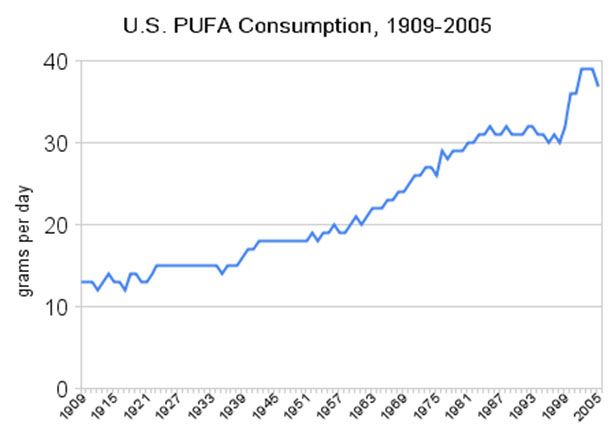
As the chart shows, US PUFA consumption has gone from just over 10 grams in 1909, to almost 40 grams in 2005. The Burr lab did the William Brown experiment in the mid 1930s. At the time, PUFA consumption was around 15 grams per day. Since 6 months on a fat free diet did not produce the skin conditions that is the ONLY symptom of so called "EFA Deficiency," it's reasonable to conclude that Omega 6 and Omega 3 need be no higher than 15 grams per day, meaning the average American could cut out 30 grams of PUFA per day with zero worries about any claimed "deficiency." In fact, since Brown lasted on basically a fat free diet for 6 months and saw improvements, it's fairly safe to conclude that even 15 grams per day is likely too much-
https://www.sciencedirect.com/science/article/abs/pii/S0022316623130215
Effects of Prolonged Use of Extremely Low-Fat Diet on an Adult Human Subject
"The only objective clinical effects of the diet on the adult human subject were a) a gradual loss of body weight during the first 3 months from 69 to 62 kg. and b) a coincident reduction to normal of a slightly elevated arterial blood pressure.
Subjectively the most striking effects were, a) disappearance of a previously experienced feeling of fatigue at the end of the day’s work and b) disappearance of recurrent attacks of migraine-like headache from which the subject had suffered for some years prior to the time of the present experiment."
One last point about the title of this post... The skin's lipid bilayer, and forgive me if I am stating the obvious here, is made out of lipids. As Omega 6 and Omega 3 are lipids, it should come as little surprise that they can be used as building blocks for this bilayer. Other direct building blocks are both the saturated and monounsaturated free fatty acids. In contrast to the title, the more saturated the fats used in this lipid bilayer, the less transepidermal water will be lost, as saturated fats pack together fairly tight and compact. A more unsaturated bilayer has more free space (due to the kinks of the double bonds) and is, as a consequence, more permeable to water and other small molecules.
-
@ZackVegas
Correlation isn't causation. Did you think that in one hundred years the only factor affecting public health is PUFA?This is from the link your provided:
"Decrease in the unsaturated fatty acids as a result of the low-fat regimen indicates the probability that even the normal adult human subject, like the rat, is unable to fabricate the highly unsaturated fatty acids, which should, therefore, be provided in the diet.
In the light of this latter observation, it cannot be assumed that the human subject could subsist indefinitely on a diet completely devoid of the unsaturated fatty acids."I've cited Omega-9 made from de nuovo lipogenesis doesn't build lipid bilayers effectively. Also, research on diets high in saturated fats is that they increase transepidermal water loss (TEWL).
-
@ZackVegas
Correlation isn't causation. Did you think that in one hundred years the only factor affecting public health is PUFA?Of course the increase in PUFA isn't the only factor. There was also a massive spike in iron intake, which is also problematic, for example. There's lots of other things, from drugs to stress to quality of food that go into any long term trend. And high PUFA oils do lead to lower quality foods. Chips fried in beef tallow only have 3 ingredients.... Potatoes, Tallow, and Salt. Chips fried in high PUFA seed oils require a host of preservatives and antioxidants, due to the instability of PUFA, as compared to saturated fats.
Yes, correlation isn't causation, but PUFA is very obviously a key driving factor in the rise of obesity. We know that large amounts of PUFA slow down metabolism, and fatten animals. We know that it takes extra steps to process in Beta Oxidation than Saturated Fats, Monounsaturated Fats, or Trans Fats (that is just textbook biochemistry). We know that Omega 6 is inflammatory. And we have seen that removing PUFA in fat free diets increases metabolism, and can even cause weight loss in humans at what is thought to be a maintenence level of calories.
This is from the link your provided:
"Decrease in the unsaturated fatty acids as a result of the low-fat regimen indicates the probability that even the normal adult human subject, like the rat, is unable to fabricate the highly unsaturated fatty acids, which should, therefore, be provided in the diet.
In the light of this latter observation, it cannot be assumed that the human subject could subsist indefinitely on a diet completely devoid of the unsaturated fatty acids."Yes, it does. But so what? The study itself showed that a human could not just survive, but significantly improve his health on a 6 month diet devoid of unsaturated fats.
The whole idea that something labeled "essential" has to be something that the body can't produce is pretty silly. For example, if blood glucose drops too low, coma and death will be the result. Yet for some reason, glucose isn't considered "essential" because the body can generate it from protein so that coma and death don't result. Again, the only issue ever mentioned from so called "Essential Fatty Acid Deficiency" is skin problems, like scaly tail in rats, or rashes or xerosis in humans.
I've cited Omega-9 made from de nuovo lipogenesis doesn't build lipid bilayers effectively. Also, research on diets high in saturated fats is that they increase transepidermal water loss (TEWL).
Don't know what studies you are referring to here, but often times, those study diets that are 'high" in saturated fat are often higher in PUFA and unsaturated fats in general. If the study used a purified diet with HCO, that would be about the only diet that contains fat with next to no PUFA, and that regiment would have to go a long way to ensure the proper vitamins and minerals that you would get from something like milkfat or beef fat in normally eaten foods.
-
using the chart showing increasing pufa consumption correlated to obesity when the increased pufa consumption is in the form of deep frying with seed oils is disingenious
keep in mind zach is the same guy who said hitler abolished usury which is so wrong especially since pro hitler people also out of the other side of their mouth commend hitler for revitalizing the economy of germany which was accomplished with interest bearing notes to fund manufacturing expansion
alot of people yap just to yap and will just ignore stuff to suit their opinion. and when someone just posts stuff that is wrong and refuses to admit it , it also has me thinking they are again willingly being wrong just to prove they arent wrong somehow.
when i see people with really good skin and physiques and overall aura supporting whole food pufa consumption and i see weirdos with bad physiognomies with anime
girl avatars in the peat o sphere who dont even point out that the articles from rp have bad citations, well, u know, it is pretty easy to decide who is correct -
using the chart showing increasing pufa consumption correlated to obesity when the increased pufa consumption is in the form of deep frying with seed oils is disingenious
The increase in PUFA was driven by seed oils specifically. It's not "disingenuous," it's literarily what happened. While some of that was indeed from deep fried foods, a lot of it was in the form of things like salad dressing, mayo, and replacing things like butter and tallow with canola and soybean oil in regular cooking. And some of it was from a shift in fatty acid composition of livestock fat. Pig fat now has a higher proportion of PUFA than it did in the 1950s, so you are getting more PUFA simply by eating things like bacon or pork shoulder.
Besides, deep frying in and of itself is not unhealthy. French Fries used to made mostly with beef tallow. McDonalds used beef tallow for their fries from when they first started until 1990, when they switched to seed oils. And the PUFA content of those seed oils went up again in the early 2000s, when they stopped using partially hydrogenated oils. Deep frying really only becomes problematic when you start using oils that break down at high heats, and considering the high PUFA seed oils are unstable even at room temperature, this change took deep frying from fairly benign to very problematic..
when i see people with really good skin and physiques and overall aura supporting whole food pufa consumption and i see weirdos with bad physiognomies with anime
What do you mean by "whole food PUFA consumption?" This is a pretty silly statement, because you will be talking about people who eat about 30 grams less PUFA than the average person. As Ray Peat mentioned, PUFA is unavoidable, outside of a lab created diet. Even 8 ounces of Orange Juice has roughly 100mg of PUFA, and the more saturated fats like dairy fat, beef and coconut have about 2-3% of their fat as PUFA. Those who only consume PUFA in "whole foods" are going to be eating at levels closer to those in the early 1900s on the chart, unless they specifically eat nothing but salmon, flax seed, and nuts.
It's true that the vast majority of processed foods today are unhealthy, but that's only because they specifically use toxic ingredients, like high PUFA seed oils, and added iron (aka, ferrous sulfate). If these same foods where made with better ingredients, like beef tallow and coconut oil, they would be more benign, even healthy, and could easily be 20% or less of a healthy diet, that was based around meat, dairy, fruits and such.
By the way, how did you ensure these people only consumed PUFA from whole foods? Did you lock them down in a metabolic ward for a few months? Did you review their cronometer data for the past 5 years? Or, did you just hazard a guess about what they eat?
-
whole food pufa like nuts seeds and avocados (uncooked) are probably healthy in normal amounts in diet
deep frying even with saturated fats is suboptimal imo
-
whole food pufa like nuts seeds and avocados (uncooked) are probably healthy in normal amounts in diet
deep frying even with saturated fats is suboptimal imo
Avocados don't have that much PUFA. An Avocado is about 5 ounces, and that would have about 13 grams of total fat. Of that total fat, only 1.5 grams is PUFA. The majority of Avocado fat is monounsaturated.
Almonds are fairly high in PUFA. 2 ounces of almonds have 29 grams total fat, but only about 6 grams of PUFA. So, in normal amounts, those two examples might contribute 8 grams PUFA to a daily total. If other fats are eaten, they might be getting about 15 grams or so a day, which is close to the 1930 numbers.
I'd agree that deep frying in things like beef tallow is sub optimal, but then again, so are nuts and avocados. But let's be honest.... avocados taste good, and french fries taste gewd. You should get enjoyment out of eating, and if something tastes great, you shouldn't have to avoid it just because it's not optimal. Deep frying in things like Tallow or HCO is benign to slightly healthy, as opposed to deep frying in high PUFA oils, which is certainly unhealthy.


Hello! It looks like you're interested in this conversation, but you don't have an account yet.
Getting fed up of having to scroll through the same posts each visit? When you register for an account, you'll always come back to exactly where you were before, and choose to be notified of new replies (either via email, or push notification). You'll also be able to save bookmarks and upvote posts to show your appreciation to other community members.
With your input, this post could be even better 💗
Register Login