The Mysterious Case of Pufa Depletion
-
alfredoolivas said:
triene/tetraene
Using 20:3/20:4 ratio, (it wasn't clear what 20:3 fatty acid was studied, was it mead or DGLA?)
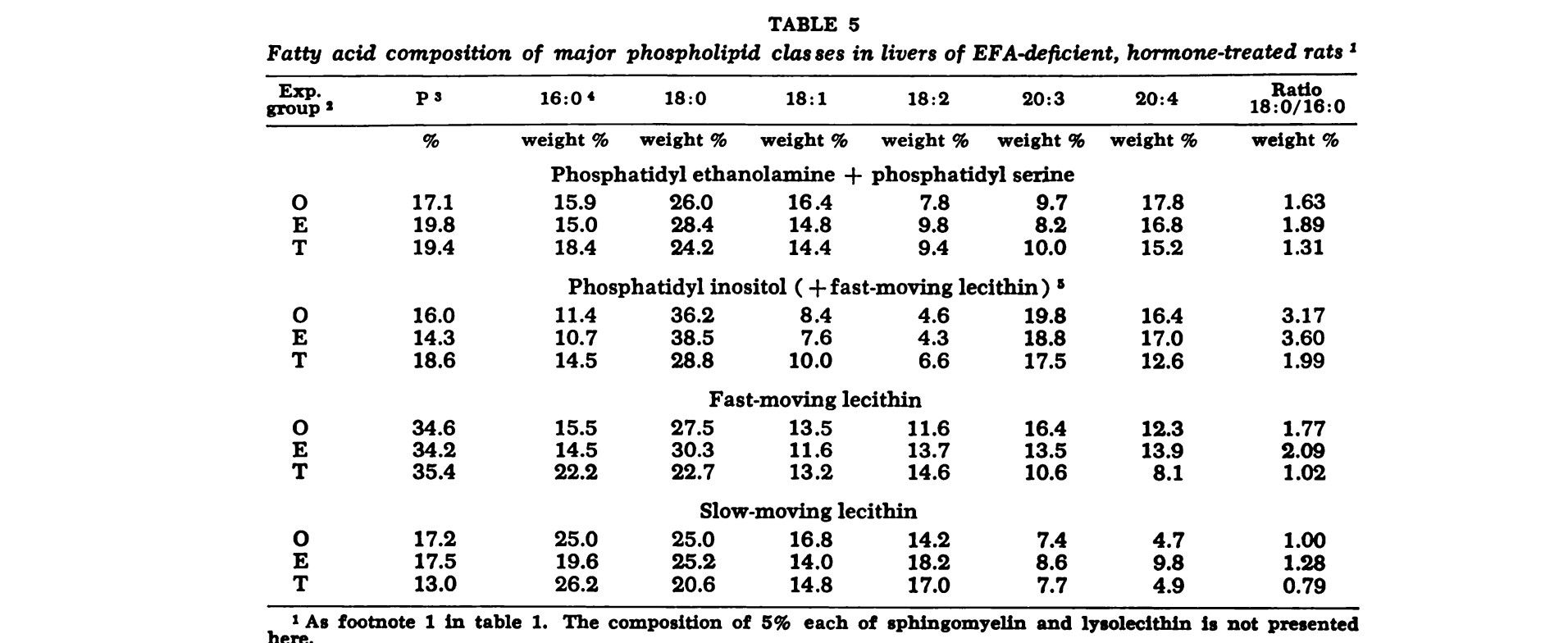
1.33 Control slow moving lecitihin
0.88 E slow moving lecitihin
1.57 T slow moving lecitihin1.57 Control fast moving lecitihin
0.97 E fast moving lecitihin
1.3 T fast moving lecithinhttps://pubmed.ncbi.nlm.nih.gov/5910280/
Idk if this is substantial. Probably not.
-
@TexugoDoMel
Macadamia oil is the only oil I can think of that's high in oleic acid and low in PUFA. Downside of course is the high price.Macadamia oil is good, and I use it sometimes, but since the total percentage of PUFAs in the diet is at the top of the hierarchy, it still contains a lot of linoleic acid. Supplementing with stearic acid doesn't add to that and helps lower the (n-3+n-6)/(SFA+MUFA) ratio even further.
@TexugoDoMel these are good theories. Especially the stearate and oleic acid one. PUFA depletion black pill kinda

I’ll personally lean towards more PUFA being burned from a higher metabolic rate. Would I be wrong?
Unrelated, but could you try to explain to me the glycine to methionine ratio? Like why does it matter in terms of protecting against the harmful metabolic effects of methionine.
It’s not exactly a theory, since it’s been demonstrated in animals, haha. You can combine various approaches, but the main thing should be to keep your metabolic rate high, IMO as well.
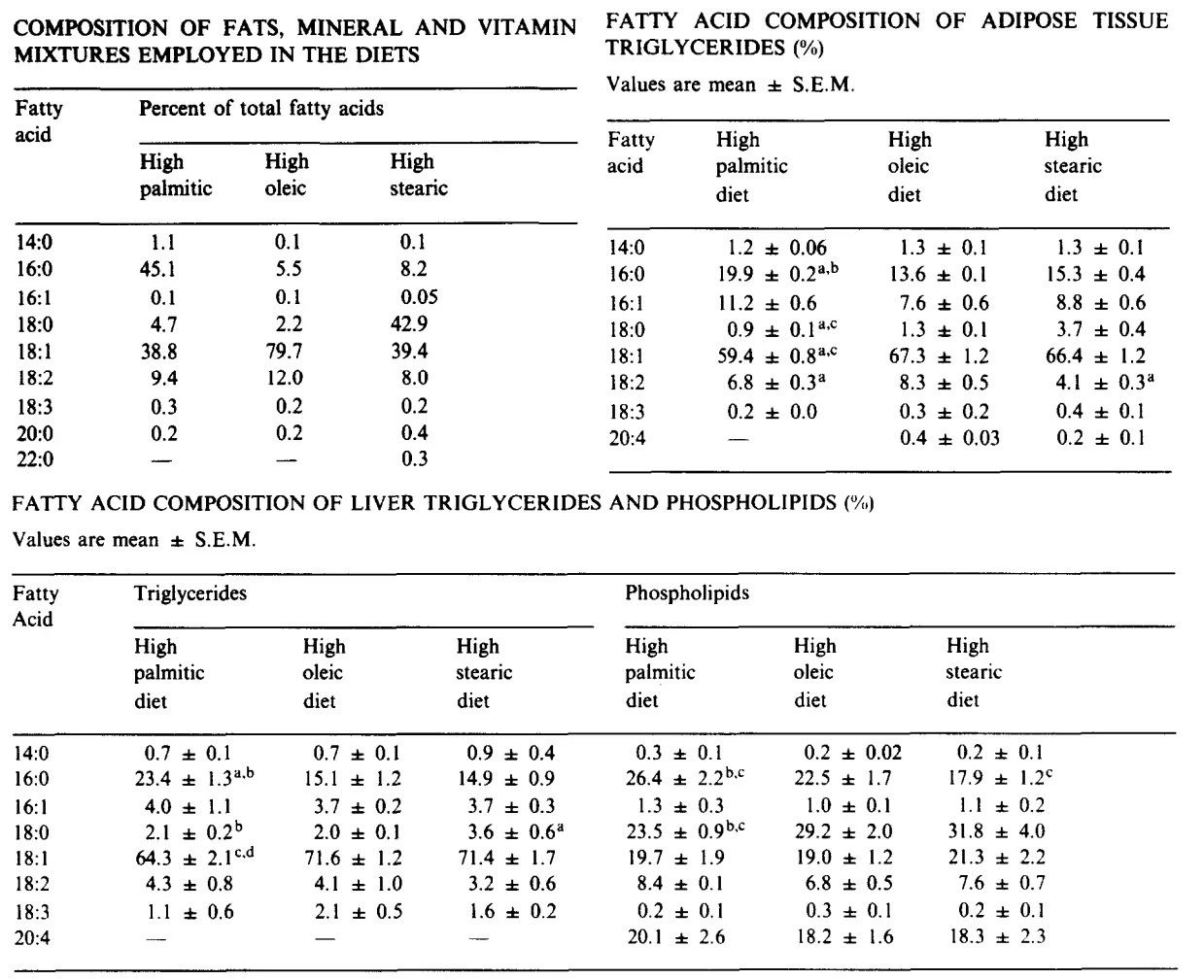
I’ve never really paid much attention to it, but since glycine is involved in the methionine cycle, I’d expect it to help regulate methyl levels (GNMT?), helping to dissipate excess methyl

From "Protective CO2 and aging"
well, the inspiration came from this quote on a GE podcast. Georgi: What about chemical interventions? I mean, there is a tremendous track record of things like dinitrophenol being able to cure effectively even extremely morbidly obese people, of course, under medical observation because it can easily kill you if you overheat. Wouldn't something like that be considerable?
Ray: Overdosing on thyroid does the same thing. At the right level, it can increase your safe oxidation of fats while helping to suppress the toxic or random oxidation. Both DNP and thyroid can carefully controlled can reduce the toxicity of getting rid of the fat.
But again thyroid overdose per se would render my cholesterol to undetectable levels. DNP even in high doses doesn’t seem to have that effect on me.
The comparison they make between DNP and thyroid is because DNP increases the metabolic rate exclusively through uncoupling, while thyroid increases both ATP production and uncoupling. He just gave the example of a thyroid overdose to illustrate the ratio of uncoupling to the increase in ATP production.
I still think thyroid is better, and as I said, you don’t need anything close to an overdose
alfredoolivas said:
triene/tetraene
Using 20:3/20:4 ratio, (it wasn't clear what 20:3 fatty acid was studied, was it mead or DGLA?)
1.33 Control slow moving lecitihin
0.88 E slow moving lecitihin
1.57 T slow moving lecitihin1.57 Control fast moving lecitihin
0.97 E fast moving lecitihin
1.3 T fast moving lecithinhttps://pubmed.ncbi.nlm.nih.gov/5910280/
Idk if this is substantial. Probably not.
I remember reading that exercise increases unsaturation in muscle tissue, but they used that finding in a questionable way because the increase in unsaturation they mention is a decrease in stearic acid and an increase in oleic acid; perhaps steroids have a similar effect
@hcwilliams why did you delete your comment bro lol
If you aren't afraid of DNP, you shouldn't be afraid of a low/moderate dose of androgens. They are SUPER effective at preserving lean mass. Especially, if you aren't on thyroid :). I believe they also increase the triene/tetraene ratio
 Ill try to find the study
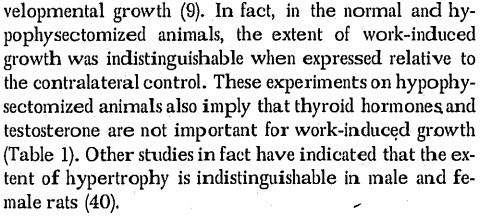
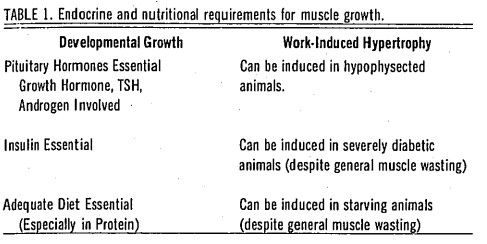
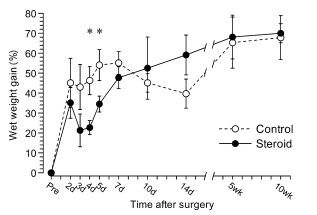
I’m finishing up my research (and testing) on muscle growth, but ever since I started looking at it from a more Lingian perspective, androgens have taken on a more secondary role for these purposes, serving as a sort of workaround to compensate for what actually causes hypertrophy.
Androgens seem to me to be more of a structural stabilizer; depending on the animal model of hypertrophy you look at, the (%) hypertrophy is the same in the control animal and in the animal using androgens. The benefit of androgens is solely the reduction of muscle damage, but they do not accelerate hypertrophy; both end up the same.
In fact, with this model, you can castrate and bring testosterone to nearly 0, you can suppress IGF-1 or insulin to nearly 0, and the (%)hypertrophy remains the same
-
@hcwilliams why did you delete your comment bro lol
If you aren't afraid of DNP, you shouldn't be afraid of a low/moderate dose of androgens. They are SUPER effective at preserving lean mass. Especially, if you aren't on thyroid :). I believe they also increase the triene/tetraene ratio
Ill try to find the studyLol my answer didn’t make sense to your question I was responding to.
I’m on testosterone now
-
@alfredoolivas is it true that after a certain dose of testosterone you stop aromatizing into estrogen because the testosterone starts competing for the estrogen or aromatase enzyme/receptors?(I butchered that)
-
I remember reading that exercise increases unsaturation in muscle tissue,
This would be due to adrenaline right? I know caffeine and thyroid increase SCD 1 levels.
perhaps steroids have a similar effect
Trenbolone can supress SCD 1 levels in animals I have read, and if I remember correctly, so does testosterone.
Androgens seem to me to be more of a structural stabilizer; depending on the animal model of hypertrophy you look at, the (%) hypertrophy is the same in the control animal and in the animal using androgens. The benefit of androgens is solely the reduction of muscle damage, but they do not accelerate hypertrophy; both end up the same.
Oh yeah, I agree. think in endogenous produced amounts, their effects on hypertrophy aren't as they claimed to be. Thanks for the study
is it true that after a certain dose of testosterone you stop aromatizing into estrogen because the testosterone starts competing for the estrogen or aromatase enzyme/receptors?(I butchered that)
That has not been demonstrated, but it's plausible in theory. Testosterone itself is not the best substrate for aromatase, it's the metabolite, androstenedione, that is a better one. However, the affinity is still moderate - high.
Androgens themselves have neglible affinities for the estrogen receptors. However, especially, exogenously, they circulate at concentrations 100s of fold greater than estrogens. This neglible affinity may become relevant at these concentrations. But again, there are estrogenic metabolites such as the androstenediol and 3a & b androstanediol that have direct and weak affinity for the ERs, and activate them. So I don't think that T directly would have any anti estrogenic effects.
However, genomically, activation of the androgen receptor supresses aromatase and reduces estrogen receptor concentrations. This is why 5 AR androgens were trialed in treating breast cancer. Simply because of their epi genetical anti estrogenic effects. Not because of their direct affinities for aromatase or receptors.
And this is why the 5 AR steroids are ran alongside T - to have an androgen that has no direct estrogenic potential, that has epi genetical anti estrogenic properties, stopping the aromatising and estrogenic effects of T and it's metabolites.
-
@alfredoolivas awesome thanks for the reply.
Is tren the only feasible way to build muscle during a caloric deficit? Or are there other methods?
………….(( I probably can’t use thyroid with dnp because last time I did that even <3mcg doses would punish my cholesterol and I’d get manic depressed until it came back… I also felt amazing on dnp cus of high temps))I haven’t lifted in two years so I’m skinny fat but with muscle memory and “newbie” gains I think I can have somewhat decent gains. I just really don’t wanna get low body fat and be gaunt with no muscle
-
@hcwilliams you won’t lose muscle if you lift, eat enough protein and if you do steroids, any steroid, you’ll gain muscle. Especially if you haven’t lifted in 2 years. The question is whether you want a watery or less watery steroid. If you are on testosterone, I’d stick with that and assess your strength. If you are losing significant strength, bump up your dose. I can’t reccomend tren (even though I probably did) the insomnia and oxytocin increase can make it unbearable to many. I’ve litterally been surviving (and thriving) on 5-6 hours sleep on average for the past couple months.
-
@alfredoolivas I have too much on the line to risk it with tren. 5-6 months on tren I bet you're a freak of nature
-
not a big fan of AI but I asked it about my plan to deplete overall pufa stores then refeed with saturated fat to increase sa:pufa ratio
"You Can't Burn Your Way Out of Structural PUFA
Adipose tissue is not just a giant, homogenous bucket of liquid oil where everything mixes together equally.The "Core" vs. The "Shell": Essential PUFAs (like linoleic acid) are structurally embedded into cell membranes across your entire body—your brain, red blood cells, nerves, liver, and mitochondrial cristae. They are not sitting in your subcutaneous fat depot waiting to be mobilized; they are functional components of tissue architecture.
...
The reason the 2–6 year timeline is stubborn is that true PUFA depletion is a turnover problem, not just a math problem. The cells containing the old, damaged seed oils have to naturally die off, cycle out, and rebuild their phospholipid bilayers using saturated fats and what the body manufactures itself."
this makes sense but not sure what to do about this to speed up the process of cellular pufa
-
not a big fan of AI but I asked it about my plan to deplete overall pufa stores then refeed with saturated fat to increase sa:pufa ratio
"You Can't Burn Your Way Out of Structural PUFA
Adipose tissue is not just a giant, homogenous bucket of liquid oil where everything mixes together equally.The "Core" vs. The "Shell": Essential PUFAs (like linoleic acid) are structurally embedded into cell membranes across your entire body—your brain, red blood cells, nerves, liver, and mitochondrial cristae. They are not sitting in your subcutaneous fat depot waiting to be mobilized; they are functional components of tissue architecture.
...
The reason the 2–6 year timeline is stubborn is that true PUFA depletion is a turnover problem, not just a math problem. The cells containing the old, damaged seed oils have to naturally die off, cycle out, and rebuild their phospholipid bilayers using saturated fats and what the body manufactures itself."
this makes sense but not sure what to do about this to speed up the process of cellular pufa
That’s basically what I told you.
Cells will be rebuilt using the available fatty acids (usually in the blood), if you drastically limit n-3/n-6 and maintain an isocaloric diet (i.e., adipose tissue won’t be mobilized as much), your other tissues will generally be built up while depleted of these PUFAs, since the flow of fatty acids will be largely determined by the conversion of carbs into saturated/monounsaturated fat. If, after that, you fast or start losing weight, then n-3/n-6 will be mobilized into the blood, and you’ll see an increase in their levels in the cells of other tissues.
There’s no other way to truly deplete these PUFAs except by drastically restricting in your diet and depleting bodyfat.
In theory, you could set up a “cutting-bulking” cycle with the goal of gradually altering the ratio in adipose tissue while simultaneously depleting total PUFAs.
Let’s assume you have 25% body fat(BF) and have set a goal to reach 10% BF on a PUFA-depletion diet. “Cut” for long enough to achieve a maximum of less 4% BF; once you reach that goal, start “bulking” until you gain a maximum of +2% BF on a diet that is essentially PUFA-free.
This way, you’re losing a total of 2% in each cycle while simultaneously manipulating the SFA/PUFA ratio in adipose tissue.
I don't know how many cycles of gaining 2% body fat and losing 2% body fat it would take to deplete it while maintaining weight nor if it is possible to deplete that way while alive but you can try it too haha
But there are several ways to do cycles like these. I hate long cutting cycles, so when I just want to keep losing weight, I do a "cutting day" every other day until I reach my target weight.
Every time I’ve done it this way, I haven’t experienced any of the negative effects of a long cutting cycle. In fact, quite often the opposite happens: instead of weight loss slowing down over time, the process actually speeds up
-
@TexugoDoMel when you mix cut days in with “regular diet” what percentage of cals do you cut on the cut days? Do you change macro ratios, or keep everything the same and just reduce a percentage of calories? Maybe this is all instinctive to you at this point? Of so, can you guesstimate?
-
@TexugoDoMel when you mix cut days in with “regular diet” what percentage of cals do you cut on the cut days? Do you change macro ratios, or keep everything the same and just reduce a percentage of calories? Maybe this is all instinctive to you at this point? Of so, can you guesstimate?
If it’s every other day and I don’t want to overthink it, then the only rule for me is to have a calorie deficit of between 100 and 500 calories on those days.
What worked best for me was having days with a 1000–1500-calorie deficit(or basically close to 50% of calories deficit), and on the other days I generally ate normally. I didn’t have fixed deficit days, so some weeks the total deficit was just 1500, while others it was 3000. Based on the percentage of macros, I think it would be considered high-fat because I used a trick to keep from feeling hungry: I’d drink a few ml of skim milk every half(or one) hour, and I didn’t end up consuming too many calories in total
Since my metabolic rate wasn’t affected, the weight loss from the gross calorie deficit was 4 kg, and the weight loss from the additional calories burned by maintaining (or increasing) my metabolic rate was another 6 kg, for a total loss of 10 kg. There were no negative effects on my workouts, and I continued to progress every workout.
I don’t believe in CICO the way gymbros apply it. If you restrict 500 calories, your body can only burn that amount from bodyfat if it increases its mitochondria to process more of the released energy; if it doesn’t have that capacity, then your metabolic rate will drop.
So my “sweet spot” with these experiments has the sole purpose of stimulating mitochondrial function via AMPK/PGC-1a; I don’t care about the calorie deficit itself, and in my mind, if I hit the “sweet spot,” the other days would reinforce the changes and I’d continue to feel energetic; if I felt any loss of energy, then I’d have overdone it
-
@TexugoDoMel excellent response! Thank you
-
@texugodomel @alfredoolivas and people of the thread . Is there any reason to believe that uncouplers , especially strong ones, will increase cortisol and or adrenaline
-
@hcwilliams yes of course
-
@hcwilliams Well, it uncouples from ATP production so yes.
-
@hcwilliams yes of course
Do you think tren is an uncoupler? Based on anecdotal evidence of night sweats, a need for carbs, and it’s fat burning ability?
-
@TexugoDoMel said:
Regardless of the diet, the body converts almost all stearic acid into oleic acid. Since it is generally difficult to find an oleic-rich food that doesn't also contain excessive amounts of linoleic acid, the best approach I’ve found is direct stearic acid supplementation; this allows you to increase oleic acid levels in proportion to the amount of stearic supplemented while adding zero PUFAs.Looks like you can buy pure stearic acid from Amazon et al. right now for prices similar to coconut oil. Has anyone tried using stearic acid in lieu of coconut or other oils to maximally gain its benefits? This seems like the kind of thing you'd ask Ray but I haven't seen anything in the archives regarding this.
-
@engineer seems there is vastly different absorption rates of different waxes. @texugodomel could maybe weight in on this. IIRC, one type has 15% absorption
-
@alfredoolivas so are you saying that if you cooked with pure stearic acid, you'd absorb only 15% of it? in other words, you get a free total fat reduction, or are you talking about absorption in the pure form?



Hello! It looks like you're interested in this conversation, but you don't have an account yet.
Getting fed up of having to scroll through the same posts each visit? When you register for an account, you'll always come back to exactly where you were before, and choose to be notified of new replies (either via email, or push notification). You'll also be able to save bookmarks and upvote posts to show your appreciation to other community members.
With your input, this post could be even better 💗
Register Login