The Mysterious Case of Pufa Depletion
-
I’ve been trying to solve my own internal dilemma.
So as far as modern science is aware, PUFA depletion for anyone is going to require 2-6 years of limiting it in diet. (Probably closer to 4-6 years, but I’ve seen some Ray quotes that include “2”, as I’m sure it relates to how quick your metabolic rate is).
I haven’t found anything that suggests that a drug might saturate your unsaturated fatty stores (which would be groundbreaking)
If you go on to bioenergetic.life and search “DNP” or Dinitrophenol , you will get a clip of Ray talking about how a high dose of thyroid or DNP will result in rapid weight loss while also burning the PUFA stores extremely quickly, meaning that either high dose thyroid or DNP is actually very protective in weight loss, as it doesn’t give pufa the chance to spontaneously convert to toxic aldehydes or disturb mitochondrial function, etc…
So in theory, COULD someone take either drug and diet down to a very low body fat, then eat regularly again ensuring all fat intake is saturated, and therefore dilute the PUFA in their stores? … which would be a HELL of a lot quicker than waiting 6 years?
Or is it the unfortunate case that no matter what you do, at the end of the day, it’s not total pufa stores that matters, it’s the actual percentage of PUFA you have in your stores , which cannot be lowered without low lypolysis and high albumin? Or will DNP dilute that percentage anyway? (Pufa gets preferentially stored so when burning fat the saturated fat gets burned and pufa stayed in the tissues)
Anyone have any intelligent thoughts about this? No dumbass answers like “dnp will kill you!!!!!”
-
I’ve been trying to solve my own internal dilemma.
So as far as modern science is aware, PUFA depletion for anyone is going to require 2-6 years of limiting it in diet. (Probably closer to 4-6 years, but I’ve seen some Ray quotes that include “2”, as I’m sure it relates to how quick your metabolic rate is).
I haven’t found anything that suggests that a drug might saturate your unsaturated fatty stores (which would be groundbreaking)
If you go on to bioenergetic.life and search “DNP” or Dinitrophenol , you will get a clip of Ray talking about how a high dose of thyroid or DNP will result in rapid weight loss while also burning the PUFA stores extremely quickly, meaning that either high dose thyroid or DNP is actually very protective in weight loss, as it doesn’t give pufa the chance to spontaneously convert to toxic aldehydes or disturb mitochondrial function, etc…
So in theory, COULD someone take either drug and diet down to a very low body fat, then eat regularly again ensuring all fat intake is saturated, and therefore dilute the PUFA in their stores? … which would be a HELL of a lot quicker than waiting 6 years?
Or is it the unfortunate case that no matter what you do, at the end of the day, it’s not total pufa stores that matters, it’s the actual percentage of PUFA you have in your stores , which cannot be lowered without low lypolysis and high albumin? Or will DNP dilute that percentage anyway? (Pufa gets preferentially stored so when burning fat the saturated fat gets burned and pufa stayed in the tissues)
Anyone have any intelligent thoughts about this? No dumbass answers like “dnp will kill you!!!!!”
Yo,
https://lowtoxinforum.com/threads/pufa-depletion-can-probably-be-accomplished-in-30-days.4954/
-
@user1 It’s common knowledge now that that study is misleading . The diet those monkeys were eating lowered lipolysis so it’s no wonder PUFA was measured low
One meal with pufa in it brought their levels back to pre study levels
-
@user1 It’s common knowledge now that that study is misleading . The diet those monkeys were eating lowered lipolysis so it’s no wonder PUFA was measured low
One meal with pufa in it brought their levels back to pre study levels
How does lowering lipolysis to the point where pufa % of total fat in many tissues reaching 5% not good or doesnt match the goal of depleting pufa reserves in tissues?
And what does one high pufa meal increasing pufa % on tissues shows?
-
@user1 It’s common knowledge now that that study is misleading . The diet those monkeys were eating lowered lipolysis so it’s no wonder PUFA was measured low
One meal with pufa in it brought their levels back to pre study levels
How does lowering lipolysis to the point where pufa % of total fat in many tissues reaching 5% not good or doesnt match the goal of depleting pufa reserves in tissues?
And what does one high pufa meal increasing pufa % on tissues shows?
Because it’s not depleting it from the tissues. The blood serum was measured which reflected no detectable pufa. If the monkeys had been tested in a fasted state the PUFA would have been reflected normally. It’s like an OmegaQuant fatty acid composition test, when people want to test how much linoleic acid they have in their tissues, they get tested in a fasted state so that the FFA that are released reflect the % of different types of fat stored in the tissues
I don’t understand your second point
-
@user1 It’s common knowledge now that that study is misleading . The diet those monkeys were eating lowered lipolysis so it’s no wonder PUFA was measured low
One meal with pufa in it brought their levels back to pre study levels
How does lowering lipolysis to the point where pufa % of total fat in many tissues reaching 5% not good or doesnt match the goal of depleting pufa reserves in tissues?
And what does one high pufa meal increasing pufa % on tissues shows?
Because it’s not depleting it from the tissues. The blood serum was measured which reflected no detectable pufa. If the monkeys had been tested in a fasted state the PUFA would have been reflected normally. It’s like an OmegaQuant fatty acid composition test, when people want to test how much linoleic acid they have in their tissues, they get tested in a fasted state so that the FFA that are released reflect the % of different types of fat stored in the tissues
I don’t understand your second point
In fact, anyone who follows a fat-free or very low-fat diet can deplete n-3 and n-6 fatty acids from most tissues in a very short time, not because lipolysis is inhibited, but rather because increased lipogenesis dilutes the circulation of PUFAs; most tissues use fatty acids from the blood to maintain their membranes
The only exceptions, where depletion does not occur rapidly even on a fat-free diet, are the brain and eyes for n-3, and adipose tissue for n-6. In the case of monkeys, they have little adipose tissue, but in humans, you can only achieve depletion (rather than dilution due to lipogenesis) if you lose adipose tissue.
If a low-fat diet increases the insulin sensitivity of tissues, and you’ve adapted properly, it’s actually a low-insulin diet, so it doesn’t have this effect of inhibiting lipolysis.
-
@user1 It’s common knowledge now that that study is misleading . The diet those monkeys were eating lowered lipolysis so it’s no wonder PUFA was measured low
One meal with pufa in it brought their levels back to pre study levels
How does lowering lipolysis to the point where pufa % of total fat in many tissues reaching 5% not good or doesnt match the goal of depleting pufa reserves in tissues?
And what does one high pufa meal increasing pufa % on tissues shows?
Because it’s not depleting it from the tissues. The blood serum was measured which reflected no detectable pufa. If the monkeys had been tested in a fasted state the PUFA would have been reflected normally. It’s like an OmegaQuant fatty acid composition test, when people want to test how much linoleic acid they have in their tissues, they get tested in a fasted state so that the FFA that are released reflect the % of different types of fat stored in the tissues
I don’t understand your second point
In fact, anyone who follows a fat-free or very low-fat diet can deplete n-3 and n-6 fatty acids from most tissues in a very short time, not because lipolysis is inhibited, but rather because increased lipogenesis dilutes the circulation of PUFAs; most tissues use fatty acids from the blood to maintain their membranes
The only exceptions, where depletion does not occur rapidly even on a fat-free diet, are the brain and eyes for n-3, and adipose tissue for n-6. In the case of monkeys, they have little adipose tissue, but in humans, you can only achieve depletion (rather than dilution due to lipogenesis) if you lose adipose tissue.
If a low-fat diet increases the insulin sensitivity of tissues, and you’ve adapted properly, it’s actually a low-insulin diet, so it doesn’t have this effect of inhibiting lipolysis.
Is there any supporting evidence for these claims? If by lipogensis you mean the creation of saturated fat from glucose then yes of course this can greatly help dilute stored PUFA, ray veven recommended this. But despite it, it still takes years to achieve dilution from what I understand . It’s also a small amount and not significant.
Insulin sensitivity also equally relates to how much insulin is needed to lower lipolysis to execute glucose oxidation so I disagree with your second point
-
@user1 It’s common knowledge now that that study is misleading . The diet those monkeys were eating lowered lipolysis so it’s no wonder PUFA was measured low
One meal with pufa in it brought their levels back to pre study levels
How does lowering lipolysis to the point where pufa % of total fat in many tissues reaching 5% not good or doesnt match the goal of depleting pufa reserves in tissues?
And what does one high pufa meal increasing pufa % on tissues shows?
Because it’s not depleting it from the tissues. The blood serum was measured which reflected no detectable pufa. If the monkeys had been tested in a fasted state the PUFA would have been reflected normally. It’s like an OmegaQuant fatty acid composition test, when people want to test how much linoleic acid they have in their tissues, they get tested in a fasted state so that the FFA that are released reflect the % of different types of fat stored in the tissues
I don’t understand your second point
In fact, anyone who follows a fat-free or very low-fat diet can deplete n-3 and n-6 fatty acids from most tissues in a very short time, not because lipolysis is inhibited, but rather because increased lipogenesis dilutes the circulation of PUFAs; most tissues use fatty acids from the blood to maintain their membranes
The only exceptions, where depletion does not occur rapidly even on a fat-free diet, are the brain and eyes for n-3, and adipose tissue for n-6. In the case of monkeys, they have little adipose tissue, but in humans, you can only achieve depletion (rather than dilution due to lipogenesis) if you lose adipose tissue.
If a low-fat diet increases the insulin sensitivity of tissues, and you’ve adapted properly, it’s actually a low-insulin diet, so it doesn’t have this effect of inhibiting lipolysis.
Is there any supporting evidence for these claims? If by lipogensis you mean the creation of saturated fat from glucose then yes of course this can greatly help dilute stored PUFA, ray veven recommended this. But despite it, it still takes years to achieve dilution from what I understand . It’s also a small amount and not significant.
Insulin sensitivity also equally relates to how much insulin is needed to lower lipolysis to execute glucose oxidation so I disagree with your second point
When I said “dilution,” I meant in the blood. If you exceed your body’s capacity to oxidize carbs and store them as glycogen, the carbs have no other way to be eliminated (except sometimes through urine) and are necessarily converted into saturated or monounsaturated fat in the liver and transported through the blood. Any HCLF/fat-free diet first creates a blood profile that is “EFA-depleted,” and then the tissues gradually rebuild their membranes using what comes from the blood.
You can actually observe this in this study of monkeys undergoing depletion over 30 days: depletion occurs first in the blood, and then to varying degrees in other tissues, and the same is true for replenishment.
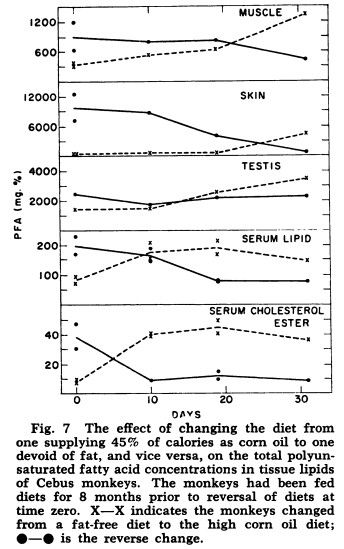
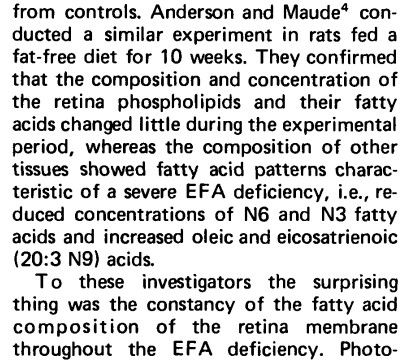
As for the brain and eyes, a fat-free diet in rats is not capable of depleting omega-3s, even after several generations. And here we’re talking about an animal with a high metabolic rate that literally begins to waste away due to the higher metabolic rate caused by EFA depletion.

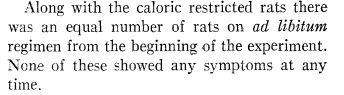
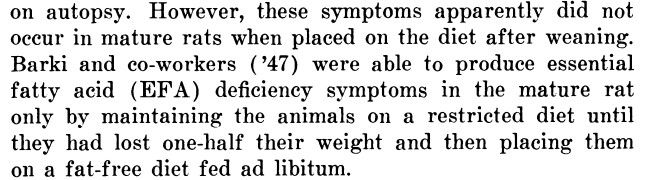
As for adipose tissue, in most fat-free studies it isn’t a variable because the experiments are conducted on young, growing rats, since growth retardation is one of the symptoms; so when you try to deplete PUFAs in an adult rat, they can remain on a fat-free diet for almost their entire lives, and as long as they don’t lose adipose tissue, they won’t have any problems.
If you want them to show symptoms, you must first deplete their adipose tissue before placing them on a fat-free ad libitum diet.
If insulin blocking lipolysis is the reason, someone on a fat-free diet would quickly develop symptoms similar to those seen with intravenous or parenteral nutrition; however, this is not the case, at least according to the only human study involving a nearly fat-free diet for 6 months
Effects of Prolonged Use of Extremely Low-Fat Diet on an Adult Human SubjectIf you're maintaining your weight (or losing weight) on a fat-free diet, insulin isn't even close to being the cause IMO.
-
@TexugoDoMel oh yes I completely agree with your first point
Someone placed on a HCLF diet might experience similar effects as someone who is pufa depleted. The pufa is safer stored away, however you have to be meticulous a stay on top of it before the 4-6 year mark where stress no longer triggers a cascade of negative effects from pufa release.
My theory is that if someone used high dose thyroid or DNP to oxidize the stored pufa quickly while keeping the electrons flowing extremely quick (to prevent inflammation) , one could get their overall PUFA stores quite low. To do such a thing , at some point you’d reach an extremely low body fat. After doing so, you can refeed with saturated fats as your only fat source, thus adding more fat to your frame and tissues , whilst keeping PUFA stores the same . I.e, diluting the % of stored pufa
Because to my knowledge , it isn’t the overall amount of pufa that causes problem but it’s the percentage of SA:PUFA that causes issues
-
@TexugoDoMel I see your point about lipogenisis aiding in PUFA depletion, however, what do you think about Brad Marshall's theory of lipogenisis stealing oxygen, if you have formed any opinion on it? If he is right it would mean that the process of depletion of PUFA via a fat free diet, would slow down the metabolic rate via this mechanism (until a PUFA depleted is reached)
It seems reasonable to me and I struggle with the idea that lipogenisis is a good thing given how it is upregulated in many diseased states, but the latter point isn't entirely relevant.
-
@TexugoDoMel oh yes I completely agree with your first point
Someone placed on a HCLF diet might experience similar effects as someone who is pufa depleted. The pufa is safer stored away, however you have to be meticulous a stay on top of it before the 4-6 year mark where stress no longer triggers a cascade of negative effects from pufa release.
My theory is that if someone used high dose thyroid or DNP to oxidize the stored pufa quickly while keeping the electrons flowing extremely quick (to prevent inflammation) , one could get their overall PUFA stores quite low. To do such a thing , at some point you’d reach an extremely low body fat. After doing so, you can refeed with saturated fats as your only fat source, thus adding more fat to your frame and tissues , whilst keeping PUFA stores the same . I.e, diluting the % of stored pufa
Because to my knowledge , it isn’t the overall amount of pufa that causes problem but it’s the percentage of SA:PUFA that causes issues
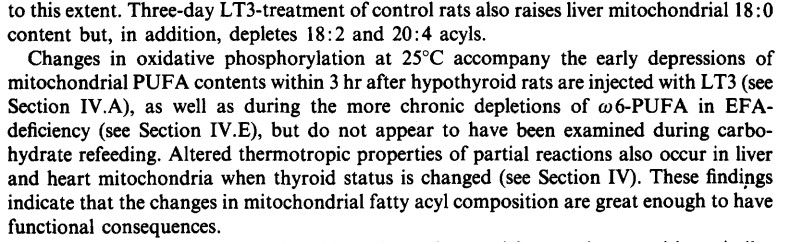
In fact, there is a theory held by some that the effects of thyroid hormone on metabolic rate are largely caused by the shift in the saturation-to-unsaturation ratio that it induces.
It would be interesting to use thyroid hormone in a weight-loss diet where omega-6 fatty acids account for no more than 0.5% of total calories.
@TexugoDoMel I see your point about lipogenisis aiding in PUFA depletion, however, what do you think about Brad Marshall's theory of lipogenisis stealing oxygen, if you have formed any opinion on it? If he is right it would mean that the process of depletion of PUFA via a fat free diet, would slow down the metabolic rate via this mechanism (until a PUFA depleted is reached)
It seems reasonable to me and I struggle with the idea that lipogenisis is a good thing given how it is upregulated in many diseased states, but the latter point isn't entirely relevant.
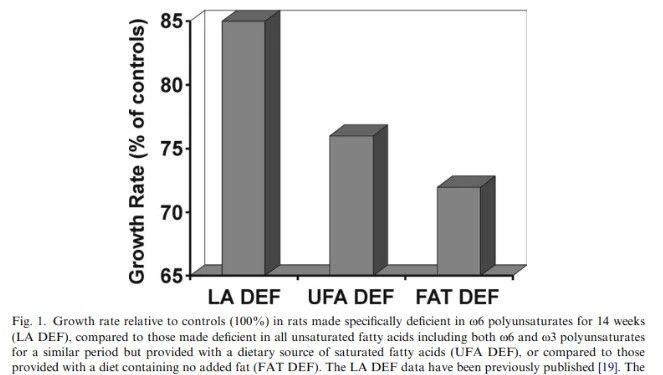
I’m not familiar with his theory on lipogenesis; I know he has one involving desaturases "stealing" oxygen as well, keeping the metabolic rate high "unnecessarily."
This happens with EFAD animals; you can lower the metabolic rate somewhat by directly adding saturated and/or monounsaturated fat, which is far less costly than, in a fat-free diet, having to take carbs, convert them into palmitic acid, elongate, and desaturate it once, twice, or three times...
I consider lipogenesis, in response to a high-carb diet, to be a natural dissipation response. Regarding increased lipogenesis in other situations, I have my own theories:
- The need for unsaturation, as in the case of cancer, in which lipogenesis is increased to provide raw material for desaturases. Something similar happens with PUFA depletion; I’ve even written about it here
- It doesn’t make sense to me that someone with excess PUFAs in their tissues would have high lipogenesis and desaturase activity. I believe that in these cases of PUFA excess, the increase in lipogenesis and desaturase activity serves as a saturating mechanism, since MUFAs have only one double bond and compete directly with PUFAs in cell membranes. Replacing two or more double bonds with one would reduce unsaturation
-
@TexugoDoMel oh yes I completely agree with your first point
Someone placed on a HCLF diet might experience similar effects as someone who is pufa depleted. The pufa is safer stored away, however you have to be meticulous a stay on top of it before the 4-6 year mark where stress no longer triggers a cascade of negative effects from pufa release.
My theory is that if someone used high dose thyroid or DNP to oxidize the stored pufa quickly while keeping the electrons flowing extremely quick (to prevent inflammation) , one could get their overall PUFA stores quite low. To do such a thing , at some point you’d reach an extremely low body fat. After doing so, you can refeed with saturated fats as your only fat source, thus adding more fat to your frame and tissues , whilst keeping PUFA stores the same . I.e, diluting the % of stored pufa
Because to my knowledge , it isn’t the overall amount of pufa that causes problem but it’s the percentage of SA:PUFA that causes issues
In fact, there is a theory held by some that the effects of thyroid hormone on metabolic rate are largely caused by the shift in the saturation-to-unsaturation ratio that it induces.
It would be interesting to use thyroid hormone in a weight-loss diet where omega-6 fatty acids account for no more than 0.5% of total calories.
@TexugoDoMel I see your point about lipogenisis aiding in PUFA depletion, however, what do you think about Brad Marshall's theory of lipogenisis stealing oxygen, if you have formed any opinion on it? If he is right it would mean that the process of depletion of PUFA via a fat free diet, would slow down the metabolic rate via this mechanism (until a PUFA depleted is reached)
It seems reasonable to me and I struggle with the idea that lipogenisis is a good thing given how it is upregulated in many diseased states, but the latter point isn't entirely relevant.
I’m not familiar with his theory on lipogenesis; I know he has one involving desaturases "stealing" oxygen as well, keeping the metabolic rate high "unnecessarily."
This happens with EFAD animals; you can lower the metabolic rate somewhat by directly adding saturated and/or monounsaturated fat, which is far less costly than, in a fat-free diet, having to take carbs, convert them into palmitic acid, elongate, and desaturate it once, twice, or three times...
I consider lipogenesis, in response to a high-carb diet, to be a natural dissipation response. Regarding increased lipogenesis in other situations, I have my own theories:
- The need for unsaturation, as in the case of cancer, in which lipogenesis is increased to provide raw material for desaturases. Something similar happens with PUFA depletion; I’ve even written about it here
- It doesn’t make sense to me that someone with excess PUFAs in their tissues would have high lipogenesis and desaturase activity. I believe that in these cases of PUFA excess, the increase in lipogenesis and desaturase activity serves as a saturating mechanism, since MUFAs have only one double bond and compete directly with PUFAs in cell membranes. Replacing two or more double bonds with one would reduce unsaturation
My original question still stands. Is it unreasonable to believe that cutting down to a very low body fat (via dnp or high dose thyroid) thus resulting in low overall pufa shortage, then refeeding with high saturated fat , cause a dilution of PUFA and essentially resulting in a % of PUFA in the tissues )only normally achievable after 2-6 years of slow detoxification) even achievable ??
-
@TexugoDoMel thank you!
So: fat free diet = oversaturation
Oversaturation = higher SCD 1
Higher scd 1 = more oleic acid
Higher oleic acid = more expression of the elongase and desaturase enzymesMore activity of these enzymes means more LA metabolism, depleting it further.
Cells maintain correct levels of desaturation in the process
Is what I am understanding, your argument ?
-
@TexugoDoMel oh yes I completely agree with your first point
Someone placed on a HCLF diet might experience similar effects as someone who is pufa depleted. The pufa is safer stored away, however you have to be meticulous a stay on top of it before the 4-6 year mark where stress no longer triggers a cascade of negative effects from pufa release.
My theory is that if someone used high dose thyroid or DNP to oxidize the stored pufa quickly while keeping the electrons flowing extremely quick (to prevent inflammation) , one could get their overall PUFA stores quite low. To do such a thing , at some point you’d reach an extremely low body fat. After doing so, you can refeed with saturated fats as your only fat source, thus adding more fat to your frame and tissues , whilst keeping PUFA stores the same . I.e, diluting the % of stored pufa
Because to my knowledge , it isn’t the overall amount of pufa that causes problem but it’s the percentage of SA:PUFA that causes issues
In fact, there is a theory held by some that the effects of thyroid hormone on metabolic rate are largely caused by the shift in the saturation-to-unsaturation ratio that it induces.
It would be interesting to use thyroid hormone in a weight-loss diet where omega-6 fatty acids account for no more than 0.5% of total calories.
@TexugoDoMel I see your point about lipogenisis aiding in PUFA depletion, however, what do you think about Brad Marshall's theory of lipogenisis stealing oxygen, if you have formed any opinion on it? If he is right it would mean that the process of depletion of PUFA via a fat free diet, would slow down the metabolic rate via this mechanism (until a PUFA depleted is reached)
It seems reasonable to me and I struggle with the idea that lipogenisis is a good thing given how it is upregulated in many diseased states, but the latter point isn't entirely relevant.
I’m not familiar with his theory on lipogenesis; I know he has one involving desaturases "stealing" oxygen as well, keeping the metabolic rate high "unnecessarily."
This happens with EFAD animals; you can lower the metabolic rate somewhat by directly adding saturated and/or monounsaturated fat, which is far less costly than, in a fat-free diet, having to take carbs, convert them into palmitic acid, elongate, and desaturate it once, twice, or three times...
I consider lipogenesis, in response to a high-carb diet, to be a natural dissipation response. Regarding increased lipogenesis in other situations, I have my own theories:
- The need for unsaturation, as in the case of cancer, in which lipogenesis is increased to provide raw material for desaturases. Something similar happens with PUFA depletion; I’ve even written about it here
- It doesn’t make sense to me that someone with excess PUFAs in their tissues would have high lipogenesis and desaturase activity. I believe that in these cases of PUFA excess, the increase in lipogenesis and desaturase activity serves as a saturating mechanism, since MUFAs have only one double bond and compete directly with PUFAs in cell membranes. Replacing two or more double bonds with one would reduce unsaturation
My original question still stands. Is it unreasonable to believe that cutting down to a very low body fat (via dnp or high dose thyroid) thus resulting in low overall pufa shortage, then refeeding with high saturated fat , cause a dilution of PUFA and essentially resulting in a % of PUFA in the tissues )only normally achievable after 2-6 years of slow detoxification) even achievable ??
It is not unreasonable, and I think is achievable. If you're not close to 10% bodyfat I actually don't believe in slow depletion not even in a lifetime.
@TexugoDoMel thank you!
So: fat free diet = oversaturation
Oversaturation = higher SCD 1
Higher scd 1 = more oleic acid
Higher oleic acid = more expression of the elongase and desaturase enzymesMore activity of these enzymes means more LA metabolism, depleting it further.
Cells maintain correct levels of desaturation in the process
Is what I am understanding, your argument ?
Basically, yeah!
I think "more expression of the elongase and desaturase enzymes" happens already with oversaturation triggering SCD1.
You can even see this effect in the livers of rats in a fat-free refeed
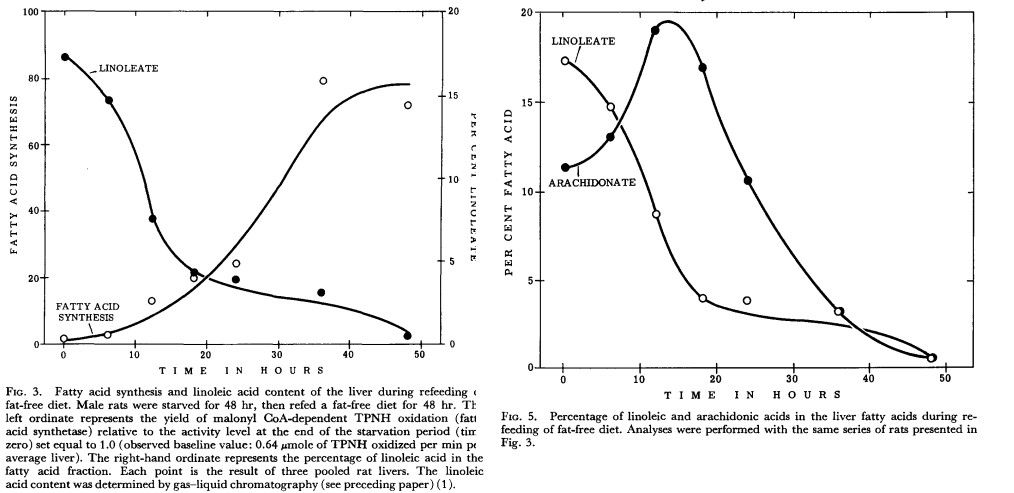
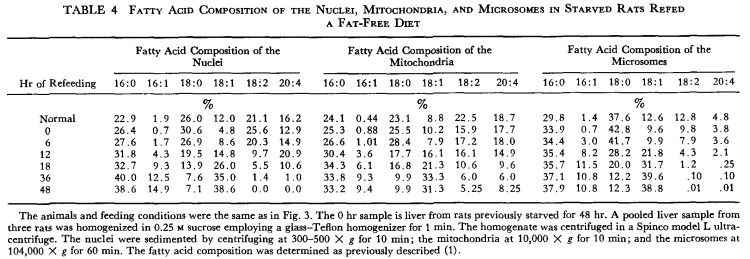
The greater the lipogenic capacity, the greater the effect; therefore, the liver will always show a discrepancy compared to other organs with low lipogenic capacity
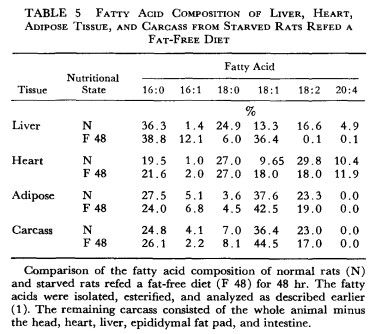
Wrote a little bit about these effects on desaturase here
-
@TexugoDoMel Thank you.
Now I have a slightly different question. Is there a benefit to mead acid itself? Or is it simply a fatty acid / biomarker that strongly suggests a linoleic acid depleted organism?
-
@TexugoDoMel Thank you.
Now I have a slightly different question. Is there a benefit to mead acid itself? Or is it simply a fatty acid / biomarker that strongly suggests a linoleic acid depleted organism?
Since it hasn’t been studied much, it’s hard to know everything about it, but it’s just as (or more) anti-inflammatory than omega-3, with the added benefit of having 3 double bonds compared to EPA’s 5 and DHA’s 6. IMO phospholipase/COX and leukotriene inhibitors are basically partially mimicking the effects that Mead Acid would have in full.

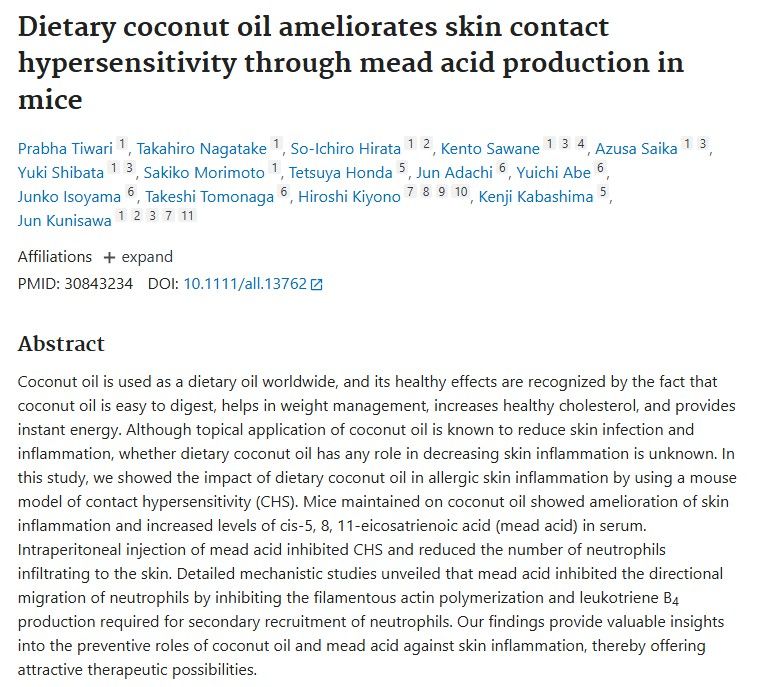
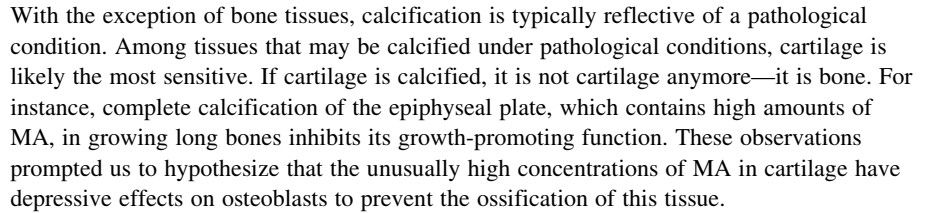
There are other benefits as well: cartilage is rich in Mead Acid, and it appears that its depletion is one of the causes of cartilage degeneration; there’s even a theory that the depletion of Mead Acid is what causes bones to stop growing
-
@TexugoDoMel thanks for your answer. I wonder why you say that about pufa depletion not being possible if not a low BF. I want to gather as much info as possible because I’m essentially a diabetic from years of pufa consumption and stress (I have bloodwork)
I’m going to attempt the DNP while taking things that keep ETC flowing / other things , diet down to <10% bf then refeed with saturated fat. If my theory is correct , my metabolism should greatly improve and respond better to thyroid
-
@TexugoDoMel Very interesting stuff thanks. Other omega 9s are created too right? I imagine those are even more understudied.
-
@TexugoDoMel thanks for your answer. I wonder why you say that about pufa depletion not being possible if not a low BF. I want to gather as much info as possible because I’m essentially a diabetic from years of pufa consumption and stress (I have bloodwork)
I’m going to attempt the DNP while taking things that keep ETC flowing / other things , diet down to <10% bf then refeed with saturated fat. If my theory is correct , my metabolism should greatly improve and respond better to thyroid
Adipose tissue seems to be able to store PUFAs for long periods—far longer than 2–6 years, even in a fat-free diet(based on animal studies). I still think it’s possible to deplete it in one year (depending on the case) by losing weight—down to about 10% body fat—on a diet low in PUFAs; IMO thyroid would be better than DNP for this purpose.
@TexugoDoMel Very interesting stuff thanks. Other omega 9s are created too right? I imagine those are even more understudied.
Omega-9 fatty acids are simply the ones most commonly known, but several endogenous PUFAs are produced. These include omega-5s, omega-7s, and even some that can’t be classified in this way
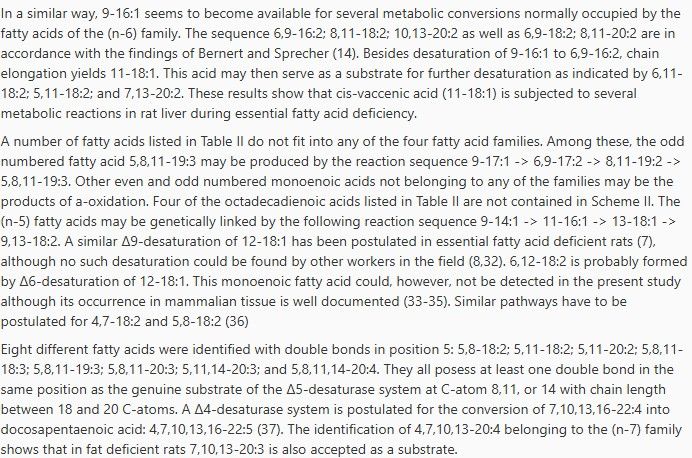
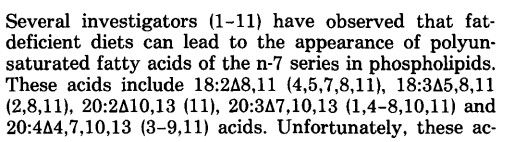
Some can even be used to produce prostaglandins isomers

-
@TexugoDoMel unfortunately I can’t use thyroid here as an uncoupler, it would destroy my cholesterol.
If I understand correctly, the 2-6 year turnover applies to those who go the “safe” route: supporting the metabolism and keeping stress low while lowering pufas. The one year or less route goes for those who choose to literally burn the pufas off, which can be done safely with uncouplers. I understand pufas are preferentially released during stress so it should be easy to accomplish, as long as uncouplers are used. I wonder if it’s possible to get to 2% within a year .
Any holes in my argument?
2.) Do you think omega quant tests are accurate for testing for fat unsaturation?
3.) I don’t mean to bug ya
 but one last thing. Any general recommendations for speeding up the process? Would you recommend keeping a low fat approach? Or eating something like cocoa butter throughout ? Or low protein? I’ve seen some other posts you’ve made and commented on and you seem to be just as curious of this as I am. I want to guinea pig this
4.) anything to protect me other than Vitamin E?


Hello! It looks like you're interested in this conversation, but you don't have an account yet.
Getting fed up of having to scroll through the same posts each visit? When you register for an account, you'll always come back to exactly where you were before, and choose to be notified of new replies (either via email, or push notification). You'll also be able to save bookmarks and upvote posts to show your appreciation to other community members.
With your input, this post could be even better 💗
Register Login