Silicon type and efficiency
-
Silicon type and efficiency
The human body's assimilation of silica depends on a critical physical factor: the size of the molecule. And, of course, on the stabilization of the molecule within the final product to prevent polymerization or crystallization. Not all forms of silicon are created equal:
Orthosilicic acid (OSA) acts as a true biological switch when it reaches cells through its active form: OSA.
Recent scientific discoveries reveal its ability to effectively influence the PI3K/Akt/mTOR signaling pathway—the cellular pathway that controls the growth, proliferation, and survival of our cells.
From the strength of our bones to the speed of wound healing, and including the protection of our neurons and arteries, OSA exerts overall protective effects. People above 45 years old are often deficient. It’s a fact. And I wouldn't rely on food for an adequate intake, given that the richest plants (horsetail, bamboo, and nettle) provide only 1% to 4% of assimilable silicon. (1)
*) The ideal form: pure MMST. 64% bioavailability (1)
To cross the intestinal barrier and enter the bloodstream, silicon must be in its simplest form: orthosilicic acid (OSA).
This is a so-called "monomeric" form (a single unit).
It is water-soluble and tiny in size, allowing it to pass through cell membranes via diffusion.
Thanks to its specific carbon-silicon bond, this molecule remains perfectly stable; this stability, combined with its small size, allows it to pass through the intestine unimpeded and diffuse throughout the body.
*) The polymerization phenomenon
Silicon is inherently chemically unstable. Once its concentration exceeds a certain threshold (approximately 100 to 120 mg/L, depending on pH—though some laboratories are developing stabilizers to achieve higher limits, up to a maximum of 1200 mg/L), orthosilicic acid molecules tend to bind with one another.
*) Silicon extracted from plants (primarily horsetail, nettle, or bamboo)
The plant extracts silicon (Si) from the soil, assimilates it, and forms a silicate or crystal—essentially a silicon salt. This is also referred to as colloidal or mineral silica. When extracted directly from the plant, silica tends to polymerize (clump together). Consequently, it is unstable and poorly assimilated (1–4%). Chemical formula: SiO2 (silicon dioxide).
Silicon serves as a structural pillar for the plant. Think of the reed that bends but does not break.
The plant transforms this silicon into a genuine microscopic exoskeleton (in the leaves and stems). It hardens cell walls, keeps leaves upright, and creates a physical barrier, helping to protect the plant against diseases and pests. It is not, however, the plant's only form of protection.
*) Orthosilicic acid (OSA)
Orthosilicic acid is a form of silicon that is more soluble than plant-derived silica. It is the form produced or assimilated by the human body. Formula: Si(OH)3CH3.
However, OSA is an unstable molecule in aqueous solution—it tends to polymerize spontaneously. That is why manufacturers often have to encapsulate or stabilize it using additives…
*) Diluted or blended monomethylsilanetriol (MMST)
MMST is the synthesized form of "organic silicon," as opposed to colloidal silicon. MMST is the form authorized by the European Commission for use as a food supplement. It is the only form shown in studies to have a bioavailability exceeding 60%. It is therefore sold in a diluted form (combined with collagen, choline, or maltodextrin, for example). Some manufacturers also add ingredients intended to help with osteoarthritis (such as Harpagophytum) or to optimize effects on hair and nails (such as aloe vera). That is certainly a valid option, provided it is taken as a course of treatment...
*) Pure MMST at maximum stable concentration
This is the most effective and rarest form. A single active ingredient: pure Monomethylsilanetriol—undiluted, unmixed, and without additives used to mask low concentration. Formula: Si(OH)4. -
Tests or studies on the bioavailability of MMST converted to OSA
Here is a summary of recent studies (post-2015) regarding the bioavailability and metabolism of monomethylsilanetriol (MMST) and its conversion into orthosilicic acid (OSA).
Figure: Silicon absorption rates by source
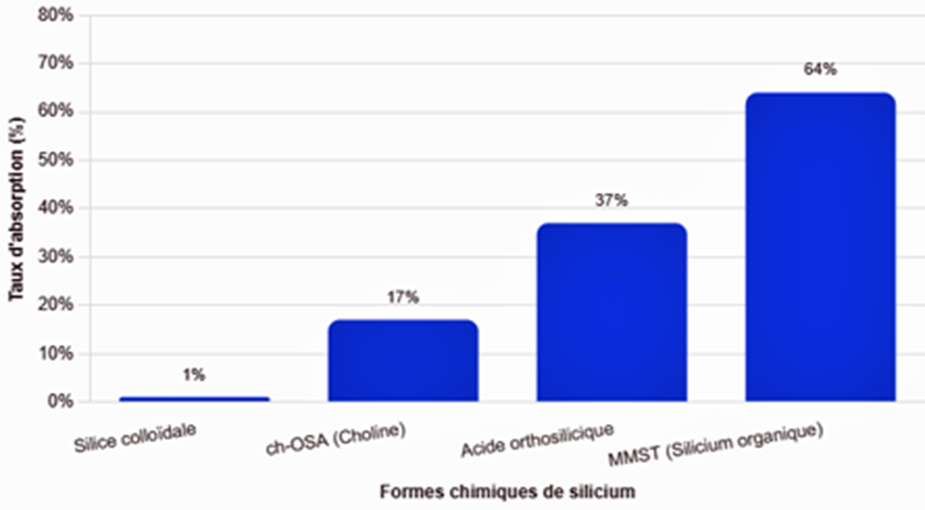
NB: In general, ch-OSA or MMMST is preferred.
To be continued on this link, my forum, in French (translator required):
https://mirzoune-ciboulette.forumactif.org/t2193-le-silicium-biodisponibilite-et-formes-de-supplementation#30767
Comparative test (selection):- Category 1: Pure MMST. 64% bioavailability
3.45 mg Si per 30 ml advised. Silicon actually assimilated by the body (64%): ~2.21 mg per dose
=> G5 siliplant España liquid 1 L / G5 LLR Ireland liquide 0.5 or 1 L / Living Silica Dr. Mercola.
10 mg / caps. 60x. - Category 2: Ch-OSA (choline to avoid polymerization)
6 mg Si per dose advised. Silicon actually assimilated by the body (17% bioavailable): ~1.02 mg per dose.
=> Europe Market: Vit’All+ 25 mg Silice organique (micro-algue) / Onatera (prêle & bambou 100 mg).
=> US market: XYMOGEN RegeneMax Liquid / Natural Factors Collagen Generator Drops.
- Category 1: Pure MMST. 64% bioavailability
-
Sources and Main References
- Bioavailability and pharmacokinetic studies (MMST)
a) Pritchard et al. (2017) – "The comparative absorption of silicon from different sources"
- Context: A study comparing MMST with other forms, such as ch-OSA and colloidal silicates.
- Results: This study confirms that MMST exhibits the highest bioavailability among the supplements tested (approximately 64%). It highlights that the small size of the molecule (monomer) prevents polymerization within the intestinal lumen, unlike stabilized forms, which tend to aggregate.
b) Jugdaohsingh et al. (2016) – "Monomethylsilanetriol (MMST) is a safe and highly bioavailable source of silicon for human consumption"
- Details: This pharmacokinetic study measured urinary excretion to validate absorption.
- Data: It demonstrates that MMST is rapidly converted into orthosilicic acid (OSA) in the bloodstream. Approximately 40% of the ingested dose is recovered in the urine as inorganic silicon (OSA), proving its efficient metabolism.
- Local concentration of OSA → polymerization if size or concentration is high → random membrane crossing → impact on the actual degree of absorption.
https://mirzoune-ciboulette.forumactif.org/t2194-le-silicium-peut-se-polymeriser-et-cristalliser#30774
- The ideal form: Orthosilicic acid (H4SiO4)
- The phenomenon of polymerization
- Why is plant-based silica (nettle, bamboo) less assimilable?
- Product examples
Pure MMST
OSA-HC (stabilized with collagen)
-
there are studies showing urinary excretion increases alot with certain foods. bananas are high but not high excretion. green beans are high and high excretion.


Hello! It looks like you're interested in this conversation, but you don't have an account yet.
Getting fed up of having to scroll through the same posts each visit? When you register for an account, you'll always come back to exactly where you were before, and choose to be notified of new replies (either via email, or push notification). You'll also be able to save bookmarks and upvote posts to show your appreciation to other community members.
With your input, this post could be even better 💗
Register Login