I have trouble sleeping
-
@lykos said in I have trouble sleeping:
might be deficient in certain b vitamins.
Nutrients to extract energy in the form of electrons in the transport chain
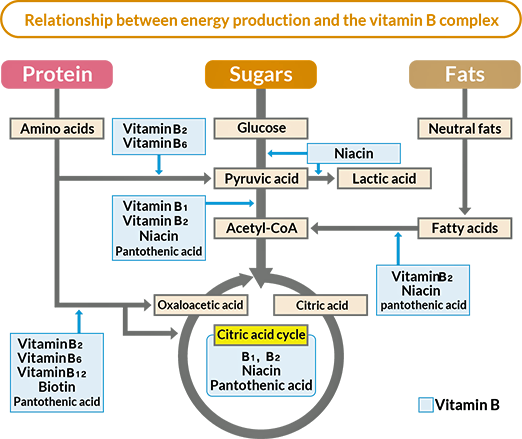
Energy metabolism in two steps
Step 1 is the catabolic breakdown of carbs, fat, and protein to extract energy in the form of electrons.
Step 2 is the translation of that energy into ATP using oxygen.
Step three: Energy production
Finally, the electrons of NADH and FADH2 are transferred to the electron transport chain (step 3), where they provide energy used to generate ATP molecules; this step needs the input of vitamins B2, B3, B5 and of iron.
Source: https://pmc.ncbi.nlm.nih.gov/articles/PMC7019700/*) Energy and nutrients needed for metabolism
- Carbs => Pyruvic acid => Acetyl CoA: Mg, B1 B2 (FAD) B3 (NAD) + B5
Required nutrients to extract energy in the form of electrons (electrons in the transport chain) (= oxidative phosphorylation => oxidation-reduction reactions are vital for ATP synthesis) - Acetyl CoA => Citric Acid Circle (Krebs circle): B1, B2 (FAD), B3 (NAD), Mg, Mn, Fe, GSH + B5
*) Proportion of B-vitamins
Good B-complex vitamin preparations contain:- the same amount of vitamins B1, B2, and B6.
- at least 4 times more vitamin B3
- at least 2 times more vitamin B5
Source: Zoelho.com Pharma-Dr.
- Carbs => Pyruvic acid => Acetyl CoA: Mg, B1 B2 (FAD) B3 (NAD) + B5
-
*) Proportion of B-vitamins
Good B-complex vitamin preparations contain:- the same amount of vitamins B1, B2, and B6.
- at least 4 times more vitamin B3
- at least 2 times more vitamin B5
Hey i believe bs work in synergy with each other if u supplement b1 u need b2 b3, thats why i only use a b complex for b vitamins, if we were to use 4x time of b3 at 100mg of b1 that would cause histamine issues and peat said you shouldn't use more that 100mg of b3 in a single use, i think thorne makes the best methylated b complex outthere, even using 100mg of p5p a day would causes issues soon enough, peat rightfully said u should not use more than 10mg a day especially the active form, i dont know where u found those proportions from but they make no sense. How does bcomplex cause cell growth cancer btw is it the methylated b12 and methyfolate?
-
@lykos said in I have trouble sleeping:
i dont know where u found those proportions from but they make no sense.
- I gave the source for the proportions (a pharma-doctor) and for the required nutrients for the assimalitation of macronutrients (link of the study), with a focus on energy. Not only.
- The proportions are given for RDA doses.
Of course if you take +/ 100 mg B1, you aren’t going to do the same (x100) with other B-vitamins.
However, taking HD B1 is going to “burn” more B2, for example. - As you showed a lot of sympathy in your last message, I’m not going to search for the study where I read it to be cautious when taking B1 between 12 and 92 mg (cell growth).

-
@LucH 100mg a day is more than safe, hell even haidut managed to reverse mice tumors based on peats recommendations of using b1, dont think it causes cancer if anything deficiency of b1 causes cancer and most people today are deficient of it because of excessive sugar consumption and lack of nutrients associated with modern diets.
-
@lykos
Haidut is not the new messy (interaction not taken into account; limited target of the study).
Even if I appreciate him much. Great work.
Now, you’d better read again what I said:
The preceding graph was there for general purpose (other readers too).
So I repeat:
B1 should be taken as a RDA (1.2 mg) or above 92 mg. So, 100 mg B1 HCl is fine every day if you metabolize well (listen to your feeling). Not a B50 every day. Otherwise it stimulate cell growth (cancer). See beneath for sources.
NB: RDA + 0.5 mg per 1000 K/cal.Graph with useful nutrients in Krebs cycle.
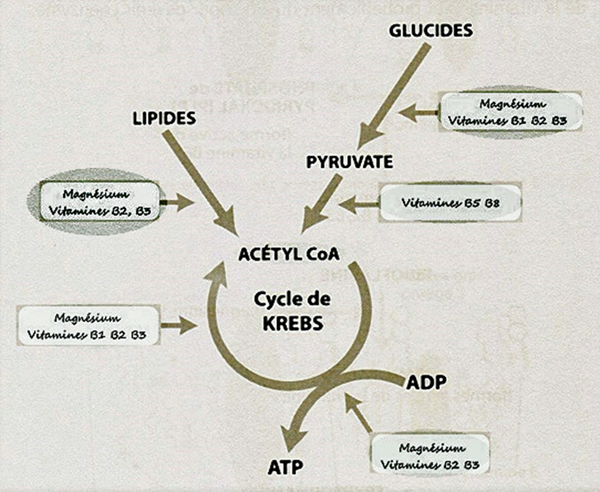
Note: We often lack B1 (refined carbs in pasta, rice and cereals), magnesium (not brought enough by food) and B6 (low-grade inflammation exhaust it). And we haven’t even talk about other possible highjacks.
For instance we haven't even considered B3 burners to produce tryptophan in patients undergoing a prolonged course of natural orange juice, milk and bone broth for collagen intake.
Considering there is a narrow interaction between B1 B2 B3 and biotin to burn carbs. Not only. But I try to limit the comment.In the context of an "exhausted" patient or someone with borderline mental health issues, here is the metabolic logic for the B3 dosage:
The "Sparing" Dose: 50–100 mg.If a patient is taking 100 mg of B1 but no other B-vitamins, they are pushing the Pyruvate Dehydrogenase (PDH) complex hard to burn through the sugar in a HD orange juice.
• The Problem: HD B1 increases the demand for its "teammate" B3 (NAD+). If the patient isn't supplementing B3, the body will prioritize energy production over everything else.The Tryptophan Drain: To get the needed B3, the liver will aggressively convert Tryptophan to Niacin at a terrible 60:1 ratio, as mentioned in most studies.
• The Minimum Fix: Research suggests that just 50–100 mg of Niacinamide (B3) is usually enough to provide the "pre-formed" niacin the cycle needs. This "shuts off" the body's emergency need to cannibalize Tryptophan, effectively "sparing" it for the brain to use for Serotonin.Why 100 mg B1 alone is risky (without appropriate cofactors)
If you're already doing 100mg of B1 to handle the carbs, you're creating a bottleneck. Without at least 50-100mg of B3 (Niacinamide), the B1 just forces the body to hijack Tryptophan to keep the lights on. You end up 'curing' your metabolism but crashing your serotonin and spiking neurotoxic byproducts like Quinolinic acid. It’s a bad trade for anyone with a sensitive nervous system.Why B2 is part of the "Safety Net"
B2 is technically required to recycle B3. If you are low on B2, your B3 levels will drop faster, which then triggers the Tryptophan-drain you are trying to avoid. Interaction when one is missing.
Not required to take B2 every day. The "Protective" Dose: 5–10 mg of B2 every other day (half-life longer). A B-50 complex 2-3x weekly is usually sufficient too.
Now I could go on with B6, how much is required, why, with someone dealing with low-grade inflammation (arthrosis) or border-line (brain mood). Not all in once.
=> A clue: B6 is the final "key" that turns Tryptophan into Serotonin. Only B6 PLP. Mind excess B6 (with staple, if not 20-25 mg/d.).Sources and references
*) Linking vitamin B1 with cancer cell metabolism (2 examples)
"In 2001, Comin-Anduix et al. evaluated the effect of increasing thiamine supplementation in multiples of the RDI on an Ehrlich ascites tumor-mouse model [58]. Their findings indicated a statistically significant stimulatory effect of thiamine supplementation on tumor growth compared to non-supplemented controls. Moderate doses of 12.5 to 37.5 times the RDI had the greatest stimulatory effect, peaking at approximately 250% greater tumor cell proliferation with 25 times the RDI. Interestingly, at values above 75 times the RDI, no change was found in tumor cell proliferation, and a slight decrease was found at 2,500 times the RDI. This observation suggests that there is a specific range in which thiamine supports proliferation. "
https://cancerandmetabolism.biomedcentral.com/articles/10.1186/2049-3002-1-16
& Thiamine and cancer
RDI for adults: "The RDI of thiamine for adults 18 and older is 1.2 mg/d for men and 1.1 mg/d for women. "
Summary (LucH):75 x the RDI: 75 x 1.2 mg = 90 mg minimum B1.
Link of the study.
https://link.springer.com/article/10.1186/2049-3002-1-16*) Thiamine analogues and angiogenesis
The dichotomous effect of thiamine supplementation on cancer cell growth is characterized by growth stimulation at low doses and growth suppression at high doses. Unfortunately, how thiamine reduces cancer cell proliferation is currently unknown.
Source: National Institutes of Health (NIH)
High Dose Vitamin B1 Reduces Proliferation in Cancer Cell Lines Analogous to Dichloroacetate
doi: 10.1007/s00280-014-2386-z 2014. Cancer Chemother Pharmacol.
Conclusion
Our findings suggest that high dose thiamine reduces cancer cell proliferation by a mechanism similar to that described for dichloroacetate (Inhibition of PDKs – Pyruvate Dehydrogenase Kinases).LucH
My website: Chez Mirzoune et Ciboulette -
@lykos said in I have trouble sleeping:
could diet alone suffice
@lykos said in I have trouble sleeping:
dont think it causes cancer
@lykos said in I have trouble sleeping:
I have trouble sleeping
You'll fix it.
-
@LucH i know most of this, where is the study that proves b complex causes cancer?
-
@lykos said in I have trouble sleeping:
where is the study that proves b complex causes cancer?
It's not the b-complex in itself; It's B1 in a B-50 complex taken on a usual way.
Link above. Only one link given. Not the right amount 50 mg B1.
Less than 12 mg or more than 90 mg.
100 mg B1 is fine if ...
So a dichotomous side effect (depending on the posology). (2 different effects). -
@LucH the b1 in thorne b complex is 100mg should be fine, btw i never seen b1 lower than 100mg in either b complex or isolated, smaller doses are usually added to cereals and processed fortified foods
-
@lykos said in I have trouble sleeping:
btw i never seen b1 lower than 100mg in either b complex or isolated
Make a search with B-50 complex and you'll see a lot. When people are searching simply for a B complex co-enzymated, they are faced with RDA or a B-50. On iherb.com or amazon.com
https://www.google.com/search?client=opera&q=B-50+complex+iherb.com&sourceid=opera&ie=UTF-8&oe=UTF-8
Note I don't like searching on amazon site because what you see in the search engine is not always what uou'll see at last. False link. Except for a specific well targeted product, ti's OK then, most of the time.LucH
My website: Chez Mirzoune et Ciboulette -
@LucH what do u think of my current diet for mthfr chicken breast, bacon, eggs, 2x times a week lentils, raw cheese 500g a week,raw honey, whole milk 2 glasses a day, potatoes boiled with the skin removed, i really like beef and i ate half a kilo of it a day before but it causes me issues. Am i missing anything, cant eat histamine foods and most fruits especially citrus fruits because of histamine, i eat raw honey for carbs and potatoes, milk.
-
@LucH you helped me with some questions i had, thanks
-
I didn’t intend to give a follow up about menus (coaching).
It takes time and energy.
Moreover you don’t read well what has been mentioned, and probably the links about histamine. Supposition. Why? => No feedback.
Moreover, I see you’ve have a tendency to argue / talk. Not a problem if you don’t agree or if you don’t follow the advice. You’re free to do so but I want transparency. Say it when you disagree.
But remind you can’t always perceive why I propose sth …
I’m rather directive in my attitude, a bit sharp for some people. 48 Hours delay is common before an answer.
You said:
“what do u think of my current diet for chicken breast, bacon, eggs, 2x times a week lentils, raw cheese 500g a week,raw honey, whole milk 2 glasses a day, potatoes boiled with the skin removed, i really like beef and i ate half a kilo of it a day before but it causes me issues. Am i missing anything, cant eat histamine foods and most fruits especially citrus fruits because of histamine, i eat raw honey for carbs and potatoes, milk”.
Comment:
I need a menu on 3 usual days. No need to give the weight or a detailed quantity, but I have to see the proportions with the macronutrients, the way you cook (fried, boiled), the nature (raw or smoked).
Separate the facts from the comments (2 parts). It takes time. Use a docx to organize them.
E.g. Breakfast with a medium banana, 1 cup full fat milk (240 ml) and 4 big tbsp oat flakes (brand mark), + pecan nuts 6 halves.
Not like this: banana + oat and milk with pecan nuts.
NB: I gave links to get informed on histamine: Why and which food. Go back and study them. I want a feedback. I want to see you do your homework … (humor).
Hope it can help.
Thanks for the last comment.
NB: 2 questions per post, except the first post. -
@LucH I know well which foods are high histamine or histamine liberators. Current diet is the same everyday on average. I know dates have histamine i eat a few of them because they are a guilty pleasure.
Breakfast: 1 glass of full fat pasteurized milk, 4 eggs slightly fried with butter, bacon.
Lunch: grilled chicken with fresh cheeses not aged, potatoes boiled without skin to avoid oxalates, raw honey
Dinner: milk, dates, raw honey, cheese again.Day 2
Breakfast: 4 fried eggs, fried bacon, milkLunch chicken,potatoes, bounty, potatoes cooked in the oven, cheese, raw honey.
Dinner: milk, dates, cottage cheese
Day 3
Breakfast 4 eggs, bacon , milk
Lunch : lentils left to bloom in water for one hour and then boiled fried onions and potatoes boiled, raw honey
dinner: milk, dates, chicken, cheese ,honeySupplements taken daily atm: thorn b basic 1 pill a day, magnesium glycinate 300mg
I will soon add betain once a day and maybe copper glycinate 2mg for dao support. -
@lykos Apart from potatoes (which have very little due to being skinned and boiled), you lack vitamin C
-
@alfredoolivas i might supplement acerola powder, citrus fruits are histamine liberators, i used to squiz a lot of fresh orange juice until i had to stop, synthetic vitamin d and c lowers ceruloplasmin
-
@lykos, meat/seafood, eggs and dairy are excellent sources of vitamin C (dehydroascorbate). Here are some quotes from Ray on the subject:
“Patrick Timpone: So, do you and do you recommend other people take daily doses of extra vitamin C?
Ray Peat: No, because milk and meat are very good sources. I experimented stopping all the known sources such as fruits, vitamin C and ate mostly milk and meat and eggs. And several weeks later, I kept testing my urine vitamin C output and it was still up in around 3000 milligrams per day even though I was just eating milk and meat.”
https://bioenergetic.life/clips/2dd91?t=2875&c=63
“But milk, for example, and meat is a major source of vitamin C that the explorers found that they didn't have to take lemons or canned fruit with them when they were spending months in the Arctic. If they ate meat, because meat, they proved that meat was a very good source of vitamin C. It turns out that all animal tissues contain lots of vitamin C, but they were simply not measuring the right material. Vitamin C, the reductant, is not the biologically effective intracellular vitamin C. The dehydroascorbate functions as an oxidant, not an antioxidant, in our cells.”
https://bioenergetic.life/clips/ddca1?t=5404&c=105
“So the whole misinterpretation of where we're getting our vitamin C was confused because it's really turning into dehydroascorbate in the body anyway, and that's what we're getting in things like meat, eggs, and milk.”
https://bioenergetic.life/clips/fcf1d?t=1430&c=28
“But if you eat fruits and vegetables and meats, eggs, fish, milk, all of those provide adequate vitamin C, but they don't show up in the chemical tests that people use because they were looking for a reductant form of vitamin C, which is what we have inside the cells. So if you eat meat, the meat has oxidant vitamin C in it which can interchange when we eat it and show up as the reductant form and back into the dehydrated form.”
https://bioenergetic.life/clips/3cd0d?t=546&c=11
“Inside the cell, about a ratio of eight to one of the vitamin C isn't in the form of ascorbic acid at all. The cell turns it into dehydroascorbate. About 80 or 85% of the vitamin C in our bodies doesn't show up in a test. It gives people the impression that meat and seafood and some plants don't contain any vitamin C when it's actually there in the form of dehydroascorbate. Dehydroascorbate works like oxygen to protect against the excess electrons.“
https://bioenergetic.life/clips/b936b?t=3191&c=62
“Once it gets into the cells, about 80% of vitamin C is in the form of dehydroascorbate. And that means that eating meat, the animal's vitamin C that it makes is in all of its tissues, including the muscles, and at least 70 to 85% of it will be in the invisible oxidized form, DHA. And so when you're eating meat, you're taking in lots of vitamin C. And still, the official Department of Agriculture charts don't show any vitamin C content for meat.”
https://bioenergetic.life/clips/bfd2a?t=5464&c=109
“In meat, it's almost all, ten times more vitamin C is present in the form of dehydroascorbate, a fully oxidized form of the molecule rather than ascorbic acid. So the tests simply are blind to the amount of vitamin C in our diet because they think it should be in the reducing antioxidant form, but it functions in the cell as an oxidant protecting against oxidative damage by maintaining normal oxidation, which is the flow of electrons all the way down to oxygen.”
https://bioenergetic.life/clips/f8666?t=1047&c=19
“So I stopped taking it (vitamin C supplement). And after I hadn't taken it for a while, I wondered how much vitamin C I must be putting out in my urine every day. And just on an ordinary diet at that time, including bread and potatoes and things that you don't think of as having any vitamin C, I was still putting out 3,000 milligrams a day consistently. And that got me interested in where the vitamin C was coming from. It turns out that meat, for example, is extremely rich in dehydroascorbic acid, dehydroascorbate. And that is not measured.”
-
@Jennifer did he specify which meat and what cuts, i read before about milk being good source of it
-
@lykos said in I have trouble sleeping:
i might supplement acerola powder
I won't do that. In short: not stable and altered. Explanation later.
-
@lykos, in the quote about the Arctic explorers, Ray said “all animal tissues contain lots of vitamin C” so I take that to mean all species and cuts of meat. In Weston A Price’s book Nutrition & Physical Degeneration, he writes about his visit with the North American Indians and how an old Indian explained that when they kill a moose, each family member gets a piece of its adrenal glands and that they also eat the walls of the second stomach, which Price goes on to say prevents scurvy and that modern science had discovered that the adrenal glands are the richest sources of vitamin C, but going by what Ray said they likely weren’t measuring dehydroascorbate.
For reference:
https://archive.org/details/NutritionAndPhysicalDegeneration/page/n63/mode/2up




Hello! It looks like you're interested in this conversation, but you don't have an account yet.
Getting fed up of having to scroll through the same posts each visit? When you register for an account, you'll always come back to exactly where you were before, and choose to be notified of new replies (either via email, or push notification). You'll also be able to save bookmarks and upvote posts to show your appreciation to other community members.
With your input, this post could be even better 💗
Register Login