Energy Protocol when suffering from a metabolic block
-
Energy Protocol when suffering from a metabolic block
I often read about forum members struggling with drive and body temperature, even though their TSH levels are within the normal range (0.5–3 µIU/mL)—and this despite taking 100 mg (and later 500 mg) of vitamin B1 HCl, magnesium, and so on.
Let’s set the thyroid aside for a moment; stimulating the thyroid won’t work if the body lacks the capacity to fuel itself or metabolize properly. That isn’t the place to start. To put it simply: you wouldn’t put the same type of fuel in a Formula 1 engine as you would in a 4-stroke lawnmower engine.
Why is vitamin B1 only part of the problem?
It has to be used correctly, after all! I frequently read about forum members taking 100 or 500 mg of B1 HCl—sometimes with magnesium or a B-complex supplement—yet failing to see any light at the end of the tunnel. They are often dealing with a precarious physiological state: non-restorative sleep, a body temperature of 36°C upon waking that barely rises by midday, and various other issues. Let’s set the thyroid aside for now, or we won't make any progress. I am looking instead at latent stress and its impact via the vagus nerve. The priority is to get adrenaline and cortisol under control.
Minefield
In a situation where body temperature remains stuck at around 36°C / 96.8° F despite high doses of vitamin B1, the problem is no longer merely a nutritional deficiency. The body is in survival and energy-conservation mode, locked in by hyper-activation of the sympathetic nervous system (latent stress); the vagus nerve blocks. Bombarding an exhausted system with 500 mg of B1 HCl without calming the hormonal storm is like flooring the accelerator of a car with a seized engine.
Why B1 fails in these individuals
Cortisol blockade: Chronically high or collapsed cortisol levels (adrenal exhaustion) prevent the intracellular utilization of nutrients. Cells refuse to produce energy (ATP) in order to protect themselves from oxidative stress. [1] Species protection. Even in a competitive athlete with a meticulously managed profile—focused on bodybuilding and monitoring body fat—this can lead to difficulties conceiving a baby…
Vagal paralysis (hypochlorhydria): Excess adrenaline slows digestion through vagus nerve modulation. The direct consequence: The stomach fails to produce adequate acid, thereby hindering rather than stimulating digestion.
Result: Not only is B1 HCl poorly ionized, but the magnesium and proteins required for transporters are not even assimilated.
The potassium vicious cycle: Adrenaline induces a potassium (K+) deficiency. Stress (adrenaline/cortisol) causes the efflux of intracellular magnesium (Mg+) and triggers a general electrolyte imbalance—characterized by relative acidity (accumulation of H+ or Na+)—resulting in a subsequent potassium deficiency.
Taking vitamin B1 in this context stimulates a metabolic process that demands even more potassium, thereby exacerbating cellular depletion and non-restorative sleep. [1]
Interaction
Cofactors are required to optimize Vitamin B1.
When B1 levels are increased, more B2 is required, though not necessarily on a daily basis.
There is an interaction between vitamins B1, B2, B3 and B5, as well as Mg, K, and Na.
Figure 1: Relationship between energy production and B vitamins.
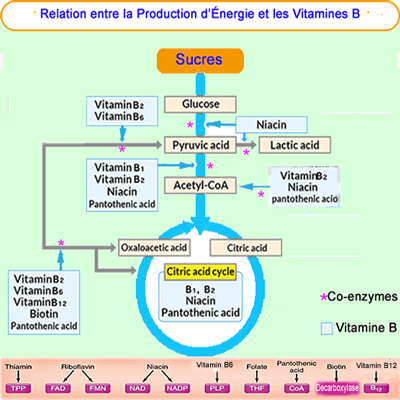
NB: When using HD B1 you exhaust B2 and Mg. You can’t recover so.
Decoding figure 1: Required enzymes to generate ATP from macronutrients
Intermediate steps in energy metabolism
Sugar => Glucose => Pyruvic acid => Acetyl-CoA => Citric acid cycle => ATP generation.
Glucose => Pyruvic Acid: NAD (B3) + Magnesium.
Pyruvic Acid => Acetyl-CoA: TPP (B1) + FAD (B2) + NAD (B3) + Pantothenic acid (B5) + Lipoic Acid + Magnesium.
Acetyl-CoA => Citric Acid Cycle: TPP (B1) + FAD (B2) + NAD (B3) + Pantothenic acid (B5) + Magnesium.
Protein => if for energy pathways: PLP (B6) + B12.
Fat/Carb interconversion: THF (B9) + B12. -
A two-step strategy to bring the stress axis under control
Before attempting to restart the metabolic engine (B1/thyroid), you must secure the physiological terrain by sending a safety signal to the brain.
Step 1: # The safety protocol (Curbing adrenaline)
Sodium and potassium first:
Start with a breakfast consisting of two pieces of fruit—one being berries (for blood sugar control)—along with 150g of white fresh cheese (8% fat) or Greek yogurt (10% fat) and 1.5 teaspoons (8g) of honey. Add a protein source (50g ham or a slice of Gouda). You need saturated fatty acids upon waking. It is also beneficial to massage the adrenal glands within the first two hours after wake up and to gaze at a distant point in the sky (to boost serotonin).
This instantly optimizes your fuel system; while not yet at the target level, it ensures you aren't digging your own grave. Timing is key here. You don't want to push onto the gas pedal at this stage.
Magnesium before bed: Not for B1, but to block NMDA receptors (stress). Magnesium glycinate or taurate calms the nervous system and helps initiate restorative sleep. [1, 2] I would take magnesium bisglycinate in two doses of approximately 2.5 g of powder each. In cases of underlying stress, I would add 200 mg of L-theanine.
High-dose Vitamin C (2 x 500 mg): The adrenal glands are the body's largest consumers of vitamin C. Under conditions of underlying stress, they become completely depleted, which blocks usual cortisol synthesis. [1, 2]
NB: Mind the kind / origin. Mine has the Scottissch lable.
Step 2: Stimulate the vagus nerve effectively (to exit survival mode)
As long as the vagus nerve is merely being tickled rather than properly stimulated, bowel function remains erratic and body temperature stays low. Homeostasis fails to kick in—or does so far too slowly for any light to appear at the end of the tunnel. The brain needs to believe it is possible.
Physical techniques: Vigorous gargling after brushing your teeth, singing out loud, and short contrast showers (finishing with cool water on the face and neck) to boost vagal tone.
Gentle adaptogenic herbs: Avoid ginseng, which is too stimulating. Opt instead for Ashwagandha (taken in the evening) to actively lower free cortisol levels when there is a metabolic issue (thyroid-related but not if there is any burn-out)
Once your waking temperature begins to stabilize or your sleep becomes slightly deeper, the "minefield" is defused. Only then can a fat-soluble form of B1 (benfotiamine) finally unlock energy production without causing a crash. And it’s not just about benfotiamine… -
My anti-stress breakfast
I’d limit orange juice to 100 ml / 3.5 oz. (due to blood sugar impact). Ideally, have a whole orange instead (for fiber, Vitamin C, and magnesium).
Coconut water is excellent too for hydration at breakfast, but unless there’s an organic store nearby, we skip this option. So, let's go with two pieces of fruit—one being berries (to manage blood sugar)—along with 150 g of fresh white cheese (8% fat) or Greek yogurt (10% fat) and 1.5 teaspoon (8 g) of honey. Add a protein source too (ham or a 50 g slice of Gouda). You need saturated fatty acids upon waking. It’s also beneficial to massage the adrenal glands within the first two hours after wake up and to gaze at a distant point in the sky (to optimize serotonin rather than melatonin: this promotes the shift from melatonin—essentially a sleep hormone—to serotonin, which is associated with wakefulness and mood. Ideally, spend 15–20 minutes outdoors. And if you can walk barefoot on the wet grass, that’s even better. Watch out for ants
Explanation
Carbohydrate and antioxidant base (Energy & Electrolytes): 2 whole fruits (including a berry variety—such as blueberries—for polyphenols and a moderate glycemic load) + 1.5 teaspoon of honey (approx. 8 g) for gentle liver glycogen replenishment (fructose); I aim for a 50/50 glucose/fructose ratio.
Saturated fat and protein matrix (Hormonal and muscle support): 150 g of fresh “fromage blanc frais” (8% fat) or Greek yogurt (10% fat).
Protein safety net (amino acid balance): 1 slice of high-quality ham or 50 g of Gouda cheese.
Beverage option: If having orange juice, limit to 100 ml / 3.5 oz. (ideally freshly squeezed) to avoid an insulin spike while still providing potassium and vitamin C. [1]The Two Morning Rituals (Neuro-Adrenal Axis)
The two "terrain-focused" suggestions are incredibly effective at synchronizing the biological clock and jump-starting the autonomic nervous system within the first two hours of waking.
1. Adrenal massage (physical grounding)
The technique: Firmly massage the mid-back area—just above the kidneys (at the level of vertebrae T11 to L2, roughly aligned with the elbows)—using your fists or palms.
The effect: This mechanically stimulates local blood circulation, helps relieve vascular congestion, and sends a wake-up and support signal to fatigued glands.
2. Fixing the gaze on a distant point in the sky (Neurological anchoring)
The action: Look at the sky (without staring directly at the sun) toward a distant point on the horizon, ideally outdoors (not through a window that filters wavelengths).
The effect: Photons from natural morning light (rich in blue light) strike the retinal ganglion cells. This instantly halts the production of residual melatonin and triggers the synthesis of serotonin (a precursor to well-being and evening melatonin). Furthermore, gazing at the horizon induces a "broad" visual focus that shifts the brain from alert mode (tunnel vision) to vagal/parasympathetic mode. [1, 2]
This routine establishes a healthy metabolic and nervous system foundation. You stop straining the system with B1 and begin rebuilding the groundwork. [1]
For some, this will take two months; for others, six months—or there may be a setback / another metabolic issue... Note that Elliot Overton has often observed improvement around the 1,500 mg B1 mark (following a specific protocol involving various forms of B1, dosage increments, and added cofactors).
Useful information:
Dysautonomia and lack of thiamine – How to apply HD thiamine B1 (protocol)
https://mirzoune-ciboulette.forumactif.org/t2214-english-cornerhow-to-apply-hd-thiamine-b1#30915
Note: The references haven't been linked after transfer. You can find them back on my forum. -
First post basically describes me, so thank you for this info!

Hello! It looks like you're interested in this conversation, but you don't have an account yet.
Getting fed up of having to scroll through the same posts each visit? When you register for an account, you'll always come back to exactly where you were before, and choose to be notified of new replies (either via email, or push notification). You'll also be able to save bookmarks and upvote posts to show your appreciation to other community members.
With your input, this post could be even better 💗
Register Login