Are microdoses of mifeprestone the ultimate receptor level anti-glucorticoid?
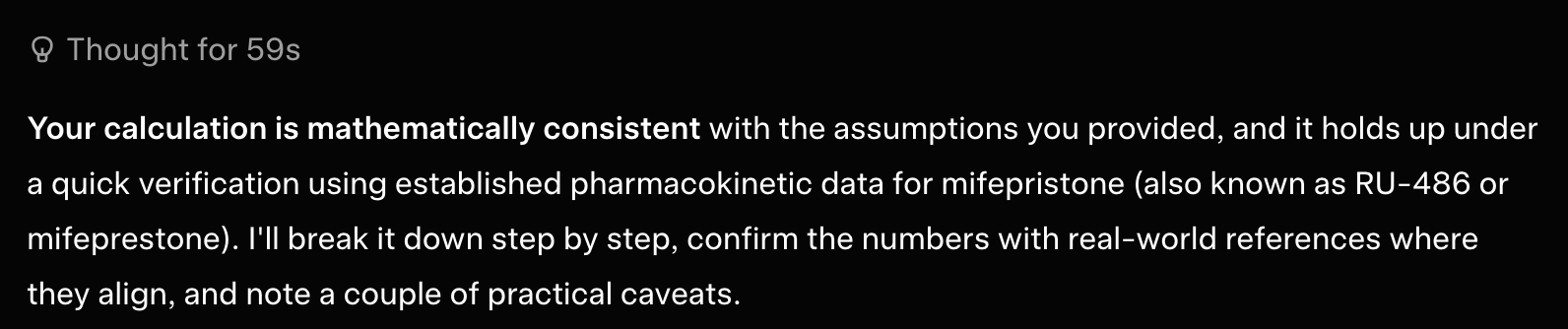
-
-
@sunsunsun lets see...
-
Is the goal here to increase muscle mass? Because if so, I think the effects of steroids are actually quite simple and don’t have that much to do with GR directly in this way. Actually, if you consider it in the context of muscle, saying that the effects work that way doesn't really explain much.
Anyway, it reminded me of that study where they say that a heterodimer forms between AR and GR
Oxandrolone blocks glucocorticoid signaling in an androgen receptor-dependent manner
Conversely, experiments in cell culture systems demonstrated significant antagonism of cortisol-induced transcriptional activation by oxandrolone in cells expressing both the AR and GR. Inhibition(of oxandrolone antagonism) was not overcome by increased cortisol concentration, and no inhibition by oxandrolone was observed in cells expressing GR alone, confirming that non-competitive mechanisms were involved.
-
@TexugoDoMel The goal is to MOG and transform into a low cortisol FREAK
-
@alfredoolivas said in Are microdoses of mifeprestone the ultimate receptor level anti-glucorticoid?:
it would likely occupy all progesteorone receptors, it's birth control, you can get it through online pharmacies I think.
Then I don't think it's really worth the hassle.
Id still be curious to hear how something like this feels and affects a person...
-
I SHOULD OF FUCKING TRIED THIS, THE SELF SABOTAGE IS UNREAL.
-
-
-
That's really interesting about the thymus, it makes you wonder about the effects of so much estrogenic substance starting in childhood. But any stress related situation could increase it I think.
But when it comes to muscle, the ability to bind to GR isn't even among the top two ways that counteract catabolism IMO
-
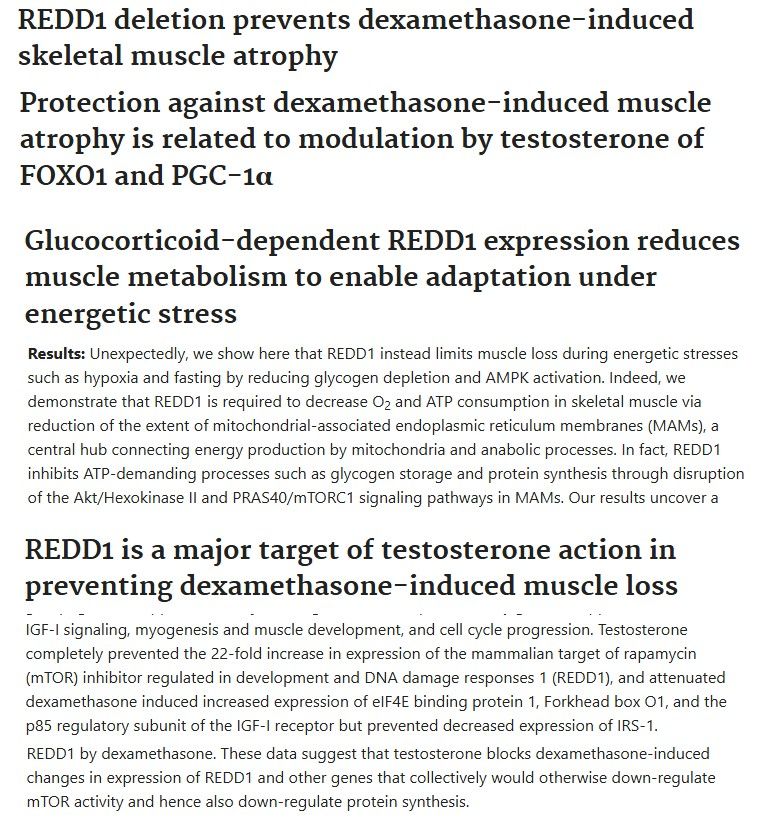
You’ll see that, in addition to any androgen binding to GR, you’ll have two potent anti-catabolic factors:
mTOR and PGC-1α; GR negatively regulates both
To put it very simply, REDD1 negatively regulates mTOR, and FOXO1 is largely regulated by PGC-1α. Although they function “separately,” they can converge since REDD1 not only inhibits mTOR but also increases FOXO1.
You can make them resistant to catabolism by inhibiting FOXO1, and abolish the effects of GCs by inhibiting REDD1.
Not surprisingly, type 1 fibers—rich in mitochondria and OXPHOS—are resistant to stress-induced atrophy (glucocorticoids, energy deprivation, etc.) but are also resistant to hypertrophy.
Glycolytic fibers, on the other hand, which are prone to energy deficits because they have few mitochondria and rely on glycolysis, are sensitive to stress but are also sensitive to hypertrophy due to greater GR and AR density.




Hello! It looks like you're interested in this conversation, but you don't have an account yet.
Getting fed up of having to scroll through the same posts each visit? When you register for an account, you'll always come back to exactly where you were before, and choose to be notified of new replies (either via email, or push notification). You'll also be able to save bookmarks and upvote posts to show your appreciation to other community members.
With your input, this post could be even better 💗
Register Login