Thyroid, from blood glucose to T3: The pivotal role of potassium and deiodinase enzymes in energy homeostasis.
-
Potassium, the hidden ally of your blood sugar levels, is an important cofactor for energy metabolism (to let glucose entry into cells).
Potassium, a behind-the-scenes player in carpooling and storage: Efficiency of glucose uptake
Target point
Potassium acts via the Na⁺/K⁺-ATPase pump, found on the surface of all cells, which continuously exchanges intracellular sodium for extracellular potassium.
This pump is directly stimulated by insulin, in parallel—though not at the same site or via the same mechanism—with the translocation of the GLUT4 transporter, which enables glucose to entry into the cell. In other words, insulin triggers both potassium uptake (via Na⁺/K⁺-ATPase) and glucose uptake (via GLUT4), but through two parallel pathways rather than through direct coupling to the same receptor.1. Potassium Charges the "Cellular Battery"
Every healthy cell acts like a tiny battery. To work correctly, it must keep most potassium inside the cell and most sodium outside the cell. Low potassium hyperpolarizes the beta cell (pancreas), which reduces insulin secretion.
• This situation (potassium rather inside, sodium rather outside the cell) creates an electrical charge across the cell membrane (called the resting membrane potential).
• When you eat a bowl of pasta or rice, your pancreas releases insulin.
Note: Potassium is not really the fuel for an electrical battery. We have to go back into the tyrosine kinase pathway.
Tyrosine kinase activation => Mitochondrial ATP production => Na+/K+ exchange with cofactors. So we aren't really talking about a battery but the energy level will slow down, like a battery could do, when insulin can’t do the job correctly because of a lack. Here potassium and magnesium.2. The Direct Link to GLUT4 (The Glucose Gates)
Insulin signals the cell to deploy specialized transport vehicles called GLUT4 receptors.
• Adequate potassium increases the efficiency of glucose uptake. When potassium is abundant, the cell can clear glucose out of the blood with far less insulin, protecting the pancreas from overworking.3. Preventing the "Stalled Starch" Backlog
Once glucose successfully enters a muscle or liver cell, it must be instantly converted into energy or stored as glycogen in muscles (and in liver after a night shift). As established by biological rules, the body requires about 19.5 mg of potassium for every single gram of glycogen it stores.
• Potassium (K⁺) is a required cofactor for pyruvate kinase, one of the key enzymes in glycolysis (the pathway that breaks glucose down for energy). Without enough potassium, that enzyme step slows or stalls.
Where potassium/glucose do interact for real
Insulin drives glucose into cells (via GLUT4 transporters) and separately drives potassium into cells (by activating the Na⁺/K⁺-ATPase pump). These happen in parallel through the action / influence of insulin. Insulin enhances a fluent metabolism of energy then.
Mind when stopping a fast: progressiveness when feeding back is highly recommended. This is seen as a “refeeding syndrome”: reintroducing carbs after starvation spikes insulin, which shoves both glucose and potassium into cells at once, but then blood potassium could crash. Some pints of salt in water could help during a fast to avoid some side-effects.
• The Post Angle: Potassium ensures a smooth, one-way traffic flow. It enhances glucose out of the blood and immediately packs it away into the energy pathway or storage, keeping the blood “clean” and blood sugar stable.The tyrosine kinase pathway / cascade
When insulin signal transduction fails—or when critical cofactors are missing—the whole system experiences a brownout. The metabolic engine cannot produce the power required to maintain the gradient, and the cellular voltage drops. Like a battery could do when lacking oil, but not on the same way, of course.
Schema detailing how Tyrosine Kinase activation, Mitochondrial ATP, Potassium (K+), and Magnesium (Mg2+) merge into one continuous energy pipeline.
Figure:
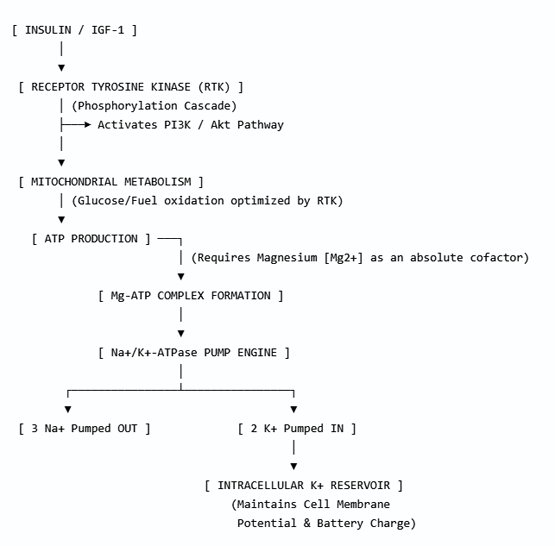
*) The Start of the Chain (as contributors to dysregulation)
If there is a lack of Insulin => RTK Failure
RTK = Receptor for Tyrosine Kinase (enzyme).
Phosphorylation cascade simple definition
A chain reaction inside a cell where one protein kinase enzyme activates another by adding a phosphate group, passing a signal down a line to change cell behavior. [1] A protein kinase is thus an enzyme that adds a phosphate group to target proteins, acting as a molecular switch to turn cell activities on or off.- If there is a lack of insulin, tyrosine kinase domains do not phosphorylate efficiently. Mitochondria don't get the optimal signal or fuel (glucose) to step up ATP production. As a physiological outcome, the energy pipeline slows at the source. ATP generation drops, leaving the pump underpowered.
NB: This doesn't hold universally. Neurons, red blood cells, and the liver use insulin-independent glucose transporters (GLUT1, GLUT3), so they keep taking up glucose even without insulin. - When there is a lack of magnesium (Mg2+) the Na+/K+ pump cannot use raw ATP. Fuel (glucose) can only become ATP when it is complexed with magnesium (Mg-ATP). Magnesium also physically stabilizes the pump's active state. Even if mitochondria make ATP, the pump cannot burn it. The engine stalls, and the cellular "battery" drains immediately.
- Without enough external potassium to exchange, the pump fails to allow an adequate bio-chemical-electrical environment. That the beginning of a falling disruptive energy level, impacting several other enzymatic cellular pathways: When energy level degrades, slowing down cellular repair, nerve conduction, and enzymatic function, a lot of problems will appear…
Sources
• Horn, R.S., Walaas, O., Walaas, E. (1973). The influence of sodium, potassium and lithium on the response of glycogen synthetase I to insulin and epinephrine in the isolated rat diaphragm. Biochim Biophys Acta, 313, 296-309.
• Hundal, H.S., Klip, A. (1993). Regulation of Glucose Transporters and the Na/K-ATPase by Insulin in Skeletal Muscle.
• Villar-Palasi, C., Guinovart, J.J. (1997). The role of glucose 6-phosphate in the control of glycogen synthase. FASEB J, 11, 544.
• Sweadner, K.J., et al. Regulation of the Na+/K+-ATPase by insulin: why and how? PubMed 9609121.
• Kreitzman, S.N., Coxon, A.Y., Szaz, K.F. (1992). Glycogen storage: illusions of easy weight loss, excessive weight regain, and distortions in estimates of body composition. Am J Clin Nutr, 56(1 Suppl), 292S-293S. (ratio de ~0,45 mmol K⁺/g glycogène, 3-4 g eau/g glycogène) - If there is a lack of insulin, tyrosine kinase domains do not phosphorylate efficiently. Mitochondria don't get the optimal signal or fuel (glucose) to step up ATP production. As a physiological outcome, the energy pipeline slows at the source. ATP generation drops, leaving the pump underpowered.
-
Which comes first — the chicken or the egg?
Various situations can arise and unfold in sequence. A single factor is not enough to disrupt homeostasis or to thwart or prevent metabolic correction (a return to an alternative equilibrium).
For example, a lack of energy (insufficient T3).
According to the "Association-Induction Hypothesis"—first developed by biophysicist Gilbert Ling and brilliantly explained by Ray Peat, PhD, on his forum:- A high-energy state: when cellular respiration is high (stimulated by the active thyroid hormone T3 and glucose), intracellular proteins alter their physical conformation. In this healthy state, they exhibit a high natural affinity for potassium—binding it firmly—while keeping sodium predominantly outside the cell. [1, 2]
We can view T3 as the ultimate regulator of cellular structure and the organization of water within the cell. - ATP optimization: since cellular structure naturally retains potassium when energy levels are high, the cell doesn’t need to waste its precious ATP by constantly running the Na⁺/K⁺-ATPase pump to counteract leakage. This results in optimized "fueling" (available energy levels).
Source:
According to Peat (PubMed: 40272924) when a cell has optimal energy and high potassium, it naturally acts as if insulin is present. A healthy potassium buffer allows the cell to readily accept glucose and convert it into energy without needing a massive surge of insulin. Potassium literally spares the pancreas because potassium itself provides the baseline "insulin-like" cellular pull. [1, 2, 3]
In his essay Glycemia, starch, and sugar in context, Peat stated a striking deductive statistic:
"Insulin itself has been found to account for only about 8% of the 'insulin-like activity' of the blood, with potassium being probably the largest factor." [1, 2]
So a lot of waste is avoided when trying to optimize the exchanges to maintain the cellular ionic exchanges and the integrity of the membranes.Useful link (in French, translator required):
https://mirzoune-ciboulette.forumactif.org/t2232-un-exces-de-calcium-comme-declencheur-du-stress-cellulaire-pq#31007
Excerpt:
Excess calcium is often viewed as a trigger for cellular stress. Why?
The cell maintains a strict concentration gradient between K+ and Na+. During an insult (toxicity, oxygen deprivation, inflammation), calcium channels open abnormally, causing an influx of calcium into the cytosol.
This calcium overload triggers a chain reaction of dysfunctions:- Stress (overload and disrupted exchange);
- ROS (damage to membranes and DNA);
- Activation of destructive enzymes.
Calcium becomes an excitatory element.
To understand how calcium (Ca2+) becomes an "excitatory" agent, one must distinguish its overall chemical nature—an alkaline-earth mineral found in the diet—from its highly localized physical behavior within the cell. It is not a matter of macroscopic volume, but rather of electrical potential, molecular geometry, and pH.Change in electrical charge (the trigger for excitation)
At rest, the interior of a muscle cell is negatively charged relative to the exterior. Calcium (Ca²⁺) carries two positive charges.- Electrical excitation: When a nerve signal commands the muscle to contract, channels open. Ca²⁺ rushes into the cell, attracted by the internal negative charge.* => Concentration gradient and appropriate Ca²⁺ polarization.
- Depolarization: This massive influx locally reverses or nullifies the membrane's electrical voltage. It is this change in electrical charge (the action potential) that propagates the excitation signal throughout the muscle fiber.
NB*: In electricity, opposite poles attract.
As the Ca2+ ion rushes into the cell, it introduces positive charges (electrical charge), reverses the membrane polarity (action potential), and triggers the mechanical response of structural proteins ("coiled proteins").
It is the disruption of equilibrium caused by this influx—followed by the energy cost (ATP) required to pump the calcium back out of the cell—that ultimately disturbs the cell's internal metabolism and balance. Thus, it is the demands placed on the system to restore equilibrium that consume energy...You can find more information on the "War of the Pumps" at the link previously provided. You will then be able to connect the dots regarding the lack of energy and potassium; subsequently, if you still lack energy, you can look into optimizing T3 levels—but you must do so correctly, not the way I’ve often seen with synthetic hormones. The problem lies not in the synthetic nature but in the lack of cofactors.
- A high-energy state: when cellular respiration is high (stimulated by the active thyroid hormone T3 and glucose), intracellular proteins alter their physical conformation. In this healthy state, they exhibit a high natural affinity for potassium—binding it firmly—while keeping sodium predominantly outside the cell. [1, 2]
-
Deiodinase enzyme roles
The thyroid's key roles
In situations of stress or prolonged insult (whether physical, mental, or environmental), the body seeks to reduce the energy expenditure associated with maintenance in order to focus on cellular survival (species protection). This braking mechanism is activated at the level of peripheral conversion through an enzymatic shift between the deiodinase enzymes DIO2/D2 (activation) and D3 (inactivation). [1]- https://pmc.ncbi.nlm.nih.gov/articles/PMC3670672/
D3 does not merely serve an inactivating function. It acts as a modulator by adding or removing an iodine atom from an enzyme, depending on whether activation (T4 to T3) or inactivation is required. And I assume D2 is not always inert, either.
D1 (Type 1 deiodinase). D1 is the only "mixed" enzyme capable of cleaving either the inner or the outer ring, thereby activating or inactivating the hormone depending on the metabolic context.
Roles of deiodinases
Deiodinases are enzymes that control energy metabolism by activating or inactivating thyroid hormones at the tissue level, directly determining the local availability of the biologically active hormone T3.What Are Deiodinases?
Deiodinases are a family of three enzymes (D1, D2, and D3) containing selenocysteine that remove iodine atoms from thyroid hormones: [1]
NB: D1 = DIO1 = Deiodinase-1 = desodinase-1.
• Type 1 (D1): double function (add or remove a ring)
D1 converts inactive T4 (thyroxine) into active T3, and clears reverse T3 (rT3) from the blood. Found mostly in the liver, kidneys, and thyroid. [1, 2, 3, 4]
• Type 2 (D2): remove a ring (T4 => T3)
D2 exclusively activates T4 into T3 inside specific tissues, providing local intracellular T3 surges. Found in brown adipose tissue (BAT), skeletal muscle, brain, and pituitary gland. [1, 2, 3]
• Type 3 (D3): Inactivates both T4 and T3 by converting them into inactive metabolites (like rT3). Acts as a physiological brake on thyroid signaling. [1, 2, 3]Role in Energy Metabolism
Deiodinases customize energy expenditure and metabolic rate independently of baseline circulating hormone levels: [1, 2, 3, 4]
• Thermogenesis (Heat Production): In brown adipose tissue, D2 activates T4 to T3 locally. This T3 binds to nuclear receptors to trigger mitochondrial uncoupling proteins (like UCP1) and PGC1α, ramping up calorie burning to generate heat. [1, 2]
• Energy Expenditure: High D2 activity in tissues like skeletal muscle and fat accelerates cellular respiration and energy usage. [1, 2]
• Metabolic Adaptation: During fasting or calorie restriction, D2 and D1 activity often drop while D3 rises, lowering active T3 levels to conserve energy and slow down the metabolic rate. Nutrient excess has the opposite effect, boosting activation. [1]Impact on T3 Levels
• Local vs. Systemic T3: More than 80% of intracellular T3 does not come directly from the thyroid gland, but is generated locally inside tissues via D1 and D2 acting on circulating T4. [1]
• Tissue-Specific Control: Even if blood levels of T3 look normal, local changes in D2 or D3 expression can create high-T3 or low-T3 environments inside individual organs (like the liver or muscle), dictating how fast or slow those specific cells burn energy. [1, 2, 3] - https://pmc.ncbi.nlm.nih.gov/articles/PMC3670672/
-
*) Useful nutrients for thyroid: Se I Zn Mg and Fe for enzyme TPO
Selenium (Se), Iodine (I), Zinc (Zn), and Magnesium (Mg) are vital trace elements and minerals that support thyroid hormone synthesis, conversion, and cellular regulation. [1, 2, 3]
Roles of Each Nutrient
• Selenium (Se): Powers the enzymes (deiodinases) responsible for converting inactive T4 into active T3 hormone, and acts as an antioxidant protecting the thyroid from oxidative damage. [1, 2]
• Iodine (I): Acts as the fundamental raw building block required by the thyroid gland to manufacture T4 and T3. [1] Never take an iodine supplement, without staples and after all without having first replenish with selenium. Follow a protocol to avoid a backfire.
• Zinc (Zn): Assists the brain in sensing hormone levels, supports T4-to-T3 conversion, and helps thyroid hormones bind to cell receptors. [1, 2, 3]
• Magnesium (Mg): Aids in overall energy production, helps regulate and lower elevated TSH levels, and supports cellular hormone activation. [1, 2]Useful nutrients for DIO enzymes
Here is the chronological, step-by-step story of how thyroid hormones are handled by the body.
Written with help of AI (ChatGPT) to set in order.The Normal State (Euthyroid)
In a healthy, nutrient-replete body, the thyroid axis operates like a well-oiled factory:- The Factory Line (Thyroid Gland): The thyroid gland extracts Iodine from the blood. Using the enzyme Thyroid Peroxidase (TPO), it binds iodine to tyrosine to manufacture T4 (about 80–90%) and a tiny bit of T3 (about 10–20%). [1, 2, 3, 4]
If you don’t live near the seacoast (< 50 Km) and don’t eat fish or seafood you lack iodine.
NB: Woman's breasts and a man's prostate will not receive much of this iodine, as it is primarily sequestered or diverted by the thyroid. Guess now what kind of risk that entails… - The Shipping Yard (The Bloodstream Pool): The thyroid dumps these hormones into the blood. The T4 travels throughout the body as an inactive storage hormone. To make the blood pool rich in active T3, the liver and kidneys use DIO-1 enzymes to convert T4 into T3. This liver/kidney conversion accounts for 80% of the active T3 floating in the blood pool. [1, 2, 3, 4]
- The Local Customers (Muscles & Tissues): Skeletal muscles pull what they need from two sources to maintain a 50/50 balance:
o 50% is absorbed directly as pre-made T3 from the blood pool.
o 50% is absorbed as T4, which the muscle internally converts into active T3 using its own DIO-2 enzymes. - The Power Plant (Mitochondria): Once inside the muscle cells, T3 binds to nuclear receptors, ordering the mitochondria to produce ATP (energy) and heat. Magnesium acts as the essential spark plug required to synthesize and utilize that ATP. [1, 2, 3, 4] Remember that magnesium is used by at least 360 enzyme reactions, as often mentioned. Current enzymatic databases have identified over 600 enzymes that require magnesium to function, plus another 200 that need it for activation. [1, 2]
To summarize one caveat (for me, LucH): The whole thing (+/ 85%) depends on T4 formation, depending on iodine and the enzyme TPO. Here we have hit the exact nail on the head.
No matter how much selenium, zinc, or magnesium a person takes to optimize their conversion enzymes (DIO-1 and DIO-2), those enzymes are entirely useless if they have no T4 raw material to work on. And as we noted, T4 production depends entirely on the availability of Iodine and the functionality of the Iron-dependent TPO enzyme.
When taking a synthetic T4 supplement for thyroid, individuals often feel better and improve their energy level but it doesn't last because of a lack of cofactors.
Depleted Reserves: An initial dose of T4 provides a temporary boost. However, it quickly depletes your body's existing nutrient reserves, stalling the conversion process and causing symptoms of fatigue to return. [1, 2] Master Post: Why Your Thyroid Medication Fails Without Cellular Cofactors
Many thyroid patients—especially those taking synthetic T4 (Levothyroxine) or T3 (Cytomel)—experience a frustrating paradox: their blood work looks perfect, but they still feel exhausted, cold, and weak, again, if we leave aside the temporary improvement.
The reason? Tissue-level hypothyroidism.
Taking synthetic hormones is only half the battle. If your body lacks the specific nutritional cofactors required to manufacture, convert, and absorb those hormones, the medication simply floats in your bloodstream completely useless to your cells.
Here is the step-by-step chronological story of how thyroid hormones travel through your body, where they get blocked by deficiencies, and how to fix it.
 Step 1: The Factory Bottleneck (T4 Production)
Before a single drop of active hormone can be used, the thyroid gland must manufacture T4.
• The Process: The thyroid gland uses an enzyme called Thyroid Peroxidase (TPO) to bind Iodine to tyrosine.
• The Required Cofactors: Iodine and Iron (Fe). TPO is a heme-dependent protein, meaning it literally requires iron as its structural engine.
• The Failure State: If you lack iron or iodine, the factory shuts down. Vegan Caveat: Because non-heme (plant) iron has a very poor absorption rate, vegans are more likely to suffer from a TPO factory shutdown. If your body cannot produce or process T4, the rest of the downstream system collapses. Step 2: The Shipping Yard (Systemic Blood Conversion)
The thyroid gland's direct output is roughly 80–90% inactive T4. To create the pool of active T3 in your bloodstream, your liver and kidneys must step in.
• The Process: The liver and kidneys use DIO-1 (Deiodinase-1) enzymes to strip an iodine molecule from T4, turning it into active T3. This creates 80% of the circulating T3 pool in your blood.
• The Required Cofactor: Selenium (Se). DIO enzymes are selenoproteins made of selenocysteine.
• The Failure State: If you are deficient in Selenium, DIO-1 fails. The pool of active T3 in your bloodstream dries up.
NB: When the body faces an overload of toxic metals or a depletion of its antioxidant reserves, available selenium is consumed in large quantities to neutralize these stressors, potentially leading to an induced deficiency affecting other vital functions (such as thyroid hormone synthesis). RDA: Approximately 70 µg/day for an adult. 100 µg as a course of treatment, but not daily—except in specific cases. Too much of a good thing becomes bad. ️ Step 3: The Local Deliveries (Skeletal Muscle Conversion)
Your muscles require massive amounts of energy, maintaining their internal T3 levels via a 50/50 balance: 50% is absorbed directly as pre-made T3 from the blood pool, and 50% is converted locally inside the muscle from T4.
• The Process: Muscles pull inactive T4 from the blood and use DIO-2 enzymes to convert it into active T3 on-demand.
• The Required Cofactors: Selenium (Se) and Zinc (Zn).
• The Failure State: When blood T3 is low, muscles try to compensate by increasing DIO-2 activity. But if you lack Selenium, the muscle cannot build the DIO-2 enzyme. The backup plan fails. The unconverted T4 shunts down the path of least resistance, turning into Reverse T3 (rT3)—an inactive molecule that blocks your receptors and worsens fatigue. Step 4: The Cellular Gatekeepers (Receptor Binding)
Once active T3 finally arrives at your cells, it faces a locked door. It must bind to the Thyroid Hormone Receptor (THR) inside the cell nucleus to deliver its metabolic message.
• The Required Cofactors: Zinc (Zn) and Vitamin A (Active Retinol). Zinc forms the structural "zinc fingers" of the receptor so the hormone can fit the lock. Vitamin A allows the receptor to successfully talk to your DNA.
• The Failure State: Without Zinc or Vitamin A, the receptors deform. T3 is completely locked out of the cell. You remain symptomatic even if your blood levels are flooded with T3. Step 5: The Power Plant (Mitochondrial Spark)
Once the message successfully passes the gatekeepers, the cell commands its mitochondria to generate energy (ATP) and heat.
• The Required Cofactors: Magnesium (Mg) and Iron (Fe).
• The Failure State: Magnesium is the ultimate spark plug required to synthesize and utilize ATP. Without it, you experience profound muscle fatigue, weakness, and cramps. Furthermore, a lack of magnesium impairs the pituitary gland, frequently driving TSH higher.
 ️ The Action Plan: How to Fix the Gaps
To ensure your thyroid therapy actually reaches your cells, target these specific dietary fixes:
🥩 For Omnivores: The Ultimate Thyroid Superfood
Dietary sources such as poultry liver provide nutritional compounds containing bioavailable iron, zinc, selenium, and pre-formed vitamin A.
 For Vegans & Poor Converters (The Vitamin A Trap)*
Many people over 45 years old possess a genetic slowdown that allows them to convert only about 15% of plant-based beta-carotene (from carrots/sweet potatoes) into active Vitamin A. Vegans cannot eat liver to bypass this.
• The Protocol: Supplementation with retinyl palmitate is sometimes utilized under professional guidance, often taken with dietary fats to assist the absorption of fat-soluble nutrients.LucH says:
- I would advise them to take 5000 UI Retinyl palmitate twice a week. At breakfast with some fat.
Essential Cofactors Needed for T4-to-T3 Conversion
• Selenium: A vital mineral and enzymatic cofactor required to manufacture thyroid hormones and assist in conversion. [1, 2]
• Iron (Ferritin): Low iron storage impairs the enzymes responsible for activating thyroid hormones. [1, 2]
• Zinc and Copper: Critical minerals that support the deiodinase enzymes responsible for turning T4 into T3. [1]
• Vitamin D and B Vitamins: Necessary for cellular energy production, immune regulation, and proper hormone receptor function. [1, 2, 3] - The Factory Line (Thyroid Gland): The thyroid gland extracts Iodine from the blood. Using the enzyme Thyroid Peroxidase (TPO), it binds iodine to tyrosine to manufacture T4 (about 80–90%) and a tiny bit of T3 (about 10–20%). [1, 2, 3, 4]

Hello! It looks like you're interested in this conversation, but you don't have an account yet.
Getting fed up of having to scroll through the same posts each visit? When you register for an account, you'll always come back to exactly where you were before, and choose to be notified of new replies (either via email, or push notification). You'll also be able to save bookmarks and upvote posts to show your appreciation to other community members.
With your input, this post could be even better 💗
Register Login