Random, interesting studies
-
Glutamine seems helpful for preventing /treating cholestasis, gall stone formation, leaky gut and to decrease endotoxin absorption.
Peaty staples like gelatin and scallops actually have high amounts of glutamin.Interesting. Thanks for posting.
One caveat: No glutamine if you're dealing with dysbiosis, often present with leaky gut. First be aware of the absence of candidosis. Glutamine is going to feed the beast.
The first sign of candida albicans is often seen with a white tongue. Test with spitting in a glass water.
One tip: When I take 500 mg glutamine powder (thin stomach lining => pain), I combine it with 500 mg taurine, on a empty stomach. I prevent the neuro-exciting effect and I introduce a high-effective AO for the brain. (500-1000 mg dose). -
First be aware of the absence of candidosis. Glutamine is going to feed the beast.
So does sugar - theoretically. That doesn't stop me from eating sugar.
Besides, in this study on people in a ICU, people that received glutamine did not developed more but fewer candida infections. And 0 people that did develope a candida infection endep up dieing, whereas 6 people from the control group died.
"In those patients, despite a similar high incidence of colonization with Candida, those receiving glutamine developed fewer Candida infections and none died, whereas six control patients who developed Candida infections died from multiple organ failure ..."
https://pubmed.ncbi.nlm.nih.gov/12093428/Dare to think.
My X:
x.com/Metabolicmonstr -
-
I was looking into the effects and overlaps between gut bacteria and steroids (there are many overlaps) and I found one very interesting strain called Turicibacter.
Researchers found that:"A decrease in the abundance of Turicibacter is closely related to autism."
https://pmc.ncbi.nlm.nih.gov/articles/PMC9659915/
the same bacteria can lower serotonin by acting like the serotonin transporter SERT.
"Turicibacter sanguinis was capable of serotonin uptake and, further, that this effect was inhibited by the selective serotonin reuptake inhibitor (SSRI) fluoxetine2."
https://pmc.ncbi.nlm.nih.gov/articles/PMC6930332/This could be helpful colon cancer since serotonin makes it grow.
And in this study Turicibacter, together with the medicinal fungus Antrodia camphorata was able to inhibit TPH, 5HT1A+B+C+D !"...inhibiting serotonin signaling-related genes, including Tph1, Htr1d, Htr2a, Htr2b, and Htr2c (p < 0.05)"
https://www.frontiersin.org/journals/pharmacology/articles/10.3389/fphar.2023.1203087/full
Turicibacter also lowers weight gain on a HFD.
https://healthcare.utah.edu/newsroom/news/2025/12/gut-bacteria-put-brakes-weight-gain-mice
If you're wondering how one can increase turicibacter, there is currently no probiotic or supplement that contains it.
But, the medicinal fungus, Antrodia camphorata, I mentioned above, significantly increases Turicibacter even at low dosages.
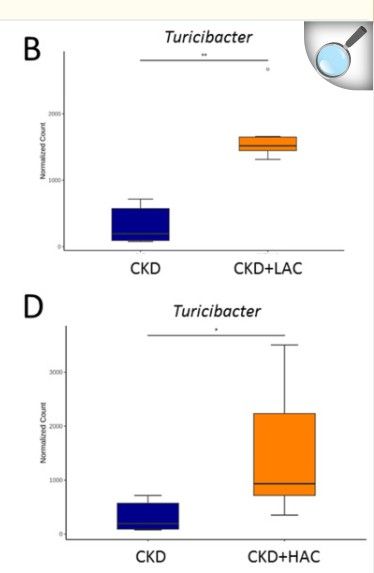
https://pmc.ncbi.nlm.nih.gov/articles/PMC10650666/
Another find the same thing.
"In high-fat diet-fed mice, Antrodia cinnamomea alcohol extract increased the relative abundance of 12 bacterial taxa, including Akkermansia, Bifidobacterium, Lactococcus, Muribaculaceae, Gordonibacter, and Turicibacter (Figure 8, Table S5)."
https://pmc.ncbi.nlm.nih.gov/articles/PMC12193264/#ijms-26-05856-f008
In this study Berberine could increase Turicibacter.
https://www.frontiersin.org/journals/pharmacology/articles/10.3389/fphar.2020.00223/ -
"that the abundance of Turicibacter is negatively and positively correlated with T and estradiol..."
https://pmc.ncbi.nlm.nih.gov/articles/PMC9659915/Kinda sounds like low Testosterone and high estrogen are implicated in autism. Peat right again.
The quote describes the very opposite of what you made of it:
The authors describe much Turicibacter = low T, high E, less autism.
The direction of action seems unclear or perhaps even reciprocal, as they suggest the higher autism prevalence in males than females as a link by naturally higher T (male) = low Turicibacter, more autism. -
@CrumblingCookie Oh yeah, youre right. Thanks for pointing that out.
I still find it interesting. Antrodia camphorata The fungus I mentioned, is available as a supplement .
-
@Mauritio I am looking into taking this (chaste berry--vitex) since progesterone can be hard to get quality access to for a reasonable price. I am a woman though, so I may be insulated from the negative effects described for men. I plan on trying it as I have done everything to fix hair loss and have found little that consistently works or that I can do long-term. I take t3/t4 now, and aspirin every night. I told progesterone via skin for a while and noticed little (maybe some resilience), but I think high does progesterone via a pill would probably help--though I'd need a prescription for that.
I looked up things that increased progesterone indirectly and AI suggested this.
-
@secondkelping b5 excesd compared to other b vits may cause hairlos. Check b1,2,3 6 12 for adiquette intake .
-
@lobotomize I've run through all of the b vitamins. I get some mild improvement if I take them, but it normally helps with initial growth but does not lengthen life of the follicles for me. My issue is keeping follicles in the anagen phase longer which I'm implementing many changes to address.
-
I've run through all of the b vitamins. I get some mild improvement if I take them, but it normally helps with initial growth but does not lengthen life of the follicles for me.
Hi,
Well seen for B5 supplement because I only get 50 % of the RDA with my usual food, which is rather varied.
Coenzyme A (via vitamin B5) is essential for synthesizing the lipids that make up the skin barrier. A sudden, massive influx of Coenzyme A can alter the composition of sebum and the lipids found on the skin's surface. If the skin is already sensitive—or under stress due to hepatic excretion—this localized biochemical change can trigger an inflammatory skin reaction (such as eczema).
Taking high-dose vitamin B5 reactivates the acetylation pathway (involving Coenzyme A). Think of high-dose B5 as bringing a team of heavy-duty cleaners into a house; they clear out the cupboards at lightning speed. However, if the hallway is narrow and cluttered (implying poor motility or irregular transit), and the outdoor trash bin is already overflowing with histamine, the debris will pile up in the middle of the living room—eventually spilling out through the window (manifesting as eczema).
Well, not everyone struggles with sluggish digestion or skin prone to breakouts. However, in cases of stress or low-grade inflammation (such as osteoarthritis), the interactions between B-group vitamins must be taken into account.- Potential bottleneck with high-dose vitamin B5: In the intestines, vitamin B5 utilizes the same transporter as biotin. A functional biotin deficiency—triggered by high doses of B5—typically manifests as skin issues, most notably dermatitis and eczema.
In cases of repeated stress, chronic elevation of cortisol partly hinders the entry of vitamin B3 into cells by altering their membrane transporters. In the short term, this is not an issue: the cell relies on the B3 already present intracellularly, which functions in the form of NAD+ (NAD+ NADH). In fact, approximately 95% of the NAD+ converted into NADH is continuously recycled within the cell itself.
However NAD+ is consumed faster than the cell can resynthesize it.
Moreover stress and chronic inflammation rapidly deplete vitamin B6 reserves. This deficiency impairs hepatic glycogenosis (the liver struggles to release glucose stored as glycogen—a process dependent on B6). At night, this inability to maintain blood sugar levels leads to reactive hypoglycemia; the body then secretes adrenaline to compensate, which triggers repeated nighttime awakenings. Simultaneously, this lack of vitamin B6 blocks the recycling of amino acids, resulting in an increase in toxic homocysteine within the bloodstream.
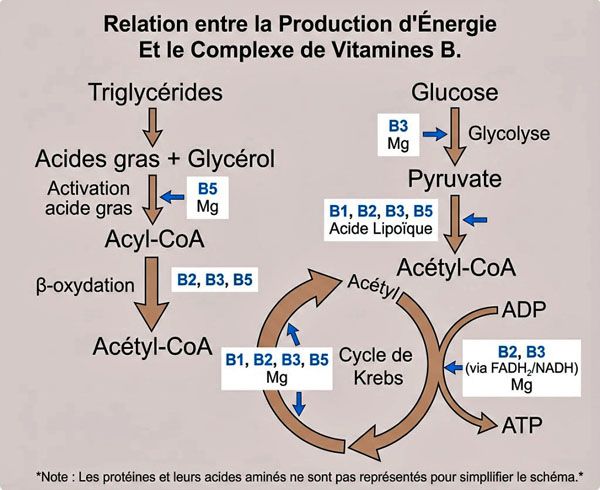
NB1: In the Krebs cycle, the cell requires NAD (B3) and FAD (B2). There is an interaction between B3 and B6. There is also an increased need for sulfur and methyl donors. Sulfur often helps manage salicylate overload, while methyl groups help manage histamine load.
NB2: If you "press the accelerator pedal" (i.e., ramp up metabolic activity), you must account for the interplay between vitamins B1, B2, B3, B5, B6, and B8, as well as magnesium—which is frequently in short supply (350–420 mg required). I increase magnesium intake during periods of stress, but never by anticipating a stressful event. Always afterwards. J.P. Curtay recommends three 300 mg doses of elemental magnesium. I would personally use magnesium bisglycinate powder: 1.25 g per dose.
Figure: Krebs cycle
- Potential bottleneck with high-dose vitamin B5: In the intestines, vitamin B5 utilizes the same transporter as biotin. A functional biotin deficiency—triggered by high doses of B5—typically manifests as skin issues, most notably dermatitis and eczema.



Hello! It looks like you're interested in this conversation, but you don't have an account yet.
Getting fed up of having to scroll through the same posts each visit? When you register for an account, you'll always come back to exactly where you were before, and choose to be notified of new replies (either via email, or push notification). You'll also be able to save bookmarks and upvote posts to show your appreciation to other community members.
With your input, this post could be even better 💗
Register Login