Random, interesting studies
-
Low-grade metabolic acidosis as a driver of chronic disease: a 21st century public health crisis, 2021
This one is the most concise overview on bicarbonate and acid-base balance I have got to see.
•Why do humans accumulate acid in the body?
•Where does dietary acid come from?
•Box 1. Ways to test for low-grade metabolic acidosis
•Four main mechanisms that compensate for chronic latent metabolic acidosis
•Box 2. The harms of low-grade metabolic acidosis
•Figure :1
•SummaryAlso, so many people only dabble with some sodium bicarbonate here and there, but in sports science it has been well proven that an HCO3- plasma increase of about 5mmol/L will substantially improve stamina and extension of peak performance.
The way to achieve such an increase is 225mg/kg BW NaHCO3 if it's enteric-coated, or 300mg if not.
That's a profound ~20g of NaHCO3 per day at a single time. Instead of the 1-5g rookie numbers so commonly making their round.
Obviously such a 20g dose contains about 6g of Na. It's ought to be better to make KHCO3 and or Ca/Mg carbonates dominate for long-term daily use. *****
The enterically-coated is superior in that it's essentially absent of side effects:Serial intake over more than one day even increases anaerobic metabolic capacity per se:
And of possible(likely!) interest to everyone with digestion issues, SIBO, malabsorption etc. are
the crucial findings that pancreatic bicarbonate secretion is directly dependent (and proportional to iirc) on plasma bicarbonate levels.A single, full-on pancreatic secretion makes use of ~13mmol HCO3- (equivalent to 1g NaHCO3) and lowers the plasma bicarbonate concentration by a substantial 1-5mmol/L.
Secretin-induced plasma bicarbonate decrease as a simple indicator of exocrine pancreatic function
And for those who lack pancreatic enzyme secretion, who are required to take them exogenously,
or also for those with sufficient pancreatic enzymes but nevertheless lack of digestive power because of their failing enzyme activity:
Addition of bicarbonate (670mg, rather conservative) with pancreatic enzymes to a test meal is able to increase fat absorption by up to ~3 times in chronic pancreatitis:
° Replacing the sodium bicarbonate in parts with KHCO3, MgO or MgCO3 and CaCO3: Lets do some basic maths.
•500mg MgCO3 (160mg Mg) would replace the buffering capacity of 833mg NaHCO3. Some peeps can easily take twice that per day, i.e 1000mg MgCO3 (320mg Mg), replacing 1666mg NaHCO3.
•500mg MgO (300mg Mg) would replace 875mg NaHCO3.
•500mg CaCO3 (200mg Ca) would replace 417mg NaHCO3. But an appropriate daily amount could be ~3x (or 4-5x) this, i.e. 1500mg CaCO3 (600mg Ca), replacing 1250mg NaHCO3.1500mg CaCO3 (600mg Ca) and 1000mg MgCO3 (320mg Mg) per day would therefore replace the buffering capacity of just 2.9g of sodium bicarbonate. Which is 34.5 mEq.
Which looks like a solid base level on paper for the long term but still lacks the punch to make up for another 17g of NaHCO3.Could we take 1g of NaHCO3 (about 274mg Na) and KHCO3 for the rest, i.e. 19g KHCO3 (about 7420mg K)?
Just make sure we still get sufficient dietary chloride.
Although, if taken over the long term I can't believe we'd really need / benefit from such extra 238 mEq from 20g NaHCO3. It seems waaaay too generous when looking at the balance from study at the top. even when considering a grain- or cheese- and protein-rich ketogenic diet.If we cut that down to 1g NaHCO3 (274mg Na), 10g KHCO3 (3900mg K), 1.5g CaCO3, 1g MgCO3,
that would be the equivalent of 15.7g sodium bicarbonate (187mEq).
That still looks generous but may be well suited to buffer extra lactate in high-intensity sports without adaptation to large sodium doses or the intermittent sodium-induced water retention ping-pong on the day after.

Seriously, there should be more studies on long-term dose finding.
The max dose long-term I could find was ~6g/day NaHCO3 in kidney patients: Which works out very well and to much benefit.
However, I'm thinking that's probably the range of dose which many people could benefit from long before they proceed to kidney damage, sarcopenia, osteoporosis, diabetes etc. -
In an effort to reduce cost, do you feel there is a way to avoid negative side effects with baking soda, versus buying the more expensive enteric sodium bicarbonate in supplement form?
-
Sorry, but I'm lost in chemistry.
I make my own electrolyte drink by dissolving a couple of teaspoons of the ingredients below in one litre of water.
• potassium bicarbonate (KHCO₃) = potash
• sodium bicarbonate (NaHCO₃) = baking soda
• magnesium sulfate (MgSO₄) = epsom salt
• iodised table salt (99.9% NaCl + iodione as potassium iodate)I have no other sources of iodine than table salt, and I probably get too much salt even though it doesn't actually taste too salty. (one can get used to a lot)
There is much fuss about baking soda, but does it matter whether the bicarbonate comes from one source or another? That is, can I skip adding the baking soda?
-
@Mossy Good question. There appears to be a way to embed the Na or K bicarbonate in a stomach-acid-resistant hydrogel.
Can you find out how they're using the listed ingredients to obtain an effective hydrogel in the Maurten Bicarb system? They use Maltodextrin, Fructose, Modified starch, Hydroxypropyl cellulose, Magnesium stearate, Xanthan gum to bind the sodium bicarb.Filling capsules really takes its time when those acid-resistant caps don't come as separated halves but must be pulled apart one by one before placing them in the capsule filler trays.
I have scoured the interwebs and found that buying sodium bicarb supplements in excipient-free, stomach-acid-resistant HPMC+gellan or HPMC-pectin capsules can cost "as little" as the same quantity of empty enteric capsules for a capsule filler at home.
But there are no sellers for KHCO3 capsules at all because of that annoying ban on anything above 100mg K in supplements. I'm therefore hovering on the thought of buying more HPMC+gellan capsules to fill at home.@Ena said:
does it matter whether the bicarbonate comes from one source or another? That is, can I skip adding the baking soda?
By what I know it doesn't matter and one can choose whatever form of (bi)carbonate one prefers!
Honestly, the whole kidney function explanations keep confusing me.What I've kept is that a solid amount of aldosterone benefits bicarbonate retention. Therefore reasonably low amounts of sodium should indeed be better for higher bicarbonate retention, I guess?
That would also mean that the ARBs, Angiotensin Receptor Blocker medications (and the ACE inhibitors to a degree as well), bear the potential to significantly screw with bicarbonate balance because of their aldosterone suppression. That alone is a large group of people. -
@Ena said in Random, interesting studies:
There is much fuss about baking soda, but does it matter whether the bicarbonate comes from one source or another? That is, can I skip adding the baking soda?
Yes, yes. Skip the baking soda. Short-term studies on healthy athletes using baking soda (NaHCO₃) do not address long-term health and longevity.
Dietary sodium is hoarded by our bodies and we tend to waste potassium. The ratio of sodium/potassium in our diet is important for blood pressure, insulin resistence, osteoporosis, diabetes mellitus, coronary artery disease and other diseases that occur as we get older. Read the details in The High Blood Pressure Solution: A Scientifically Proven Program for Preventing Strokes and Heart Disease (pdf)
-
@DavidPS
Interesting book!- In contrast, dry cows (those not producing milk) or beef steers are
equally healthy whether or not they are given supplemental salt,7 and the
same is true for other domestic animals.8 And although wild herbivores
such as deer have been reputed to travel great distances to go to natural salt
licks, it is difficult to substantiate this belief. For example, Dr. A. R. Patton
analyzed mud sent in by forest rangers from areas in the Montana Rockies
where wild animals congregate to lick the soil. The rangers called these
sites salt licks, but Dr. Patton did not find sodium in any of the mud
samples. What he did find, however, was iodine,9 an element needed to
make thyroid hormone.*
- the total of the sodium plus the potassium inside the cell is constant:
Na + K = constant
The reasons for this have to do with the laws of physics and are outlined
in Chapter 4. Here’s the bottom line: It is impossible to lower sodium inside
the cell without replacing it with potassium. That’s why these two
substances are intimately linked in an inescapable balance. A low sodium
diet can’t possibly work unless it contains enough potassium to replace the
sodium inside the body’s cells.
- In contrast, dry cows (those not producing milk) or beef steers are
-
@CrumblingCookie said in Random, interesting studies:
I have scoured the interwebs and found that buying sodium bicarb supplements in excipient-free, stomach-acid-resistant HPMC+gellan or HPMC-pectin capsules can cost "as little" as the same quantity of empty enteric capsules for a capsule filler at home.
Great info. Thank you!
-
[bicarbonate of potassium or sodium]
Thanks @DavidPS and @CrumblingCookie.
I'll skip the baking soda from now on ... -
@dapose said in Random, interesting studies:
I’m using Boswellia every night before bed with baking soda and glycine water. Most consistent vivid dreams I’ve had as an adult!
It’s a COX enzyme blocker, very good anti inflammatory for me.Nice! Do you notice any hormonal or metabolic effects from it ?
Dare to think.
My X:
x.com/Metabolicmonstr -
@mossy @ena
Enteric HPMC+gellan capsules work well for encapsulating bicarbonate.
The pectin coating of enteric HPMC+pectin capsules, however, reacts with (potassium) bicarbonate, discolours it and their purpose of reliable stomach-resistance fails. I've found that out myself. Don't use the capsules with pectin-coating. -
@LucH Merci Beaucoup! This is very interesting strategy you and your AI has come up with! But how long to alternate between M1 and M2 states? Does a guy just skip baking soda every other day? Or more like load up for one week then stop for a week? Or should it be more intuitive like reading the weather or the environment, like if I eat out and get stay up too late, I should be in defense mode, and then if things are running smooth and I feel good and happy, I go into repair mode… ?
Does this M1/M2 thinking ably to aspirin as well?
Thanks again. Very interesting -
@Mauritio said in Random, interesting studies:
@dapose said in Random, interesting studies:
I’m using Boswellia every night before bed with baking soda and glycine water. Most consistent vivid dreams I’ve had as an adult!
It’s a COX enzyme blocker, very good anti inflammatory for me.Nice! Do you notice any hormonal or metabolic effects from it ?
Nothing too specific on hormonal or metabolic front. But I’ve gone on and off Boswellia a few times and it without a doubt makes dreams more vivid and way more memorable for me.
A side not… I recently started taking Gonadin by Idealabs (first time and for about a week) I read every single comment on the old RPF for Georgi’s thread and I saw your name pop up a few times in that thread. Did you like taking Gonadin? Are you still using it to any regularity? And specifically the newest version of it…
peace! -
@dapose I started taking frankincense too. The range of benefits is just too wide to ignore.
I don't take Gonadin anymore. I think the old one was better and had some really interesting chemicals like Diosgenin or phytol in it.
The new one makes me robotic.Dare to think.
My X:
x.com/Metabolicmonstr -
@Mauritio yeah it seemed from that long thread that everyone was liking phytol and had definite productive responses to it… couldn’t tell why that needed to be changed. I’ll see how the new one goes. I really like the taste of the passionflower extract azf.
-
500mg/KG BW sodium citrate (SC) is about equally effective as 300mg/KG BW sodium bicarbonate (SB) in raising blood pH and blood HCO3- in healthy people.
The increase in the SC group however took about 1h longer to set in and also lasted for longer than the SB:
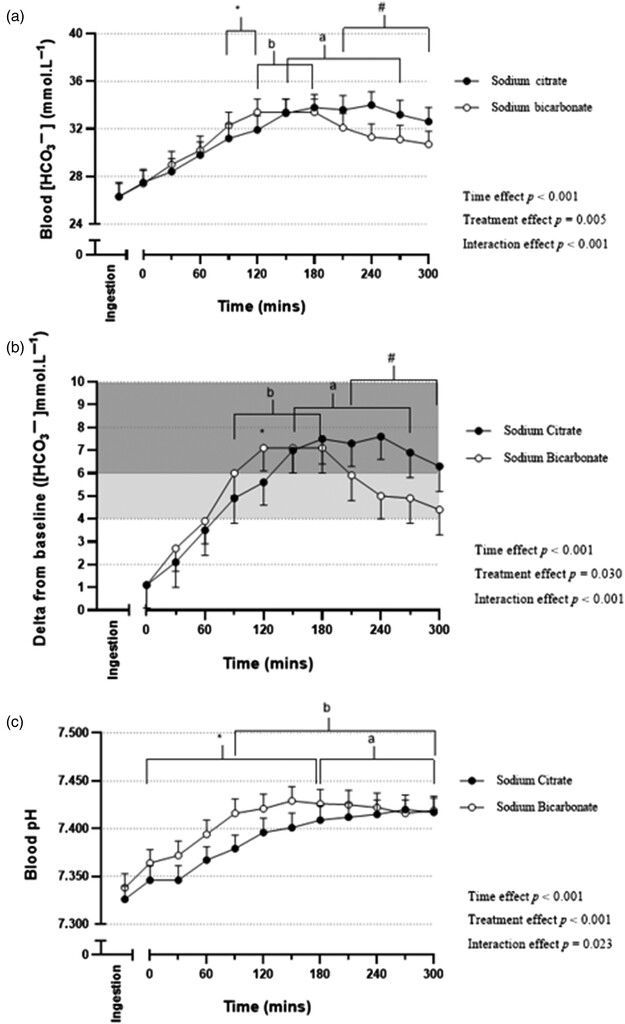
I'd say give the citrates a try for simplicity although in this study, the gastrointestinal side effects/complaints were comparable between SC (~35g!) and uncoated SB (~21g!).
Whilst the SC also does meddle with stomach pH, it won't react to CO2 (burping, flatulence).
The release of HCO3- from citrate happens indirectly through liver tricyclic-acid metabolism.And of course use potassium citrate or a citrates blend instead of the sodium salt.
@mossy @ena There are several online suppliers of potassium citrate capsules (~1110mg per capsule, whereof 400mg K) as an affordable alternative to buying the pure powder and dissolving a teaspoon in water two times a day.
10grs of potassium citrate contain about 3.6grs K, 10grs of potassium bicarbonate ~3.9grs K.
Although the same amount (by weight) of citrate is not as effective as bicarbonate, on a regular daily basis I think one can shift between using either. -
Thank you @CrumblingCookie. Good information. But I see no financial advantage in citrate, here in the UK potassium citrate powder costs £14/kg and potassium bicarbonate £4/kg.
-
Protective Effects of Ginger against Aspirin-Induced Gastric Ulcers in Rats
-
Phytol
Phytol lowers weight gain on a HFD. Drastically increases UCP1 (by 10x in white adipose tissue!), PGC1a and AMPK. It also strongly increases the most important enzyme for glucose oxidation, Pyruvate dehydrogenase (PDH).
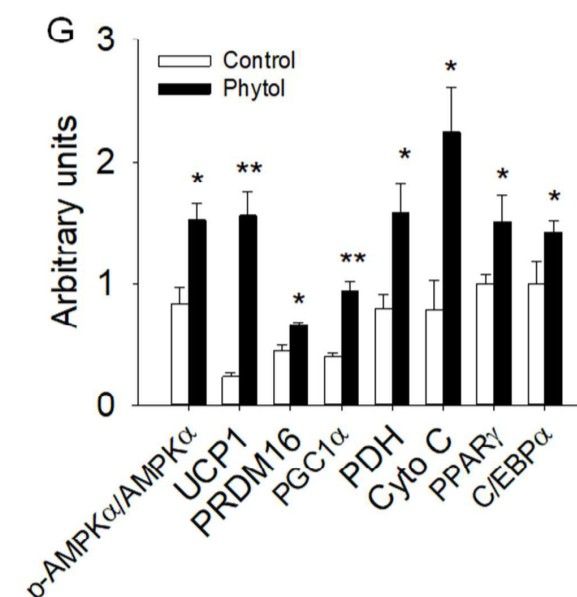
https://sci-hub.ren/10.1039/C7FO01817G
"...PHY efficiently interacts with COX-1 and 2, NF-κB, and IL-1β. In conclusion, PHY exhibits anti-inflammatory activity, possibly via COX-1 and 2, NF-κB, and IL-1β dependent pathways."
https://pubmed.ncbi.nlm.nih.gov/32583784/
Phytol, Produces Antihyperalgesic, Anti-inflammatory, and Antiarthritic Effects
https://pubmed.ncbi.nlm.nih.gov/32091204/
Phytol seems to be a GABA-A receptor agonist, lengthening sleep time
https://pubmed.ncbi.nlm.nih.gov/39357640/
Again, it binds to GABA-A receptor, but also to 5HT1A. Not sure if it agonizes or antagonizes it.
https://pmc.ncbi.nlm.nih.gov/articles/PMC11926570/
Phytol drastically inhibits gastric ulcers
https://pubmed.ncbi.nlm.nih.gov/38717706/
Could be a dopamine d2 antagonist based on its antiemetic properties. But could also be due to possible 5ht3 antagonism (similar to ondansetron) .
https://pmc.ncbi.nlm.nih.gov/articles/PMC10008523/
Anti-bacterial effect / anti-biofilm
https://pubmed.ncbi.nlm.nih.gov/27667264/
https://pmc.ncbi.nlm.nih.gov/articles/PMC5723315/
In Vitro Anticancer Activity of Phytol on Human Non-Small Cell Lung Cancer A549 Cells
https://pubmed.ncbi.nlm.nih.gov/40468754/
Phytol lowers inflamamtion (paw edema) induced by serotonin or histamine.
It also lowered inflammatory cytokines and MDA and increased glutathione. The effect was dose dependant.
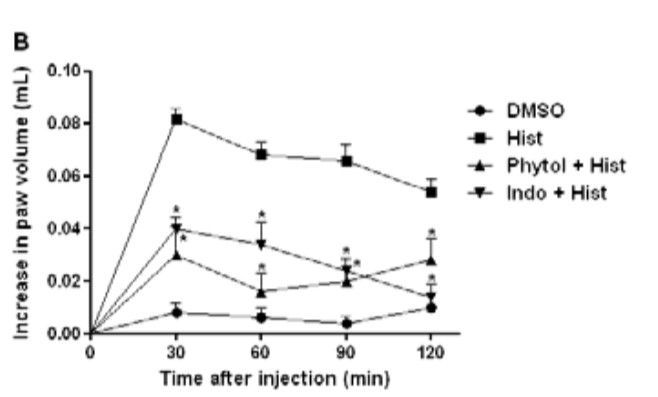
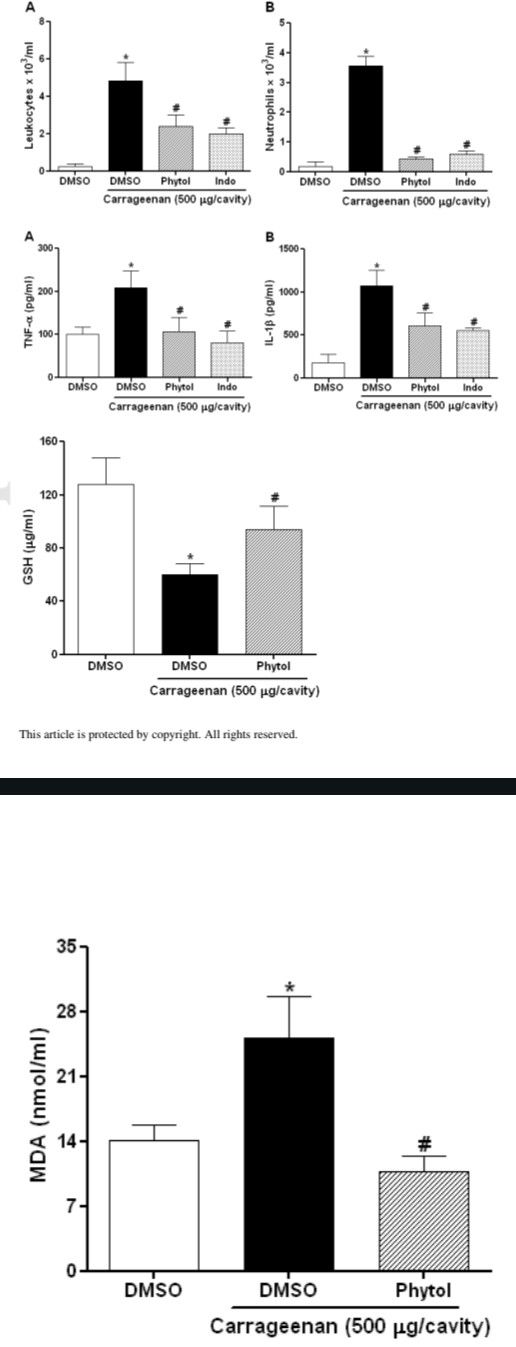
https://sci-hub.ren/10.1111/fcp.12049
BTW Haidut posted studies on phytol increasing progesterone and testosterone synthesis. The optimal dose was an HED of around 0.8mg/kg
https://lowtoxinforum.com/threads/archive-info-for-old-gonadin-version.43485/
Haidut also posted this study which shows that phytol inhibits an enzyme thst leads to lower NAD levels. So they showed that giving mice phytol increased blood NAD levels.
https://pubmed.ncbi.nlm.nih.gov/23832361/It's a completely different pathway compared to what is usually used to manipulate NAD levels.
This enzyme is mostly expressed in liver and kidneys.
In studies it was shown that inhibitiing this enzyme reversed NAFLD and acute kidney injury!
https://pmc.ncbi.nlm.nih.gov/articles/PMC11741923/Dare to think.
My X:
x.com/Metabolicmonstr -
Lemon balm / Melissa
Anti-estrogenic:
anti-cancer effect against breast cancer . Most effective against estrogen sensitive breast cancer.
https://pubmed.ncbi.nlm.nih.gov/32351599/It decreases the severity of dismenorrhea, again pointing towards an anti-estrogen effect.
https://pmc.ncbi.nlm.nih.gov/articles/PMC6447884/Decreases symptoms of PMS.
https://pmc.ncbi.nlm.nih.gov/articles/PMC4557408/Anti- prolactin/Anti-TSH:
https://pubmed.ncbi.nlm.nih.gov/7202226/
Lowers weight gain on a HFD. Lowers FFAs and triglycerides.
https://sci-hub.ren/10.1016/j.jep.2020.113360
Thyroid:
It seems to be the common opinion that lemon balm is anti-thyroid. The studies that I've read only point towards it being anti-TSH. That's a difference. Peat was against TSH.
"TSH has direct actions on many cell types other than the thyroid, and probably contributes directly to edema, fibrosis, and mastocytosis."
I found a study where they induced hyperthyroidism and indeed lemon balm did lower thyroid hormones - but only in the hyperthyroidism group. Not in the group that only received lemon balm. As you csn see below, in normal animals it had basically no effect on thyroid hormones (MO group).
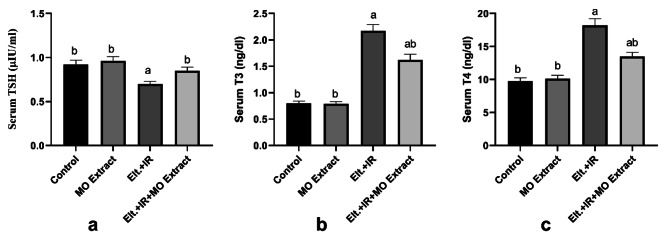
https://pubmed.ncbi.nlm.nih.gov/2985357/Dare to think.
My X:
x.com/Metabolicmonstr -
Androgenic and aphrodesiac action of the medicinal plant Lithospermum Arvense (bird millet)




Hello! It looks like you're interested in this conversation, but you don't have an account yet.
Getting fed up of having to scroll through the same posts each visit? When you register for an account, you'll always come back to exactly where you were before, and choose to be notified of new replies (either via email, or push notification). You'll also be able to save bookmarks and upvote posts to show your appreciation to other community members.
With your input, this post could be even better 💗
Register Login