Bile can serve as a reservoir for funghi, making them harder to treat
-
These are interesting findings from studies IMO:
Blood-group influence on Candida/fungal colonization:
It exists and has a signficant impact. It comprises two main known factors:No. 1:
The main groups A, B, 0, whereof 0 carries the greatest risk for (chronic) Candida infection. This is likely because type-0 cells show an L-fucose open end, to which Candida adhesins can preferably bind to.Here's an Iranian study on this in healthy people without fungal diseases:
A comparative study of Candida albicans mean colony counts and blood group antigens in the saliva of healthy subjects, 2014
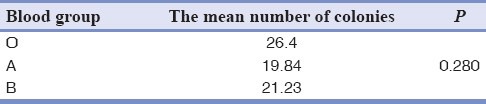
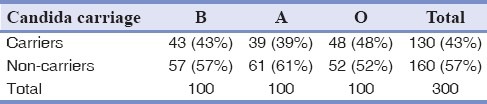
Tbh, I can't openly see why these stark differences from a sample size of 300 are not statistically significant.
However, the authors even point to a greater caveat and possibly much large impact:According to the molecular studies conducted on the interactions between adhesin receptor and oral epithelial cell-surface antigens, we should expect that most of the C. albicans fungi in blood group O are attached to the oral epithelial cells and fewer free fungal cells are found in the saliva. Therefore, it seems that saliva collection methods alone are not sufficient to calculate the amount of fungal cells in the oral cavity.
No.2:
Being a secretor/non-secretor through as determined by the FUT2 gene.
A functional FUT2 gene allows people to secrete their blood group antigens (sugars) into mucosal fluids like saliva, gut mucus, and tears. Homozygous FUT2 mutations make for a non-secretor.
These free-floating blood group antigens in the mucus act as decoy receptors (sort of like free mannose for E.coli). If you don't have this peripheral shielding your mucosal cells bear the full brunt of the fungal exposure.This one is from the U of Edinburgh:
Non-secretion of blood group antigens and susceptibility to infection by Candida species, 1989
This one from the U of Glasgow:
Blood group glycolipids as epithelial cell receptors for Candida albicans , 1996
In the 2nd week the benefits started fading. I seem to develope tolerance once again.
Wondering and curious about whether you are indeed developing tolerance via specific cytochrome upregulation or receptor downregulation.
Or whether your subjective benefits are exhausting some other pathway or regenerative substrate, like choline or calcium or anything. -
And I was looking for the answer on whether FMTs are a guarantor for clearance of fungal abundance in the small intestinal or colonic lumen.
Surprisingly, it's a no!
It appears to be even the other way round.Here's something interesting IMO about FMTs:
Gut fungal dysbiosis correlates with reduced efficacy of fecal microbiota transplantation in Clostridium difficile infection, 2018
In this study, it is shown that CDI is strongly accompanied by over-representation of Candida albicans and decreased fungal diversity, richness, and evenness.
Post-FMT, successful responders lack their previous C. albicans dominance but rather display a high relative abundance of Saccharomyces and Aspergillus.
High abundance of C. albicans in donor stool also correlates with reduced FMT efficacy.
In essence, therefore, annihilation of Candida dominance in CDI patients is crucial for FMT success and arguable it could be much advisable to pre-/co-treat any CDI with antifungals along with either ABx or FMT.Another study showed contrasting results of FMT on UC:
Fungal Trans-kingdom Dynamics Linked to Responsiveness to Fecal Microbiota Transplantation (FMT) Therapy in Ulcerative Colitis, 2020
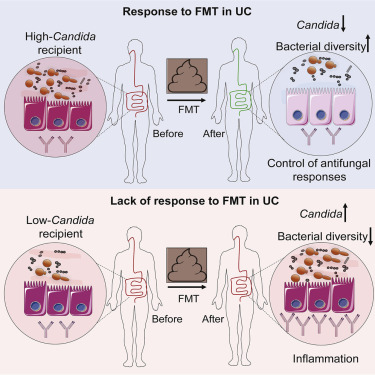
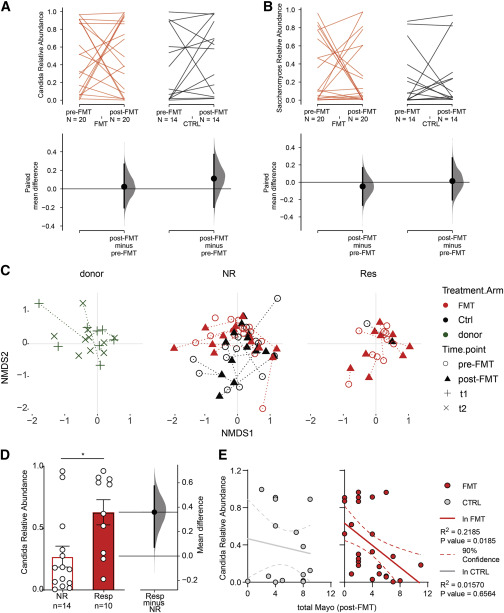
Herein they showed that in contrast to FMT in CDI, clinically successful response to FMT in UC very much depended on high Candida abundance at baseline, which decreased after FMT. The authors argue that the prior Candida dominance may provide a specific niche for bacterial engraftment, ameliorating UC.
So, the very opposite of the pre-conditions in CDI.
However, what the authors do not talk about in their text but what their graphs clearly show is the following caveat: UC patients with a low relative Candida abundance at baseline did not only not clinically benefit from the FMT, but their dysbiosis, inflammation and Candida levels post-FMT was mostly even larger than before (confounders? Small sample size?):
 ´
´ -
Wondering and curious about whether you are indeed developing tolerance via specific cytochrome upregulation or receptor downregulation.
Or whether your subjective benefits are exhausting some other pathway or regenerative substrate, like choline or calcium or anything.Not sure. But I suspect its the liver becoming better at metabolizing it. Happens to me with many other supplements as well. Not caffeine though. So it seems to affect only cetain enzymes.
I'll try dandelion next.Also finally found some good aged cascara, and it really does seem to be good for liver health.
Dare to think.
My X:
x.com/Metabolicmonstr -
@Mauritio Dandelion root, one of the bitters, helped restore my liver's ability to conjugate or make bile. But I was also taking vco and taurine to help restore that ability.
I noticed my bowels were pale, and during that time, my skin was experiencing allergy. The pale color meant I don't have enough bile production to allow effective secretion of toxins fecally. And my skin became the alternative path for toxin clearance.
-
@yerrag Interestingly I can't find a single study showing cholagogue or choleretic effects of dandelion.
I took dandelion extract for the first time yesterday and it seems to be quite stimulating. Not sure if that was a one time only effect, but I found a study showing that it increases dopamine, noradrenaline and adrenaline.
"T. officinale extract exerts it effects by significantly (p<0.05) decreasing the levels of corticosterone and increasing the concentrations of dopamine, noradrenaline, and adrenaline. "
https://pmc.ncbi.nlm.nih.gov/articles/PMC6340315/Dare to think.
My X:
x.com/Metabolicmonstr -
I am quoting Deepseek AI on the choleretic effects. I haven't been quite doing personal deep research lately ao here goes:
Yes, dandelion root (Taraxacum officinale) is widely recognized as having choleretic effects.
Here’s a breakdown of what that means in practice:
How it works
Research, primarily in animal models, indicates that dandelion root extract can stimulate the liver to increase bile production. The effect is attributed to its bitter sesquiterpene lactones (like taraxacin) and other compounds. By increasing bile flow, it may help:
· Improve digestion of fats
· Gently relieve constipation linked to poor bile output
· Support the liver's natural detoxification pathwaysThe distinction you need to know
· Choleretic: Dandelion root is a choleretic — it increases bile production by the liver.
· Cholagogue: It is often also described as having mild cholagogue action — meaning it may also help stimulate the release of bile from the gallbladder.Evidence and traditional use
· Traditional herbalism: It’s a classic "bitter" digestive tonic and liver herb, approved by the German Commission E (a respected herbal regulatory body) for dyspeptic complaints and disturbances in bile flow.
· Clinical research: Human clinical trials are limited, but animal studies and pharmacological reviews consistently support its choleretic activity.
· Caveat: Because it stimulates bile flow, it is contraindicated for people with blocked bile ducts, active gallstones causing symptoms, or acute gallbladder inflammation unless under professional supervision.So, if you were connecting your previous queries — yes, the jump from the slang "cholalogic" to the real medical term "choleretic" leads directly here: dandelion root is one of the classic, evidence-backed examples.
-
@yerrag I am not doubting that it has these effects, I was just surprised that there isnt any studies on it (as opposed to gentian for example)
BTW I took it again today and the stimulating effects seem to be a lot less pronounced already.
Dare to think.
My X:
x.com/Metabolicmonstr -
@Mauritio It's admirable that you have caught on to Ray's method of feel when using substances. I slowly become more sensitized such as when I make a connection between feeling skin allergies when I observe a pattern emerge that my skin allergy would coincide with pale stools signifying the lack of bile production. But it's notable that I only make that connection because skin allergy is not a common experience with me that when it happens it stands out for me to be able to make a cause and effect relationship to it. Yet, my pattern recognition ability fails me when I take dandelion root, as I dont feel any palpable effect from taking it. I would only get confirmation that it is working after 2 weeks of taking it when I see my stools look darker followed up by the loss of skin allergy. Still, knowing the skin is a secondary mechanism of detox helps me connect the dots in being able to identify loss of bile production with my liver and gallbladder.
I am not as sensitive as you and Ray when it comes to directly feel the effect of taking aubstances and I have to rely on observing outward effects after a given amount of time to allow for the delay for effects to be observed. I even have to shy away from outright using stacks as opposed to a gradual addition of substances, just to be able to identify which substance has an outsize effect, and which can be removed from the stack because it gives diminishing returns or even has unintended effects that confound rather than elucidate. Still, I rely on feel as much as I can.
Although I am more tech ( personal devices such as bp, spO2, and ECG) and test (blood test as the most common example) oriented, as feel isn't enough for me when I can't rely on it when it is absent.
As to you noting the absence of studies for various herbs in the apothecary of herbal medicine, there are many studies that have yet to be made given the richness that abounds in flora. But for those where studies have been made, many are not searchable despite the efforts of Google to make them aearchable, and many are even intentionally siloed and disappeared. Thus, we are able only to benefit from a small subset of herbs that mankind has discovered if we were to rely on the limited scope modern and commercial medical science and its curators limit us to.
-
Hesperitin, as in the aglycone flavonol with CAS # 520-33-2, is said to be super-potent against fungal biofilms,
in contrast to the Hesperidin glycoside CAS # 520-26-3.
The latter is actually a precursor whose rutenoside group must first be hydrolyzed for it to become active hesperitin. Practically, this means for anyone suspecting/targeting fungal biofilm in the (distal) colon, hesperidin is a sound option. It's available as consumer-targeted dietary supplements extracted from citrus fruit.
But for anything more proximal, all along the small intestine, direct hesperitin is needed. No domestic OTC-products are available, but raw powders can be obtained with extra costs and efforts.I'm not done with this fungal topic yet. I've looked into every side avenue of why fluconazole past a certain dosage thresold was so effective on me for the short time I had taken it.
And none of the alternative explanations via potassium efflux pumps (IRk specifically) or its cytochrome inhibition profile make any sense as to why it would alleviate diarrhea. It likely really is a C. glabrata-dominated fungal biofilm background to it all.Taking the flucotysin by itself btw was really stupid of me. Since I reckon nobody who had been reading here had the experience of being a clinical fungal disease expert who could have told me before I will stress it from the lay level:
5-FC was/is idiotic to take by itself because resistance/tolerance to it arises essentially immediately.
So that's why it had no significant effect at all.
Among the echinocandins group of antifungals, rezafungin is the latest and most hydrophilic / hygroscopic and also provides a very long half-life in-vivo allowing for once-weekly i.v. administration schedules. -
@CrumblingCookie so did you stack stuff with fluconazole to lower its MIC and MFC?
are you gonna get brexafemme? -
@sunsunsun Yes, a bulb of garlic/d, oregano oil 4-5 drops/d, borax water, propolis extract. Maybe, maybe it will take even more than 300mg/d to show effects without such a stack.
It's also quite certain from studies that (flucon)azole is really pretty useless against C. glabrata biofilms as it simply doesn't penetrate nor dissolve it. Probably that's why some treatments call for weeks of really high dosage (800mg/d) followed by months or forever of a lower maintenance dosage. With the latter probably just keeping whatever's already established itself under check yet without further removing any of it.
If going with azoles, maybe superdosing hesperitin could be of intestinal and systemic complementary merit and maybe superdosing nystatin (20M IU/d) for the intestinal lumen could be, too.The brexafemme in the patient studies doesn't even look as exceptional but more or less equally successful, empirically, as fluconazole when treatment groups aren't separated according to prior susceptibility testing.
It should be distinctly more promising wrt biofilms, however, because fungal biofilms can sustain themselves with almost no ergosterol (azoles) whereas the β-(1,3)-glucan (ibrexafungerp or echinacandins) is much more essential to their structure and survival.At this point there is so little data on the brexafemme, though. I'd prefer an echinocandin. Mica- or rezafungin are reported to be efficacious against biofilms yet their mucocutaneous use, albeit highly promising, is still on the fringe side. Maybe the reza even therapeutically reaches the bile? Its distribution pattern and volume suggests it pretty much goes everywhere and its excretion is mostly fecal (not biliary but by passive diffusion) and still in its active drug form.
-
@CrumblingCookie Hesperedin/ Hesperitin are interesting substances. IIRC @cs3000 posted some good studies on them on the RPF.
And not only is it anti-fungal, but in accordance with the topic of this thread, it could help with fungal issues via alleviating cholestasis / helping with bile flow.
It is an FXR agonist:
"HP prevented bile acid toxicity in HepaRG cells, and this effect was blocked by FXR silencing. HP appears to activate FXR to prevent cholestatic liver injury."And a Cholagogue:
"...HP promoted bile acid excretion into feces..."https://pubmed.ncbi.nlm.nih.gov/32841642/
Also seems to be anti-estrogenic and activates 5HT1a
https://pubmed.ncbi.nlm.nih.gov/23238426/
https://pubmed.ncbi.nlm.nih.gov/22996046/ -
Satish Rao MD seems to be one of the few who actually tackle SIFO, i.e. a non-invasive persistent fungal burden in the small intestine, without parroting health-scene mumbo-jumbo. In this short interview he briefly talks about the beginnings and reluctance of medical peers, but also how one can essentially pretty much forget about any sensible testing methods other than culturing of samples of duodenal juice obtained from gastroduodoscopy (caveat: Taking a duodenal juice sample instead of discarding the pumped-off fluids sounds simple enough and I've known about it for years, yet still pretty much not even any universitiy clinic does this! To my surprise, it's not only me being surrounded by stubborn idiots but he also mentions this situation in practice and how gastroenterologists just need to discuss these goals once in advance with their microbiology lab provider to set up such a then routine diagnostic)
Youtube VideoHe also tackles SIBO by choosing the Abx according to the individual antibiograms of such sample cultures. Which makes a lot of sense. Another facepalm moment to not do so.
As for the SIFO, if the culture is unavailable he goes by clinical suspicion and states that a three weeks' regimen of fluconazole 100mg daily is well tolerated and of very little worry in comparison to the hoops and ordeals to otherwise (or subsequently) go through.
I must remark, however, that fluconazole is of very little efficacy and at best only fungistatic against C. glabrata in contrast to the better-suited posaconazole.
On a side note: C. glabrata or C. krusei don't produce D-arabinitol. Only C. albicans does. Testing for D-arabinitol in urine can therefore only show presence of C. albicans.@mauritio Thanks! I had found cs3000's three RPF threads on it and they had great info. Nice to see that the Iranians have already run some human trials with 500-1000mg p.o. of it daily. It's four times as bioavailable as an equimolar amount of hesperidin (from colonic hydrolysis in healthy people). Lemons containing much more precursors for it than oranges.
Hesperitin's boosting of mitochondria and efficacy against senescence is mightily impressive. It's also synergistic with other flavonoids like the naringin which you had been all over about. Hesperitin is being sold for about USD150-250/kg. -
I was hoping for more impressive results when I stumbled upon a potential anti-fungal-biofilm effect of melatonin but the addition of MEL shows no truly reliable effect on any Candida species nor their biofilms.
Instead, posting this table here rather serves as an illustration of how insanely resistant biofilm-embedded Candida spp. are to antifungals: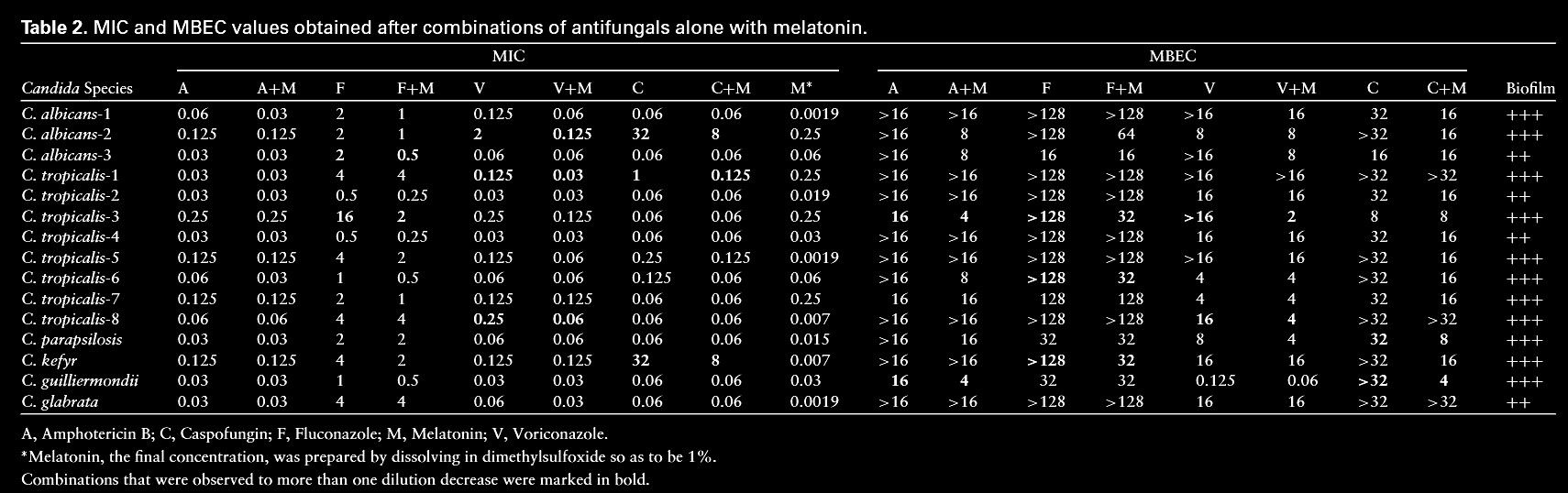
From: The effect of melatonin on antifungal susceptibility in planktonic and biofilm forms of Candida strains isolated from clinical samples, Kilinçel et al., 2019
On the plus side, only 19 out of 350 clinical samples of Candida strains were at all biofilm-building in vitro, i.e. not every fungal strain one could have or get will be as devilish.
-
@mauritio Thanks! I had found cs3000's three RPF threads on it and they had great info. Nice to see that the Iranians have already run some human trials with 500-1000mg p.o. of it daily. It's four times as bioavailable as an equimolar amount of hesperidin (from colonic hydrolysis in healthy people). Lemons containing much more precursors for it than oranges.
Hesperitin's boosting of mitochondria and efficacy against senescence is mightily impressive. It's also synergistic with other flavonones like the naringin which you had been all over about. Hesperitin is being sold for about USD150/kg.Nice. do you have any exerience with hesperedin ? (since hesperetin is so hard to get)
-
@Mauritio I'm going to dot the i's and cross the t's in this case and source the hesperitin for 500mg of it twice daily with antifungals.
Haven't tried any hesperidin/bergamot extract before, of which I've only heard that it's effectively lowering triglyceride and total cholesterol levels in people whose digestion isn't whacked. -
@CrumblingCookie
Why aren't you taking much higher doses of hepseredin and let your gut do the conversion ?I think taking hesperidin / hesperitin might be one of the highest ROIs in the bioenergetic field.
Especially if you take into account the studies @cs3000 posted on the RPF and I've also added some here. It's wild how many benefits it has.Dare to think.
My X:
x.com/Metabolicmonstr -
I think taking hesperidin / hesperitin might be one of the highest ROIs in the bioenergetic field.
I have done 3l of orange juice for a few months which apparently has 1,800 mg Hesperidin.
I didn't notice any benefits from this. If this multi factoral experiment means anything.

-
@alfredoolivas I think I notice more from a hesperidin supplement than from an equivalent amount of orange juice.
I call this "the isolated compound paradox" . Happens frequently, not sure why. -
Why aren't you taking much higher doses of hepseredin and let your gut do the conversion ?
I want it to be active in high concentrations already in the lumen of the proximal small intestine for on-site support of nystatine megadosing and the azole (+ maybe NAC). If I were to not have that target I'd indeed simply buy and use plenty of the OTC capsules.
I think taking hesperidin / hesperitin might be one of the highest ROIs in the bioenergetic field.
+1. Great findings.
IMO much more promising, functional and better ROI than e.g. urolithin A or all those Mephistophelean crooked dopamine modulators far, far far downstream.
Melatonin is the other protagonist of mitochondrial health I'm currently swayed by.Had been taking 160mg of it each night for a few weeks now. The daytime grogginess btw disappeared with a combo of large-dose niacin, riboflavin, biotin and P5P. Took 3grams melatonin last night. Same effect of relaxed sleepiness from about 1 hour in but much smoother skin today. However, at such doses it appears to be the most powerful inducer of the gastrointestinal MMC I've come across and that's way too much for me in my state of being. Probably great for the on-the-brink-of-constipation folks, though. Oh boy, I do hope to become better.
Back to the fungal topic:
I'm suspecting there's something profoundly wrong with the quality of pharmacy nystatine 500,000 IU tablets. They may be consistently underdosed or super-degraded garbage. Perhaps that's why they stopped working rather than from causes within the individual.
It's a bit of a mental barrier to start assuming such but every now and then throughout the years I have come across anecdotes of other pharmaceuticals where brand or origin is of crucial difference for therapeutic response.
Raw nystatine is super sensitive and quickly degrades upon exposure to light or humidity.



Hello! It looks like you're interested in this conversation, but you don't have an account yet.
Getting fed up of having to scroll through the same posts each visit? When you register for an account, you'll always come back to exactly where you were before, and choose to be notified of new replies (either via email, or push notification). You'll also be able to save bookmarks and upvote posts to show your appreciation to other community members.
With your input, this post could be even better 💗
Register Login