Dandruff or scalp irritation? Try BLOO.

    Bioenergetic Forum
    • Categories
    • Recent
    • Tags
    • Popular
    • Users
    • Groups
    • Register
    • Login

    Boiling greens

    Scheduled Pinned Locked Moved The Kitchen
    27 Posts 8 Posters 714 Views 6 Watching
    Loading More Posts
    • Oldest to Newest
    • Newest to Oldest
    • Most Votes
    Reply
    • Reply as topic
    Log in to reply
    This topic has been deleted. Only users with topic management privileges can see it.
    • C Offline
      Corngold @Milk Destroyer
      last edited by

      @Milk-Destroyer

      I am using an ai:

      Overall nutrient loss from boiling is more dramatic for vitamins than minerals. Total nutrient losses after boiling kale can range from 87 to 95%, though this figure includes vitamins and other compounds, not minerals alone.

      I asked for more on all the vitamins and research cited:

      Here's a comprehensive breakdown of the vitamins affected by boiling kale, along with the research behind each finding:

      Vitamin C (Ascorbic Acid)
      This is the most severely affected vitamin. A study published in PMC using HPLC analysis found that boiling galega kale reduced total vitamin C content by 63%, with ascorbic acid (AA) specifically dropping by 38%, and dehydroascorbic acid (DHA) falling by 85%. A separate study confirmed similar results: Akdaş and Bakkalbaşı found that ascorbic acid decreased by 53.1% from boiling, compared to just 2.9% from steaming — making boiling the second-worst method after stir-frying (54.9%). The 2023 Journal of Food Processing and Preservation review by Khalid et al. explains that vitamin C loss is primarily driven by leaching, and is worsened by longer cooking times, higher temperatures, greater surface area exposed to water, and exposure to light and oxygen. nih + 2

      Vitamin B1 (Thiamine)
      A study in PMC measured vitamins in kale using HPLC and found that after blanching at 100°C for 20 minutes, only 86.9% of vitamin B1 was retained — meaning a loss of about 13%. A ScienceDirect study found that cooking kale prior to preservation reduced B-group vitamins by 29–75%, noting that vitamins B1 and B2 are essential for metabolism and nerve function, making their loss nutritionally significant. nihScienceDirect

      Vitamin B3 (Niacin)
      The same HPLC-based study found that vitamin B3 was more heavily affected than B1, with only 55.6% retained after blanching — a loss of roughly 44%. nih

      Vitamin B2 (Riboflavin)
      The ScienceDirect study specifically examined vitamins B1 and B2 in kale, finding that cooking before preservation caused reductions of 29–75% depending on method, with B2 (riboflavin) losses being notable — and epidemiological studies have linked low riboflavin diets to increased cardiovascular disease risk. ScienceDirect

      Vitamin A / Beta-Carotene (fat-soluble)
      Fat-soluble vitamins like A and K are better preserved through sautéing than boiling, as the presence of oil enhances their absorption — whereas water-based cooking does not provide this benefit. Total carotenoids (the precursors to vitamin A) degraded by 28.2% from stir-frying, and while boiling figures were not separately isolated, water-soluble phytochemicals were significantly reduced by boiling overall. pTaylor & Francis Online

      Vitamin K (fat-soluble)
      Vitamin K is among the more stable vitamins — even after cooking, kale still offers substantial amounts of it, as it is fat-soluble and therefore not as prone to leaching into boiling water. That said, some loss does occur with prolonged boiling. Well Wisp

      Not the best format to read but here's a site on nutritional facts of kale:https://deltacalendar.com/nutrition/kale-analysis/

      Looks like steaming or stir-frying are superior to boiling for nutrient absorption.

      If you make southern greens with collards, kale and mustard greens, (garlic, peppers, onions, bacon, vinegar, brown sugar, hot pepper, etc) you will be eating more than one serving.

      I feel like if you're eating fruit, meat, milk, and eggs you should be covered with any additional cooked greens.

      1 Reply Last reply Reply Quote 0
      • C Offline
        Corngold @hwisdom
        last edited by

        @hwisdom

        What do you think of microwave defrosting? Any difference? I was thinking longer exposure might be worse than short and intense exposure. Maybe defrosting isn't as bad?

        I also have leaned away from microwaving food.

        LucHL 1 Reply Last reply Reply Quote 0
        • LucHL Offline
          LucH @Corngold
          last edited by LucH

          @Corngold said:

          What do you think of microwave defrosting? Any difference?

          Hi,
          I won't use microwave: Proteins are exploded.
          Critical temp for Vit C is 60° C but is higher with steamed cooking. (no pressure).

          Pressure cooking and amino acids
          Effect of high pressure steam on the eating quality of meat proteins
          High-pressure processing has potential for food preservation purposes because it can inactivate microorganisms and enzymes.
          The spatial configuration of some enzymes is changed. Proteins are composed of amino acids connected by amide bonds. Due to high reactivity under pressure and heat the molecules are twisted and changed. They could be no longer recognized by our digestive enzymes.
          Reference:
          The use of high pressure to modify the functionality of food proteins
          https://doi.org/10.1016/S0924-2244(97)01015-7
          However some studies have shown to make it easier to digest meat but high pressure can affect protein conformation and can lead to protein denaturation, aggregation or gelation, depending on the protein system, the applied pressure, the temperature and the duration of the pressure treatment.

          Steamed cooking with Vapok or "vitaliseur Marion" (Marion Kaplan):
          The most respectful cooking method
          Gentle steaming (95°C) is by far the ideal cooking method. It preserves nutrients (vitamins, enzymes, minerals) while eliminating natural toxins (excess fats, purines, bacteria) or artificial ones (mainly pesticides). It is a very quick cooking method that is very respectful of the integrity of the food.

          sunsunsunS 1 Reply Last reply Reply Quote 1
          • sunsunsunS Offline
            sunsunsun @LucH
            last edited by

            @LucH I agree, steaming is S-tier

            1 Reply Last reply Reply Quote 0
            • MossyM Offline
              Mossy
              last edited by

              Interesting. So pressure cooking may not be the best? That is how I do a lot of my cooking. I know microwaving has been in the cross-hairs for quite some time. I quit using my microwave for about 10 years because of all the negative talk about it, but have started again about 2 1/2 years ago. It's a definite time saver. I read somewhere that microwaving vegetables actually retained the most nutrients (could it have been Peat that said this?). I'm not asserting this as if I know it to be true, but kind of thought dumping in response to this subject. As time allows, maybe I can provide better information, source, quotes, etc.

              It's really tough to get the final answer on anything, but I respect and am open to arguments against modern cooking. In general, the modern world does tend to contaminate much that it touches. But, in the name of objectivity, one thing we know, the microwave and the pressure cooker have been around long enough for us to know that some people were able to eat food from them and not only survive, but live long lives.

              "To desire action is to desire limitation" — G. K. Chesterton
              "The true step of health and improvement is slow." — Novalis

              C 1 Reply Last reply Reply Quote 0
              • C Offline
                Corngold @Mossy
                last edited by

                @Mossy said:

                It's really tough to get the final answer on anything, but I respect and am open to arguments against modern cooking. In general, the modern world does tend to contaminate much that it touches. But, in the name of objectivity, one thing we know, the microwave and the pressure cooker have been around long enough for us to know that some people were able to eat food from them and not only survive, but live long lives.

                Have you heard of food irradiation? Supposedly the majority of food in stores including produce, meat, etc., is "irradiated" before it is packaged.

                https://www.iaea.org/newscenter/news/what-is-food-irradiation-and-why-is-it-important

                I don't know what the risks are. It seems if large agencies defend it then it might be pretty bad. On the other hand not many people know or talk about it, and I don't know if it's still being done.

                As for modern cooking, you're right because we "contaminate" so much, down to "bioengineered" food products.

                My opinion is that if you find traditional recipes for greens or other foods, then that is best. As for nutrients, isn't it that nutrients from greens leach into the broth? So a hearty soup / stew should have a good amount of nutrients in the broth.

                Had to ask a i for help:

                Water-soluble nutrients (leach heavily into broth)

                Vitamin C : 50–70% lost into the water (and further degraded by heat)
                B vitamins (folate, B6, thiamine): 30–60% can leach out
                Potassium and other minerals: 30–50% may pass into the broth

                Fat-soluble nutrients (mostly stay in the greens)

                Vitamins A, K, E: largely retained in the leaves since they don't dissolve in water
                Beta-carotene: mostly stays put, and heat can actually improve its bioavailability

                What this means practically
                The broth itself becomes genuinely nutritious — think of it like a light vegetable stock. If you discard the water, you're throwing away a meaningful share of the water-soluble vitamins and minerals. Drinking or using the broth in soups, rice, or sauces is a simple way to recover those nutrients.
                Factors that affect how much leaches out

                Chopping: more cut surfaces = more leaching
                Boil time: longer cooking = more loss
                Water volume: more water = more dilution and loss
                Temperature: a gentle simmer loses slightly less than a hard boil

                The bottom line: roughly 30–60% of water-soluble nutrients end up in the broth depending on conditions. Fat-soluble nutrients stay mostly in the greens. If you want maximum retention, steaming or sautéing is more efficient — but if you're boiling, save and use the broth.

                I don't think it's anything to worry too much about unless you're vegan or vegetarian. Those diets usually create vitamin / mineral deficiencies because they avoid dairy, meat, and fish.

                @Mossy

                MossyM 1 Reply Last reply Reply Quote 0
                • LucHL Offline
                  LucH
                  last edited by LucH

                  @mossy
                  Talk with AI (Claude)
                  Context 1 (nutrition and health forum)
                  LucH says:
                  I won't use microwave: Proteins are exploded. (...)
                  Context 2:
                  LucH thinks:
                  Pressure cooking may become a problem for human metabolism as long you usually use this way. So it’s a question of frequency and quantity.
                  And saying it’s quicker and that we all know people who do so for their grand-ma who lives like a well-fit centenarian (nearly a 100 year-old well-fit body-shaped person)...
                  We have all heard of a 100 year-old smoker who’s fine. Nobody won’t refute / disprove that cigarette is bad for lungs ...

                  Demand for AI
                  Don’t comment what precedes.
                  The forumer cooks the weekend for the week. The menus are +/ balanced for macronutrients LPG and most nutrients. Eat home-made food, not much from manufactured origin.
                  Be positive, moderate in advice. Need to register in 2 or 3 times, like most people when it’s a thorough change. The key demand: How to adapt to optimize when you don’t have time or energy to prepare a meal after a workday.
                  Don’t ask for detailed menus. Of course, he / she doesn’t suffer from thyroid, adrenal glands, low-grade inflammation, immune reaction …

                  Claude says:
                  Blabla (not pertinent).
                  => I summarize after 2x re-redirection.
                  So we suppose a lack of time and energy during the week. We accept short-time and easy cooking with potatoes, pasta and rice.
                  We use “meat cuts” that are allowed or +/ beneficial when cooked by pressure.

                  Here are suggestions for 3 “models”, for 2 days in the week.
                  Section 1 (for 2 days)
                  These share connective tissue and collagen — exactly what pressure cooking handles best. The result is tender, the cooking time is cut by half or more, and they reheat well during the week without drying out.
                  These are also generally less expensive cuts — an added practical advantage for batch cooking.

                  Examples:
                  Tough / thick cuts for pressure cooking — examples
                  Poultry
                  • Chicken thighs and drumsticks — ideal, stay moist
                  • Chicken whole legs — same
                  • Turkey thighs — less common but excellent
                  • Chicken wings — good for a richer result
                  Duck
                  • Duck legs — perfect for pressure cooking, fat renders well
                  • Duck confit-style preparation — works very well under pressure
                  • Duck thighs — same logic as poultry above
                  Rabbit
                  • Whole pieces or legs — underused but very well suited
                  • Stays tender, mild flavour, pairs with anything
                  Pork belly
                  • Shoulder — excellent
                  • Spare ribs — very good
                  • Cheeks — outstanding result
                  Beef / veal
                  • Shin, cheek, shoulder, short ribs
                  • Osso buco cuts — veal shin particularly good

                  Comment (LucH)
                  Moderate pork.
                  Duck breast and pork belly are specific cases
                  Duck breast (magret)
                  • Naturally tender — pressure cooking is too aggressive
                  • Best cooked pan-seared on weekend, medium doneness
                  • Reheats gently during the week without drying if sliced cold and warmed briefly in a covered pan with a little water. (Fine with musterd, if you like it so).
                  • 650g covers 3 days easily if portioned right
                  Pork belly
                  • Fatty and layered — pressure cooking actually works here
                  • Fat renders, meat stays moist, reheats very well
                  • Good candidate for the pressure cooker batch

                  So the distinction within this category
                  Cut / Method
                  Duck breast / Pan weekend, gentle reheat weekdays
                  Pork belly / Pressure cooker viable
                  Duck legs / Pressure cooker ideal
                  Chicken thighs / Pressure cooker ideal
                  NB: Roasted before pressure is best.

                  Section II (for 2 other days)
                  Pragmatic choices. What works well under pressure cooking
                  Legumes — best case for pressure cooking. Not 2 days in a row (anti-protease).
                  • Lentils, chickpeas, white beans, black beans
                  • Texture and digestibility actually improve
                  • Portion and freeze — grab one portion per weekday
                  Comment (LucH)
                  These two categories are where pressure cooking makes the most sense nutritionally and practically — long cooking times reduced problems. Need still to alternate.
                  What goes with it that's fast, real, and doesn't require weekend pre-cooking.
                  Eggs, tins, cheese — things that live in your kitchen permanently, no planning needed, combined with freshly cooked starch in 10 minutes total.

                  Third part — spontaneous weekday meals, no planning needed
                  Eggs + salad or tomato + a soup
                  • 5 minutes maximum
                  • Always available, no weekend prep required
                  Beans + pasta
                  • Pasta cooking = passive wait
                  • Beans from weekend batch or a tin — straight on top
                  Lentils + rice
                  • Both cookable during the week, passive
                  • Or lentils from weekend batch — even faster
                  Frozen mixed vegetables + wok + bacon
                  • 10 minutes, high heat, done
                  • Bacon adds fat and flavour instantly
                  • Frozen vegetables are nutritionally fine — underrated

                  MossyM 1 Reply Last reply Reply Quote 0
                  • Milk DestroyerM Offline
                    Milk Destroyer @alfredoolivas
                    last edited by

                    @alfredoolivas Perhaps, but I'm not certain. I actually was eating a lot more kale recently (maybe 150g a day) for a week and I did notice I had lost some weight (like 5lbs), but I was also walking in nature more at the time.

                    I'll try incorporating it more consistently and get back to you.

                    1 Reply Last reply Reply Quote 1
                    • MossyM Offline
                      Mossy @Corngold
                      last edited by

                      @Corngold said:

                      Have you heard of food irradiation? Supposedly the majority of food in stores including produce, meat, etc., is "irradiated" before it is packaged.

                      Now that you mention it, I do remember reading about that concept a while back. I don't know much about it, but you've motivated me to look into it.

                      Modernity has strangely meant a degradation of quality for the masses, The most affluent and prosperous era on earth (from my limited knowledge) should equate to the highest quality being more prevalent. That is not the case. Companies tout how something is "real" on packing, because in many cases the standard is synthetic, artificial, bio-engineered, etc.

                      There is something hearty and seemingly more nutritious about soups and broths. Coincidentally, soups and homemade broth are a staple of my cooking. And it's pressure cooking that allows for this extraction, or so it seems, over a shorter period than traditionally required. Based on your AI response, arguably the high heat of pressure cooking is the biggest factor to consider. It seems any leeching would simply go from the vegetable to the finished broth. But, if the heat killed off the nutrients before that could happen, that would be a bad thing, to say the least.

                      "To desire action is to desire limitation" — G. K. Chesterton
                      "The true step of health and improvement is slow." — Novalis

                      LucHL 1 Reply Last reply Reply Quote 0
                      • LucHL Offline
                        LucH @Mossy
                        last edited by

                        @Mossy said:

                        if the heat killed off the nutrients before that could happen, that would be a bad thing, to say the least.

                        Only ionizing some "food" to avoid fungus and kill insects. So. No inpact on enzyms and protein integrity.

                        Milk DestroyerM 1 Reply Last reply Reply Quote 0
                        • MossyM Offline
                          Mossy @LucH
                          last edited by

                          @LucH said:

                          We have all heard of a 100 year-old smoker who’s fine. Nobody won’t refute / disprove that cigarette is bad for lungs ...

                          Indeed. And I was going to offer up this very anecdote with my original comment. There are always exceptions to things we know in general are bad.

                          I appreciate your thorough response, and will comb through it. Thank you.

                          "To desire action is to desire limitation" — G. K. Chesterton
                          "The true step of health and improvement is slow." — Novalis

                          1 Reply Last reply Reply Quote 0
                          • Milk DestroyerM Offline
                            Milk Destroyer @LucH
                            last edited by

                            @LucH I've always wondered if substances going through airport xrays would have some effect on their structure, what do you think?

                            LucHL 1 Reply Last reply Reply Quote 0
                            • LucHL Offline
                              LucH @Milk Destroyer
                              last edited by LucH

                              @Milk-Destroyer said:

                              I've always wondered if substances going through airport xrays would have some effect on their structure, what do you think?

                              It is entirely a matter of intensity, duration, and repetition
                              Summary:
                              1. The Sun (The Borderline Case)
                              Time exposure makes the difference
                              While visible light is completely safe, the Sun emits Ultraviolet (UV) rays. UV light sits exactly on the border of the ionizing spectrum. It has short enough wavelengths to pack a punch. It physically damages skin cells and causes sunburns, which is why it can lead to structural DNA changes (skin cancer) over time.
                              However Infra-Red light is fine when you adapt the wavelength and the duration.
                              Picture 8.
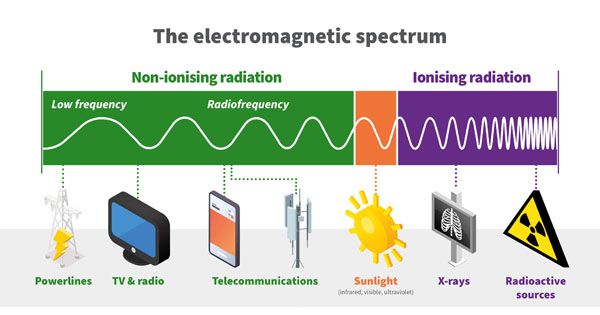
                              8. Electro-magnetic Spectrums from several devices.jpg

                              2. Cell Phone in a Pocket (Trouser or Breast Pocket)

                              • Ionization Capability: Absolutely zero.
                              • Warmth has a incidence (thermal effect).
                                NB: Everybody won’t agree here. I don’t put mine in a trouser pocket since it has an influence on my hand when I use it for a long time on internet.

                              3. Public Electric Streetlight
                              Zero impact if you’re not electrical sensitive (50Hz to 60Hz).
                              NB: It's different if it's a high-voltage pylon. Cows whose water trough is under this type of pylon produce significantly less milk.

                              4. Airport Scanners
                              Too short to have an impact. + low level on the scale.

                              5. Dental xRays:
                              Yes.
                              I’ve asked Google to develop some points. Has to be confirmed by another source since we can’t trust AI, as you already know. AI flatters you and sometimes invents / often extrapolates to avoid contradicting itself.

                              The Physics of Exposure
                              • Intensity: Both airport scanners and dental X-rays use extremely low-intensity beams. They are engineered to look only at surface levels or thin jaw bones, requiring a fraction of the power used for deep-tissue medical scans like CT scans. [1, 2]
                              • Duration: The exposure time is measured in milliseconds. The beam clicks on and off almost instantly, minimizing the window of interaction with your cells.
                              • Repetition: For the average person, these events happen once or twice a year. The human body has highly efficient, constant cellular repair mechanisms that easily fix the minor, isolated cellular stress caused by such infrequent, low-dose exposures. [1]

                              The Exception: Developing Life
                              Your concern about pregnant women is scientifically spot-on.
                              • Rapid Cell Division: A fetus is in a state of rapid development. Cells are dividing constantly to form organs and body structures.
                              • Higher Sensitivity: Cells undergoing mitosis (division) are significantly more vulnerable to DNA alterations from ionizing radiation.
                              • Precautions: This is why dental offices use extra precautions, like lead aprons that cover the abdomen, or delay non-urgent routine X-rays until after delivery, purely as a protective measure for that sensitive stage of life. [1, 2]
                              For an adult, a few routine exposures do not accumulate enough energy to alter your body's structure.


                              1 Reply Last reply Reply Quote 1

                              Hello! It looks like you're interested in this conversation, but you don't have an account yet.

                              Getting fed up of having to scroll through the same posts each visit? When you register for an account, you'll always come back to exactly where you were before, and choose to be notified of new replies (either via email, or push notification). You'll also be able to save bookmarks and upvote posts to show your appreciation to other community members.

                              With your input, this post could be even better 💗

                              Register Login
                              • 1
                              • 2
                              • 2 / 2
                              • First post
                                Last post