Bile can serve as a reservoir for funghi, making them harder to treat
-
@CrumblingCookie so did you stack stuff with fluconazole to lower its MIC and MFC?
are you gonna get brexafemme? -
@sunsunsun Yes, a bulb of garlic/d, oregano oil 4-5 drops/d, borax water, propolis extract. Maybe, maybe it will take even more than 300mg/d to show effects without such a stack.
It's also quite certain from studies that (flucon)azole is really pretty useless against C. glabrata biofilms as it simply doesn't penetrate nor dissolve it. Probably that's why some treatments call for weeks of really high dosage (800mg/d) followed by months or forever of a lower maintenance dosage. With the latter probably just keeping whatever's already established itself under check yet without further removing any of it.
If going with azoles, maybe superdosing hesperitin could be of intestinal and systemic complementary merit and maybe superdosing nystatin (20M IU/d) for the intestinal lumen could be, too.The brexafemme in the patient studies doesn't even look as exceptional but more or less equally successful, empirically, as fluconazole when treatment groups aren't separated according to prior susceptibility testing.
It should be distinctly more promising wrt biofilms, however, because fungal biofilms can sustain themselves with almost no ergosterol (azoles) whereas the β-(1,3)-glucan (ibrexafungerp or echinacandins) is much more essential to their structure and survival.At this point there is so little data on the brexafemme, though. I'd prefer an echinocandin. Mica- or rezafungin are reported to be efficacious against biofilms yet their mucocutaneous use, albeit highly promising, is still on the fringe side. Maybe the reza even therapeutically reaches the bile? Its distribution pattern and volume suggests it pretty much goes everywhere and its excretion is mostly fecal (not biliary but by passive diffusion) and still in its active drug form.
-
@CrumblingCookie Hesperedin/ Hesperitin are interesting substances. IIRC @cs3000 posted some good studies on them on the RPF.
And not only is it anti-fungal, but in accordance with the topic of this thread, it could help with fungal issues via alleviating cholestasis / helping with bile flow.
It is an FXR agonist:
"HP prevented bile acid toxicity in HepaRG cells, and this effect was blocked by FXR silencing. HP appears to activate FXR to prevent cholestatic liver injury."And a Cholagogue:
"...HP promoted bile acid excretion into feces..."https://pubmed.ncbi.nlm.nih.gov/32841642/
Also seems to be anti-estrogenic and activates 5HT1a
https://pubmed.ncbi.nlm.nih.gov/23238426/
https://pubmed.ncbi.nlm.nih.gov/22996046/ -
Satish Rao MD seems to be one of the few who actually tackle SIFO, i.e. a non-invasive persistent fungal burden in the small intestine, without parroting health-scene mumbo-jumbo. In this short interview he briefly talks about the beginnings and reluctance of medical peers, but also how one can essentially pretty much forget about any sensible testing methods other than culturing of samples of duodenal juice obtained from gastroduodoscopy (caveat: Taking a duodenal juice sample instead of discarding the pumped-off fluids sounds simple enough and I've known about it for years, yet still pretty much not even any universitiy clinic does this! To my surprise, it's not only me being surrounded by stubborn idiots but he also mentions this situation in practice and how gastroenterologists just need to discuss these goals once in advance with their microbiology lab provider to set up such a then routine diagnostic)
Youtube VideoHe also tackles SIBO by choosing the Abx according to the individual antibiograms of such sample cultures. Which makes a lot of sense. Another facepalm moment to not do so.
As for the SIFO, if the culture is unavailable he goes by clinical suspicion and states that a three weeks' regimen of fluconazole 100mg daily is well tolerated and of very little worry in comparison to the hoops and ordeals to otherwise (or subsequently) go through.
I must remark, however, that fluconazole is of very little efficacy and at best only fungistatic against C. glabrata in contrast to the better-suited posaconazole.
On a side note: C. glabrata or C. krusei don't produce D-arabinitol. Only C. albicans does. Testing for D-arabinitol in urine can therefore only show presence of C. albicans.@mauritio Thanks! I had found cs3000's three RPF threads on it and they had great info. Nice to see that the Iranians have already run some human trials with 500-1000mg p.o. of it daily. It's four times as bioavailable as an equimolar amount of hesperidin (from colonic hydrolysis in healthy people). Lemons containing much more precursors for it than oranges.
Hesperitin's boosting of mitochondria and efficacy against senescence is mightily impressive. It's also synergistic with other flavonoids like the naringin which you had been all over about. Hesperitin is being sold for about USD150-250/kg. -
I was hoping for more impressive results when I stumbled upon a potential anti-fungal-biofilm effect of melatonin but the addition of MEL shows no truly reliable effect on any Candida species nor their biofilms.
Instead, posting this table here rather serves as an illustration of how insanely resistant biofilm-embedded Candida spp. are to antifungals: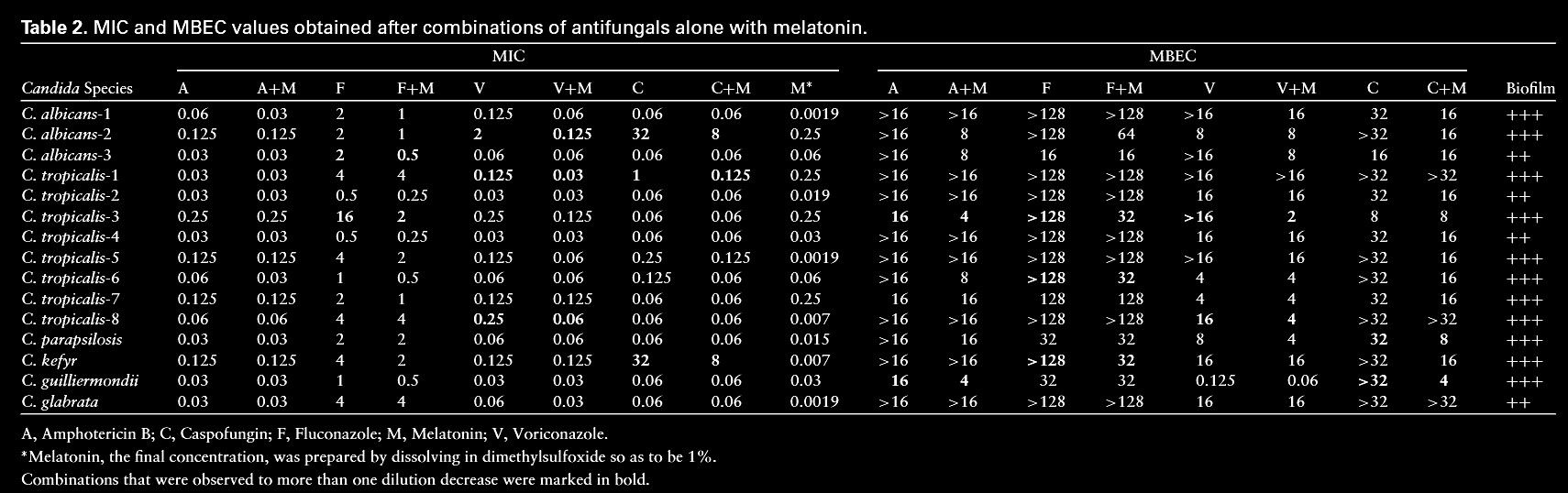
From: The effect of melatonin on antifungal susceptibility in planktonic and biofilm forms of Candida strains isolated from clinical samples, Kilinçel et al., 2019
On the plus side, only 19 out of 350 clinical samples of Candida strains were at all biofilm-building in vitro, i.e. not every fungal strain one could have or get will be as devilish.
-
@mauritio Thanks! I had found cs3000's three RPF threads on it and they had great info. Nice to see that the Iranians have already run some human trials with 500-1000mg p.o. of it daily. It's four times as bioavailable as an equimolar amount of hesperidin (from colonic hydrolysis in healthy people). Lemons containing much more precursors for it than oranges.
Hesperitin's boosting of mitochondria and efficacy against senescence is mightily impressive. It's also synergistic with other flavonones like the naringin which you had been all over about. Hesperitin is being sold for about USD150/kg.Nice. do you have any exerience with hesperedin ? (since hesperetin is so hard to get)
-
@Mauritio I'm going to dot the i's and cross the t's in this case and source the hesperitin for 500mg of it twice daily with antifungals.
Haven't tried any hesperidin/bergamot extract before, of which I've only heard that it's effectively lowering triglyceride and total cholesterol levels in people whose digestion isn't whacked. -
@CrumblingCookie
Why aren't you taking much higher doses of hepseredin and let your gut do the conversion ?I think taking hesperidin / hesperitin might be one of the highest ROIs in the bioenergetic field.
Especially if you take into account the studies @cs3000 posted on the RPF and I've also added some here. It's wild how many benefits it has.Dare to think.
My X:
x.com/Metabolicmonstr -
I think taking hesperidin / hesperitin might be one of the highest ROIs in the bioenergetic field.
I have done 3l of orange juice for a few months which apparently has 1,800 mg Hesperidin.
I didn't notice any benefits from this. If this multi factoral experiment means anything.

-
@alfredoolivas I think I notice more from a hesperidin supplement than from an equivalent amount of orange juice.
I call this "the isolated compound paradox" . Happens frequently, not sure why. -
Why aren't you taking much higher doses of hepseredin and let your gut do the conversion ?
I want it to be active in high concentrations already in the lumen of the proximal small intestine for on-site support of nystatine megadosing and the azole (+ maybe NAC). If I were to not have that target I'd indeed simply buy and use plenty of the OTC capsules.
I think taking hesperidin / hesperitin might be one of the highest ROIs in the bioenergetic field.
+1. Great findings.
IMO much more promising, functional and better ROI than e.g. urolithin A or all those Mephistophelean crooked dopamine modulators far, far far downstream.
Melatonin is the other protagonist of mitochondrial health I'm currently swayed by.Had been taking 160mg of it each night for a few weeks now. The daytime grogginess btw disappeared with a combo of large-dose niacin, riboflavin, biotin and P5P. Took 3grams melatonin last night. Same effect of relaxed sleepiness from about 1 hour in but much smoother skin today. However, at such doses it appears to be the most powerful inducer of the gastrointestinal MMC I've come across and that's way too much for me in my state of being. Probably great for the on-the-brink-of-constipation folks, though. Oh boy, I do hope to become better.
Back to the fungal topic:
I'm suspecting there's something profoundly wrong with the quality of pharmacy nystatine 500,000 IU tablets. They may be consistently underdosed or super-degraded garbage. Perhaps that's why they stopped working rather than from causes within the individual.
It's a bit of a mental barrier to start assuming such but every now and then throughout the years I have come across anecdotes of other pharmaceuticals where brand or origin is of crucial difference for therapeutic response.
Raw nystatine is super sensitive and quickly degrades upon exposure to light or humidity. -
I want it to be active in high concentrations already in the lumen of the proximal small intestine for on-site support of nystatine megadosing and the azole (+ maybe NAC). If I were to not have that target I'd indeed simply buy and use plenty of the OTC capsules.
Where are you sourcing hesperitin?
Had been taking 160mg of it each night for a few weeks now. The daytime grogginess btw disappeared with a combo of large-dose niacin, riboflavin, biotin and P5P. Took 3grams melatonin last night. Same effect of relaxed sleepiness from about 1 hour in but much smoother skin today. However, at such doses it appears to be the most powerful inducer of the gastrointestinal MMC I've come across and that's way too much for me in my state of being. Probably great for the on-the-brink-of-constipation folks, though. Oh boy, I do hope to become better.
3g ?? That's wild. Did you buy it in bulk or what ? Lol
But melatonin seems to behave differently in different dosages. Although I thought high doses increase prolactin significantly. Do you notice any high prolactin symptoms ? Maybe super high doses behave differently. -
@Mauritio Yes I have it in bulk so I just grabbed my next best spoon and filled that up. It's indeed harmless. From within the EU you can get it from Lithuania via rawpowders(dot)eu.
Afaik the rise in PRL isn't chronic but only acute and like what a good night's light hygiene should do anyway. Nothing to take before any sexual or other endeavours. When I had first tested 10, 20, 30mg doses (during daytime) I felt and measured the drop in body temperature for the following hours.Hesperitin comes from the lands of pandas. Thinking that a 500mg dose should achieve a proven to be biofilm-busting 0.5-1mg/mL concentration in the duodenum and jejunum.
Nystatin is a blend of more than one molecule. Its activity is currently standardized to 5710 IU/mg in accordance with modern production techniques.
Taking two doses of 11 million IU within hours in one evening and followng up with 5 million IU four times throughout the next day has ascertained a serious chronic fungal burden.
Felt as if I wouldn't be able to bear it. Brutally strong headaches. Stiff neck. Super-high intracranial hypertension. Barely made it through two nights of not even being able to rest my head on my neck but only kind of sideways because of the intense pressure. Thought it could be a good idea to take NAC to relieve the liver of whatever but I assume it was NAC's biofilm-busting property which made things even worse. Lots of vomiting. Sort of an aseptic meningitis experience. Brutal, brutal, brutal.
Currently continueing, somewhat stable, with 2.5 million IU four times daily before daring to raise it or to add any extras. -
I've been reconsidering past supplements and their effects in the face of fungus and biofilm.
work in progress• All the B vitamins and also vitamin E quite strongly feed Candida glabrata (Caveat crucial differences to C. albicans).
• Magnesium feeds it too and the ambivalence is enhanced by its much stronger osmotic effect when mucosal absorption is impaired.
• Calcium significantly stabilizes biofilms, explaining possible initial symptom relief at the cost of long-term worsening. Perhaps even more effective against systemic effects of C. albicans than glabrata as it could temporarily "clog-up" the candidalysin etc toxins of C. albicans within the biofilm.
• Zinc and iron supplemenation feed it and greatly strengthen its biofilms. On the other hand zinc can significantly raise mucosal immune responses so it's quite double-edged; good for prolonging and intensifying any suffering even though most people need more zinc for many bodily functions.
• Copper, in contrast, is a disruptor and also raises defence mechanisms. It's quite a burden on the system but at least doesn't help out the fungus.
• Butyric acid and lactic acid act as topical biofilm disruptors and can therefore aggravate local symptoms. Nice to have endogenously as naturally prophylactic countermeasures. Caveat: C. glabrata is immensly acid-restistant.
• Alpha lipoic acid, interestingly, causes fungal membrane permeabilization at its subinhitory concentrations achievable by oral or iv. administration. I.e. it weakens fungal cells and makes them more sensitive to penetration by azoles and other antifungals or destruction by host immunity.
On the other hand, orally administered ALA exerts significant chelation of the metals and minerals like zinc and iron in the GI lumen and topically. Such sequestration significantly disrupts fungal biofilms and has the potential to aggravate local symptoms especially in the duodenum, jejunum and, if mucosal absorption is impaired by biofilms, further beyond.
Talk of ALA in the context of fungi is dominated by its half-time and redistribution issues (Cutler protocol) of toxic metals like cadmium and mercury and it is being argued by quite a few folks that these heavy metals were at the base and enablers of any chronic fungal infection. But from the aforementioned, ALA obviously has possible (over)straining impact also in the absence of pathological levels of Cd or Hg.
• EGCG binds iron, therefore a powerful biofilm disruptor especially topically; potential to aggravate local symptoms. EGCG weakens growth and resilience of Candida by inhibiting their endogenous folate synthesis.
• The major importance of (divalent) metals/minerals in biofilm composition and stability brings up the potential of oral EDTA administration as a more powerful chelation tool against intestinal fungal pools. EDTA's meagre oral absorption is of very good benefit and of relative merit over ALA's worrisome systemic heavy metal redistribution in this context.
• NAC: A powerful biofilm disruptor whilst at the same time strengthening fungi through its antioxidant properties. This is a new addition as to why NAC reliably causes diarrhea in some people.
NAC should be fine when taken with Amphotericin B or Nystatin, but not when combined with the ROS-dependent killing through azoles (study).
• Ascorbic acid / vitamin This one also disturbs biofilms and may explain strong adverse reactions.
Important: Murine in-vivo models show that even normal daily doses of ascorbic acid (as in 200mg) will significantly counteract therapeutic success by azoles. I.e. significantly greater mortality with added ascorbic acid.
On the other hand, there's synergy of ascorbic acid with the polyene Amphotericin B as it assumedly helps to stabilize the Ampho B and prevent its early degradation. The influence was neutral between ascorbic acid and Nystatin (study).
• Enzymes: I've again been considering beta-glucanases against fungal biofilms and cell walls. Chitinases/(Hemi)-cellulases are of secondary importance. IMO the two only proper oral enzyme products against Candida are the Biofase by D & G Industries and the Ther-Biotic Interfase Plus by SFI Health / Klaire Labs. They are pricey and for some reason I keep skimping on them. I don't see great use of nattokinase or serrapeptase or fibrin targeting against fungal biofilms. However, I'm reconsidering bromelain in the face of strong past aggravating reactions to this compound. By what I can find the direct antibiofilm activity of bromelain is not so clear but most of its promises are shown against candidal adhesins. I.e. the extracellularly placed proteins used by Candida to attach themselves to surfaces and tissues.
In the face of bromelain's excellent systemic uptake and distribution I'm thinking that it may help weaken the apical attachment of fungus from the host's side at the base of their biofilms (rather than attacking the exterior layers). Bromelain appears to cover pretty much the same targets as papain: Maybe one is slightly more effective than the other but I see no need to take both. It will always somewhat irritate the mucosa, of course. Perhaps of extra benefit over papain is the dilution and degradation of mucus viscosity to increase its transmucosal cleavage of adhesins.
IME the disruptors are an everlasting pain without concurrent antifungals.
And the antifungals are (besides mostly underdosed) greatly insufficient if not combined with proper biofilm disruptors.
Current tools to use: Nystatin, an azole, hesperitin, NAC, bromelain. No or minimal supplemental minerals. Must look into EDTA (otherwise EGCG or ALA on an empty stomach).Addendum 1:
There's tetrasodium EDTA/edetate which is alkaline and disodium edetate which is slightly acidic.
The disodium form would seem to be more sensible to pass through the stomach. It's freely and cheaply available.
In contrast, for i.v. use it's always calcium disodium EDTA as it is supposed to release its pre-loaded calcium ion upon facing the greater binding affinity of a heavy metal ion. Quite necessary for i.v. use to lower acute cardiovascular risk and bone loss but it makes no sense for oral use against biofilm as one would explicitely want to sequester also calcium.
There was one poster one reddit 8years ago reporting on using disodium EDTA and feeling initial symptoms already from a mere 50mg before eventually creeping it up to 300mg once per day. Better to start humbly then.
Addendum 2:
Definitely encapsulate any oral disodium EDTA. It's not very acidic but obviously readily grabs calcium. If you know how freshly mineralized teeth feel: Having drunk 2Na-EDTA dissolved in a glass of water, even after an immediate extra rinse, feels like the opposite of that. -
Had a hunch that grapefruit seed extract (GSE) may be a good thing against fungi.
Didn't realize before that the active bioflavonoids in GSE are essentially all naringin (and a fraction of hesperidin).Naringin at 400µM which is about about 0.23mg/mL (?) destroys mixed dental caries (cavities) biofilm in vitro.
That's about 10 drops of high-quality GSE in half a teaspoon of water. GSE's quite a good thing for dental and oral care then.
Would like to see the full text to see the specific results of the other bioflavonoids: curcumin, quercetin, morin, rutin, and hesperetin.
Prevalence and eradication of mixed biofilms of Streptococcus mutans and Candida albicans using naringin: In vitro and in silico investigations, 2026 -
@CrumblingCookie This confirms what some light research revealed for me a few years ago, on GSE. I have it on my list of ingredients for a homemade toothpaste.
-
Have grazed the RPF reservoirs once again about fungi.
The absolute most knowledgable posts IMO came by user Sergey. Hoped to find more from him about it all.
Maurition has been the most persistent poster of related studies and bits on fungi throughout impressively many years. There was also interesting, productive interplay between amazoniac and Travis yet he was too focused-in on C. albicans exclusively. As are all the easily misleading megadosing B2, B3, aspirin contributions by haidut (false generalization of candidal species).
User narouz had been one of the most trying (as far as forum posts can tell) to get a grip of his fungal burden for many years.Alas, the persistently active and concealed Candida species in diseases of a chronic course are mostly C. parapsilosis, C. tropicalis, C. glabrata.
Plus chronic persistence of Aspergillus fumigatus as a superior perpetrator in specific disease types.
Plus the other odd fungi / mycobiome found in brain tissues, neurodegenerative diseases and also distinctly present in tumor tissues but not in tumor-surrounding healthy tissues and blood of the same people. -
L-form, aka protoplast or spheroplast, yeasts and fungi are likely the much more widespread and pressing issues next to biofilms. IMO of a more widespread importance than the specialty case of additional biliary survival as per this thread's original topic.
Such L-form variants (predominated by filamentous Aspergillus, plus Candida parapsilosis and others) were found in autistic children, and often their mothers yet not in healthy controls.
Acquisition of the L-forms especially during gestation and infancy is suspected to confer a particular kind of life-long immunological blindness to these.
Dysbiotic microbiota in autistic children and their mothers: persistence of fungal and bacterial wall-deficient L-form variants in blood, 2019An according collection of case studies, albeit with a strong conflict of interests (authors are heavily involved in Mosaic Diagnostics, formerly Great Plains Laboratory, with their urine organic acid tests):
Case Study: Rapid Complete Recovery From An Autism Spectrum Disorder After Treatment of Aspergillus With The Antifungal Drugs Itraconazole And Sporanox, 2020
The seemingly most powerful antifungal combination discovered so far which targets the fungal membranes and therefore equally well any L-form persister fungi variants
is Itraconazole or Posaconazole + a HIV protease inhibitor like Atazavir (+Ritonavir as a systemic inhibitor of degradation via Cyp3A4 to boost ATV's impact. RTV can be very cheap; thus no biggie):Enhanced antifungal activity of posaconazole against Candida auris by HIV protease inhibitors, atazanavir and saquinavir, 2024
There are a few more studies published on combinations like this without the particular use of spheroplasts but on "normal" fungi, too.
Such combos also overcome aquired resistancies by upregulated efflux pumps (CDR1/2) and the filaments and biofilm abilities. @sunsunsun -
 B BearWithMe referenced this topic on
-
Sounds interesting. How do you make coconut oil suppositories?
-
You can buy molds from which you can make suppositories of 2ml volume each from Amazon. I get a good idea of how to incorporate essential oils into a carrier oil like coconut oil from essential oil therapy books. Kurt Schnaubelt, PhD, has written a few books and I've read them to get started on it. He explains it thoroughly, to a science level that I think with some patience lay people can understand. There are many other authors but I haven't read them.
I just moved and everything is in shambles as I try to get things flowing so I can't give you exact titles but search tools and AI will easily fill you in.




Hello! It looks like you're interested in this conversation, but you don't have an account yet.
Getting fed up of having to scroll through the same posts each visit? When you register for an account, you'll always come back to exactly where you were before, and choose to be notified of new replies (either via email, or push notification). You'll also be able to save bookmarks and upvote posts to show your appreciation to other community members.
With your input, this post could be even better 💗
Register Login