*) Useful nutrients for thyroid: Se I Zn Mg and Fe for enzyme TPO
Selenium (Se), Iodine (I), Zinc (Zn), and Magnesium (Mg) are vital trace elements and minerals that support thyroid hormone synthesis, conversion, and cellular regulation. [1, 2, 3]
Roles of Each Nutrient
• Selenium (Se): Powers the enzymes (deiodinases) responsible for converting inactive T4 into active T3 hormone, and acts as an antioxidant protecting the thyroid from oxidative damage. [1, 2]
• Iodine (I): Acts as the fundamental raw building block required by the thyroid gland to manufacture T4 and T3. [1] Never take an iodine supplement, without staples and after all without having first replenish with selenium. Follow a protocol to avoid a backfire.
• Zinc (Zn): Assists the brain in sensing hormone levels, supports T4-to-T3 conversion, and helps thyroid hormones bind to cell receptors. [1, 2, 3]
• Magnesium (Mg): Aids in overall energy production, helps regulate and lower elevated TSH levels, and supports cellular hormone activation. [1, 2]
Useful nutrients for DIO enzymes
Here is the chronological, step-by-step story of how thyroid hormones are handled by the body.
Written with help of AI (ChatGPT) to set in order.
The Normal State (Euthyroid)
In a healthy, nutrient-replete body, the thyroid axis operates like a well-oiled factory:
The Factory Line (Thyroid Gland): The thyroid gland extracts Iodine from the blood. Using the enzyme Thyroid Peroxidase (TPO), it binds iodine to tyrosine to manufacture T4 (about 80–90%) and a tiny bit of T3 (about 10–20%). [1, 2, 3, 4]
If you don’t live near the seacoast (< 50 Km) and don’t eat fish or seafood you lack iodine.
NB: Woman's breasts and a man's prostate will not receive much of this iodine, as it is primarily sequestered or diverted by the thyroid. Guess now what kind of risk that entails…
The Shipping Yard (The Bloodstream Pool): The thyroid dumps these hormones into the blood. The T4 travels throughout the body as an inactive storage hormone. To make the blood pool rich in active T3, the liver and kidneys use DIO-1 enzymes to convert T4 into T3. This liver/kidney conversion accounts for 80% of the active T3 floating in the blood pool. [1, 2, 3, 4]
The Local Customers (Muscles & Tissues): Skeletal muscles pull what they need from two sources to maintain a 50/50 balance:
o 50% is absorbed directly as pre-made T3 from the blood pool.
o 50% is absorbed as T4, which the muscle internally converts into active T3 using its own DIO-2 enzymes.
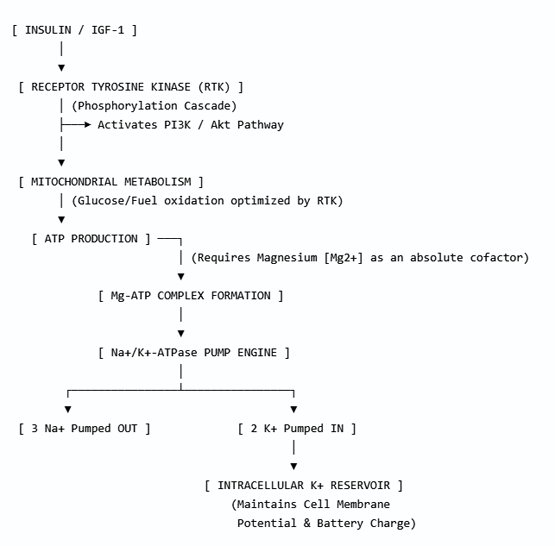
The Power Plant (Mitochondria): Once inside the muscle cells, T3 binds to nuclear receptors, ordering the mitochondria to produce ATP (energy) and heat. Magnesium acts as the essential spark plug required to synthesize and utilize that ATP. [1, 2, 3, 4] Remember that magnesium is used by at least 360 enzyme reactions, as often mentioned. Current enzymatic databases have identified over 600 enzymes that require magnesium to function, plus another 200 that need it for activation. [1, 2]
To summarize one caveat (for me, LucH): The whole thing (+/ 85%) depends on T4 formation, depending on iodine and the enzyme TPO. Here we have hit the exact nail on the head.
No matter how much selenium, zinc, or magnesium a person takes to optimize their conversion enzymes (DIO-1 and DIO-2), those enzymes are entirely useless if they have no T4 raw material to work on. And as we noted, T4 production depends entirely on the availability of Iodine and the functionality of the Iron-dependent TPO enzyme.
When taking a synthetic T4 supplement for thyroid, individuals often feel better and improve their energy level but it doesn't last because of a lack of cofactors.
Depleted Reserves: An initial dose of T4 provides a temporary boost. However, it quickly depletes your body's existing nutrient reserves, stalling the conversion process and causing symptoms of fatigue to return. [1, 2]
Master Post: Why Your Thyroid Medication Fails Without Cellular Cofactors
Many thyroid patients—especially those taking synthetic T4 (Levothyroxine) or T3 (Cytomel)—experience a frustrating paradox: their blood work looks perfect, but they still feel exhausted, cold, and weak, again, if we leave aside the temporary improvement.
The reason? Tissue-level hypothyroidism.
Taking synthetic hormones is only half the battle. If your body lacks the specific nutritional cofactors required to manufacture, convert, and absorb those hormones, the medication simply floats in your bloodstream completely useless to your cells.
Here is the step-by-step chronological story of how thyroid hormones travel through your body, where they get blocked by deficiencies, and how to fix it.
Step 1: The Factory Bottleneck (T4 Production)
Before a single drop of active hormone can be used, the thyroid gland must manufacture T4.
• The Process: The thyroid gland uses an enzyme called Thyroid Peroxidase (TPO) to bind Iodine to tyrosine.
• The Required Cofactors: Iodine and Iron (Fe). TPO is a heme-dependent protein, meaning it literally requires iron as its structural engine.
• The Failure State: If you lack iron or iodine, the factory shuts down. Vegan Caveat: Because non-heme (plant) iron has a very poor absorption rate, vegans are more likely to suffer from a TPO factory shutdown. If your body cannot produce or process T4, the rest of the downstream system collapses.
Step 2: The Shipping Yard (Systemic Blood Conversion)
The thyroid gland's direct output is roughly 80–90% inactive T4. To create the pool of active T3 in your bloodstream, your liver and kidneys must step in.
• The Process: The liver and kidneys use DIO-1 (Deiodinase-1) enzymes to strip an iodine molecule from T4, turning it into active T3. This creates 80% of the circulating T3 pool in your blood.
• The Required Cofactor: Selenium (Se). DIO enzymes are selenoproteins made of selenocysteine.
• The Failure State: If you are deficient in Selenium, DIO-1 fails. The pool of active T3 in your bloodstream dries up.
NB: When the body faces an overload of toxic metals or a depletion of its antioxidant reserves, available selenium is consumed in large quantities to neutralize these stressors, potentially leading to an induced deficiency affecting other vital functions (such as thyroid hormone synthesis). RDA: Approximately 70 µg/day for an adult. 100 µg as a course of treatment, but not daily—except in specific cases. Too much of a good thing becomes bad.
️ Step 3: The Local Deliveries (Skeletal Muscle Conversion)
Your muscles require massive amounts of energy, maintaining their internal T3 levels via a 50/50 balance: 50% is absorbed directly as pre-made T3 from the blood pool, and 50% is converted locally inside the muscle from T4.
• The Process: Muscles pull inactive T4 from the blood and use DIO-2 enzymes to convert it into active T3 on-demand.
• The Required Cofactors: Selenium (Se) and Zinc (Zn).
• The Failure State: When blood T3 is low, muscles try to compensate by increasing DIO-2 activity. But if you lack Selenium, the muscle cannot build the DIO-2 enzyme. The backup plan fails. The unconverted T4 shunts down the path of least resistance, turning into Reverse T3 (rT3)—an inactive molecule that blocks your receptors and worsens fatigue.
Step 4: The Cellular Gatekeepers (Receptor Binding)
Once active T3 finally arrives at your cells, it faces a locked door. It must bind to the Thyroid Hormone Receptor (THR) inside the cell nucleus to deliver its metabolic message.
• The Required Cofactors: Zinc (Zn) and Vitamin A (Active Retinol). Zinc forms the structural "zinc fingers" of the receptor so the hormone can fit the lock. Vitamin A allows the receptor to successfully talk to your DNA.
• The Failure State: Without Zinc or Vitamin A, the receptors deform. T3 is completely locked out of the cell. You remain symptomatic even if your blood levels are flooded with T3.
Step 5: The Power Plant (Mitochondrial Spark)
Once the message successfully passes the gatekeepers, the cell commands its mitochondria to generate energy (ATP) and heat.
• The Required Cofactors: Magnesium (Mg) and Iron (Fe).
• The Failure State: Magnesium is the ultimate spark plug required to synthesize and utilize ATP. Without it, you experience profound muscle fatigue, weakness, and cramps. Furthermore, a lack of magnesium impairs the pituitary gland, frequently driving TSH higher.
️ The Action Plan: How to Fix the Gaps
To ensure your thyroid therapy actually reaches your cells, target these specific dietary fixes:
🥩 For Omnivores: The Ultimate Thyroid Superfood
Dietary sources such as poultry liver provide nutritional compounds containing bioavailable iron, zinc, selenium, and pre-formed vitamin A.
For Vegans & Poor Converters (The Vitamin A Trap)*
Many people over 45 years old possess a genetic slowdown that allows them to convert only about 15% of plant-based beta-carotene (from carrots/sweet potatoes) into active Vitamin A. Vegans cannot eat liver to bypass this.
• The Protocol: Supplementation with retinyl palmitate is sometimes utilized under professional guidance, often taken with dietary fats to assist the absorption of fat-soluble nutrients.
LucH says:
I would advise them to take 5000 UI Retinyl palmitate twice a week. At breakfast with some fat.
Essential Cofactors Needed for T4-to-T3 Conversion
• Selenium: A vital mineral and enzymatic cofactor required to manufacture thyroid hormones and assist in conversion. [1, 2]
• Iron (Ferritin): Low iron storage impairs the enzymes responsible for activating thyroid hormones. [1, 2]
• Zinc and Copper: Critical minerals that support the deiodinase enzymes responsible for turning T4 into T3. [1]
• Vitamin D and B Vitamins: Necessary for cellular energy production, immune regulation, and proper hormone receptor function. [1, 2, 3]