Dandruff or scalp irritation? Try BLOO.

Subcategories

  • Scientific papers, books, blog posts. Discussion of whatever you find interesting and notable.

    659 Topics
    4k Posts
    AlphaZanceA
    Abstract Background The Metabolic Syndrome (MetS) is highly prevalent and associated with an increased risk for Type 2 diabetes mellitus (T2DM) and cardiovascular disease (CVD). Lifestyle recommendations to treat MetS often include the replacement of saturated fats (SFA) and monosacharides with unsaturated fat. However, it is unclear whether metabolic parameters will improve more when the saturated fat in American Heart Association (AHA) diets is replaced with higher concentrations of mono or poly-unsaturated fatty acids (MUFA, PUFA). Objective To test the hypothesis that an AHA diet enriched in MUFA improves lipoprotein lipids, insulin resistance, inflammation and endothelial function to a greater extent than a diet enriched in PUFA in middle-aged men and women with MetS. Methods A prospective, open-label, parallel group design with randomization to a hypocaloric MUFA or PUFA enriched diet following weight stabilization on an AHA Step I diet. Participants consumed 3 MUFA or PUFA enriched muffins daily with additional supplementation as required to ensure 25-50% increases in dietary fat intake from these sources at the expense of SFA and the opposing unsaturated fat. Changes in MetS components were measured at baseline and after 6 months of dietary intervention. Results Thirty-nine participants (mean age 60.8 years, 79% African-American, 60% women) with MetS completed the 6-month study. Compared to baseline, assignment to either MUFA (n=23) or PUFA (n=16) both were associated with weight loss (WL) (MUFA: −2.3±1 kg, P=0.06; PUFA: −4.6±2 kg; P=0.002), but PUFA was also associated with reductions in triglycerides (TG) (−30±18 mg/dL, P=0.02), systolic blood pressure (BP) (−7±3 mmHg, P=0.01), diastolic BP (DBP) (−4±2 mmHg, P=0.01) and improved flow mediated dilation (FMD) (7.1±1.8% vs. 13.6±2%, absolute increase; P=0.0001). When compared to MUFA treatment, PUFA intervention was associated with reduced TG (P=0.04) and DBP (P=0.07) as well as increased FMD (P=0.04) even after adjustment for changes in weight. There was no effect on total cholesterol, low-density lipoprotein cholesterol (LDL-C), glucose, high-sensitivity C-reactive protein (hs-CRP) or other inflammatory proteins. Overall, 25% (4 of 16) assigned to PUFA and 13% (3 of 23) to MUFA converted to non-MetS status. Conclusion Substitution of SFA with PUFA in patients with MetS is associated with greater reductions in TG and improvement in endothelial function than MUFA that is independent of WL. These preliminary findings raise the possibility that PUFA may be the unsaturated fat of choice to reduce cardiometabolic risk in patients with MetS. https://pmc.ncbi.nlm.nih.gov/articles/PMC5010036/ The conflict you’ve highlighted is the central battleground between Bioenergetic (Ray Peat) principles and Mainstream Lipid Science. To understand why a study like the MUFFIN study shows positive results for Polyunsaturated Fats (PUFA) while Ray Peat viewed them as metabolic toxins, we have to look at the different metrics they prioritize: short-term blood markers versus long-term cellular stability. 1. The Chemical Difference: Why Peat Opposed PUFA Ray Peat’s primary argument against PUFAs (like those found in soybean, corn, and sunflower oils) was based on their chemical structure. PUFAs have multiple "double bonds." Saturated Fats (SFA): Have no double bonds. They are straight, stable, and resistant to heat and oxygen. Polyunsaturated Fats (PUFA): Have multiple double bonds. These bonds are "open" sites where oxygen can attack, leading to lipid peroxidation. According to Peat, when these unstable fats are incorporated into human tissues (cell membranes and mitochondria), they make the body more susceptible to oxidative stress, inhibit thyroid function, and promote the formation of age pigments (lipofuscin). 2. Analyzing the MUFFIN Study through a "Peat" Lens The MUFFIN study found that PUFAs were superior to Monounsaturated Fats (MUFA) for improving triglycerides and blood pressure in patients with Metabolic Syndrome. A follower of Ray Peat would likely critique these findings using the following arguments: A. The Weight Loss Confounding Factor In the study, the PUFA group lost significantly more weight (-4.6 kg) than the MUFA group (-2.3 kg). The Mainstream View: PUFAs might improve insulin sensitivity, leading to better weight loss. The Peat View: PUFAs are known to be "pro-metabolic" only in the sense that they can be toxic to the mitochondria, sometimes causing a "wasting" effect or a stress-induced increase in metabolic rate. Peat often argued that PUFAs interfere with the body's ability to store energy efficiently, which might show up as weight loss but at the cost of increased systemic stress. B. The "Blood Clearing" Effect vs. Tissue Accumulation The study focuses on Triglycerides (TG) and Flow Mediated Dilation (FMD). The Mainstream View: Lowering triglycerides in the blood is a sign of improved cardiovascular health. The Peat View: PUFAs lower blood lipids because they are easily oxidized and "pulled" out of the blood into the tissues, or because they inhibit the liver's ability to release glucose and fats. Peat argued that having lower fats in the blood isn't a benefit if those fats are being stored in your cell membranes, where they remain vulnerable to turning into toxic byproducts like acrolein and 4-HNE. C. The Randle Cycle (Glucose Competition) Ray Peat’s work heavily emphasized the Randle Cycle, a metabolic process where the oxidation of fats inhibits the oxidation of glucose. Peat argued that PUFAs are particularly effective at blocking the "burning" of sugar. While the MUFFIN study suggests improved "metabolic management," Peat would argue that over the long term, high PUFA intake forces the body into a state of "fat-burning" that mimics diabetes at a cellular level, suppressing the more efficient oxidative metabolism of glucose. 3. Why the results differ The MUFFIN study and Ray Peat are essentially looking at two different things: Feature Mainstream/MUFFIN Study Focus Ray Peat/Bioenergetic Focus Primary Goal Lowering blood markers (TG, BP, LDL). Increasing metabolic rate and CO2 production. Timeframe Short-term (6 months). Decades of tissue accumulation. Mechanism PUFAs as "essential" signaling molecules. PUFAs as "anti-thyroid" and oxidative toxins. Endothelial Health Measured via blood flow (FMD). Measured via resistance to lipid peroxidation. Summary The MUFFIN study provides evidence that for obese individuals with metabolic syndrome, replacing saturated fats with PUFA can lead to rapid improvements in clinical biomarkers (blood pressure and triglycerides). Ray Peat would counter that these improvements are superficial. He would argue that the participants are trading "good-looking" blood tests for long-term "rotten" cellular membranes. From a Peat perspective, the "metabolic syndrome" is caused by a lack of sugar oxidation, and adding PUFAs—even if they lower blood pressure in the short term—further suppresses the thyroid and the body's ability to use oxygen properly.
  • Websites, newsletters, articles, podcasts, interviews, explainers, books, and other resources that relate to the work of Dr. Raymond Peat.

    62 Topics
    703 Posts
    CiceroC
    I noticed the reprint of Nutrition for Women says "100 short articles by Ray Peat, PHD," where the old one said "92...". What did they add to it? Also, note that From PMS to Menopause is for sale on Peat's website but not Amazon, and Peat's website doesn't have Generative Energy. Weird. I wonder if Katherine gets more of the money if you order from Peat's site. I'd imagine so.
  • Do you have a question? You can post it here, but you will only receive unqualified personal opinions and NOT medical advice in any shape or form. If something seems like medical advice but it's posted in this category, it's actually a personal opinion.

    1k Topics
    11k Posts
    L
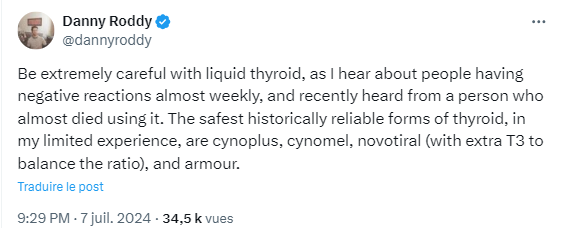
    @awawat there’s more where that came from ( ͡° ͜ʖ ͡°) Also, I would consider your rT3 levels if you’ve taken only T4 with no results for a while. Peat talked about success with low doses over a course of 6-24 months. Maybe you could play with higher ratios of t3 to t4 in your lunch and dinner doses. Danny Roddy probably has the most complied info on practical thyroid use, between convos with Peat, and feedback with health coaching. I think he might have a concise vid on using thyroid on YouTube
  • From medical devices to supplements. Red lights, CO2 tanks, large trash bags, kuinone, and more.

    393 Topics
    4k Posts
    sunsunsunS
    @saturnuscv which brand pharma oxandroloine?
  • Recipes, food, meal prep, brands. Discuss them all here.

    236 Topics
    2k Posts
    JenniferJ
    @Mossy, thank you for understanding. I’ve been taking advantage of the beautiful weather we’ve been having here and helping my dad build up the endurance he lost since having the flu in January so I’ve been away from my computer and the forum more, lately. I think the thread’s title should read Cooking With Mossy because you’re far more ambitious and precise with your cooking than I am. You remind me of my brother. While I hardly ever measure ingredients and prefer using my senses—for example, I can tell by smell when something is done baking—my brother is methodical and likes following detailed instructions. I joke that it’s because he’s a Virgo, a sign known for its meticulous attention to detail, sometimes to its own detriment, and that if you want something done to perfection, hire a person with Virgo (or Capricorn) placements. I’m so glad you’ve made strides with your health and with your level of dedication, I have no doubt that you’ll continue to. I think my success with thyroid is a reflection of my long-standing deficiency, having had an under-active thyroid since birth and certain stressful experiences like molestation that suppressed it further. I think the average person with a healthier history could improve their thyroid function with diet and lifestyle changes alone. Having overcome the trauma, my need to supplement is minimal now outside of winter so I’m hopeful it will eventually be unnecessary. I’ve been a swimmer since I was in utero —in fact, one of my earliest memories is me as a baby in our pool wishing my mum had put me in the blue floaty she put my cousin in, instead of the red floaty I was in because even barely out of the womb I had strong preferences and don’t care for red lol—so I don’t actually fear I would drown, but I can see myself getting tossed around like a beach ball. However, it’s not mastering surfing that I’m after, but the surfer’s relaxed lifestyle and mindset. I could easily spend hours floating in the ocean on a surfboard (or steamer trunk—shout-out to Joe ), never catching a wave, and be in total bliss if I was in the flow, just being water, my friend. Haha! Fair enough. My dad isn’t a finger tapper, though. I sometimes wish he was because it has been a struggle getting him to eat, especially since his cancer treatments. I used to make all his meals in bulk on Mondays and he would just pull whatever he wanted out of the freezer and reheat it in the microwave throughout the week, but I’m having to make him all his meals daily now because he won’t eat otherwise. LOL at ask Jennifer. I’ve been collecting random knowledge in preparation for if I’m ever a contestant on a game show. I’m convinced with each fact I gather that no matter how useless, it will be the answer to the question that stands between me and the grand prize so it goes in the memory bank. Even if there is credibility to the claimed benefits of sprouting and fermenting, it sounds like grains are only a fraction of your diet so I personally would stick with the flour that’s been working for you. You’re already eliminating the worst offenders (IMO)—the franken ingredients—by baking from scratch. The only reason I like sprouted flour is because I find it sweeter and as a devout Wonka follower, the sweeter the better. My dad doesn’t eat a ton of grains, anyway.
  • Discussing pistol squats, concentric exercise, resting, and other forms of strength training.

    92 Topics
    1k Posts
    alfredoolivasA
    @sunsunsun thx sushi
  • Fat Consumption before TT Test

    2
    0 Votes
    2 Posts
    298 Views
    M
    @Mallard6146 bump
  • 0 Votes
    6 Posts
    948 Views
    cs3000C
    @cs3000 May be key to use IR light that includes 8-10 uM wavelength , IR-C https://www.nature.com/articles/s41598-019-48187-0 which is weird because only a tiny amount of IR-C comes from the sun, and doesnt penetrate skin as well as ir-A or B. but was the wavelengths that worked on mitochondria in epithelial cells [image: 1721285996407-4e1665e9-e423-4dc6-967c-da8be1b716b8-image.png] humans might emit infrared around 9-10 uM though which matches the mitochondria study https://www.researchgate.net/post/What_is_the_IR-radiation_emitted_by_the_human_body & the embryo study used a lamp "at wavelengths ranging from 1 μm to 14 μm, with a peak at 2.9 μm."
  • How to get more calories without starch or dairy

    1
    0 Votes
    1 Posts
    217 Views
    No one has replied
  • Ivermectin where buy ooga

    7
    0 Votes
    7 Posts
    613 Views
    H
    @hwisdom https://covid19criticalcare.com/treatment-protocols/ You'll find dosage in these protocols too. Maybe you can just figure out what would work in your case. It's very safe so you can't screw up too much.
  • Russian drones hit sunflower oil terminal in Ukraine

    1
    1
    0 Votes
    1 Posts
    207 Views
    No one has replied
  • This topic is deleted!

    1
    0 Votes
    1 Posts
    12 Views
    No one has replied
  • Are the aminos of milk perfect?

    2
    0 Votes
    2 Posts
    336 Views
    hwisdomH
    @hwisdom (i had to type at least 8 characters otherwise it wouldnt let me post)
  • Does DHEA stunt height?

    2
    0 Votes
    2 Posts
    379 Views
    hwisdomH
    @DG quite the opposite actually look what happened to peat mf grew 1.5inches at 40 smth
  • Thoughts on cigarettes

    15
    0 Votes
    15 Posts
    2k Views
    L
    @thyroidchor27 and I believe urea can “detox” ammonia. Same with sodium benzoate found in the original glass version of Dr Pepper.
  • 0 Votes
    33 Posts
    3k Views
    yerragY
    @Mr-X said in Edema with water logged lungs / heart atrial fibrillation / pleural fluid around the lungs - approach to fix: @yerrag Thanks for all of your help. Yesterday when I came she was so nervous panicy. She talks all the time that she wants to go home. I can understand after 2 1/2 months in the same room same bed never was outside since then. Couldn’t speak clearly told weird stuff let me first change my clothes before were going home the want to poison me here and so on i was so in shock She was so nervous, i put out magnoil and ithink i squeezed 25-30 drops on here legs. What a hell of a transformation in 30 minutes. She was calm was speaking full sentences we looked sport on TV she remembered old players and so on. Eyes where open, we could sit for half an hour on the bed. Also 3 different nurses said wow she so good today than long time before. than i put 5 drops of energin on her. One squeeze of Glass pimpette of vitamin d oil And gave her her multivitamin pill / 125mg thiamine hcl / 150mg benfothiamine She felt asleep into deep sleep since yesterday she also dont need the oyxgen machine anymore. She got 96% SPo2 oxygen tested on the machine from the nurse. Im so glad because I saw a thread on RPF yesterday how toxic oxygen is for the brain. I think the most common issues at the moment she has a little bit of heart valve inflammation also after 6 weeks of antiobiotics IV. COPD was before, the kidneys are weak but its also known long before chronically but was so worst that by the start of the last week she put her on dialysys. I want to help her for the heart valve inflammation. I think next they will also stop the IV antibiotics. What do you guys think of Vitamin E (TocoVit) for this purpose? Anti estrogen, anti inflammatory, energy promoter. What she has before hypothyroidism. (only gets t4 so I also thinking givin her 1mcg of t3 to start with maybe next week) Panic and anxiety shes takin SSNRI Venlafaxin and oxazepam high blood pressure shes gettin beta blocker and other blood pressure medication. I let go on the idea of pyrucet I think today i hold back on the b1 to 125mg and 75mg benfothiamine I cant give here energin because the nurses saw their yellow stain on her legs 2 days in the row. I wanted to put it on wash it off after 1 hour but they came before unfortunately. Takeaway from yesterday u can throw all your mag pills away the days before i gave her 450 mag bisglyicinate pills saw not so good improvement. I think the only option to get magnesium into our body is either haiduts magnoil topically with DMSO or magnesium bicarbonate. But thats hard in germany because of lack of milk of magnesia I'm concerned she started dialysis as doctors don't know squat about acid base balance and it doesn't get better the longer she stays in the hospital the worse and her more acidic her ecf is. The longer the acidic condition holds up, the worse it is for the organs as they calcify, especially the kidneys. the meds are a major cause of it unfortunately. one day she's being treated for this, and next day it's another it's like playing whack-a-mole except it's not fun. and it's also like a roller coaster of one day she's on a high and the next few days she'll be sleeping endlessly. doctors are used to seeing patients that way and are desensitized to their plight and soon they treat it as normal. They truly have no idea. But it's not easy going home either because .ost people are so dependent on doctors and they're helpless. And caring for elders is not easy either. The better ones know more about nutrition from food and can cook.
  • How do I grow my maxila?

    12
    0 Votes
    12 Posts
    1k Views
    J
    @edouard Yea I’ve tried the androgenification one and also didn’t notice anything, but I definetly have from the isolated T3
  • Coconut oil for a preworkout boost

    3
    1
    0 Votes
    3 Posts
    415 Views
    cs3000C
    @Mauritio yea and a decent amount an hour or so before sleep could be good for sleeping through the night if wake up too soon. as would spare the glycogen for longer . i just got some coconut milk powder there's 2 types of palm oil , that kernel oil which has a bunch of lauric acid / very different profile to the other palm oil with no MCTs or lauric acid. so probably used the 2nd type https://www.researchgate.net/figure/Fatty-acid-composition-of-palm-oil-and-palm-kernel-oil_tbl1_282129563
  • Is it safe to drink milk after taking albendazole?

    4
    0 Votes
    4 Posts
    350 Views
    BioEclecticB
    @ThinPicking Ha, good catch, this one got me. Will be more on the lookout from now on.
  • This topic is deleted!

    1
    0 Votes
    1 Posts
    61 Views
    No one has replied
  • Bottom Range Vitamin D

    7
    0 Votes
    7 Posts
    758 Views
    LucHL
    @Mallard6146 said in Bottom Range Vitamin D: The range is 30 - 100. minimum target: 35 ng/ml. Optimal above 45 ng/ml, for me. But everybody won't agree Excess magnesium can hinder the absorption of vitamin D. Neither too little nor too much magnesium (RDA Mg: 360 and 420 mg according to sex f / m) is favorable. If the ratio PUFA : MUFA > 1, you will have difficulty increasing the levels of 25(OH)D. This brings us directly to 18-20g and 12-15g of PUFA consumed daily by American men and women (Kris-Etheton, 2000) and their negative impact on the absorption of already low quantities of vitamin D in food. So beware of manufactured foods which often contain an addition of soy and corn oil. By the way, if your sun shadow exceeds your height, you will not make vitamin D. Question of wavelength. Useful link (in French, translator needed, but with links in English): Absorption de la vitamine D insuffisante ? http://mirzoune-ciboulette.forumactif.org/t1664-absorption-de-la-vitamine-d-insuffisante#20619 Facteurs qui facilitent ou contrecarrent l’absorption de la vitamine D3
  • Small amount of coconut oil orally increases wound healing

    1
    1
    0 Votes
    1 Posts
    210 Views
    No one has replied
  • Why do a lot of guys get puffy past the age of 30

    7
    0 Votes
    7 Posts
    1k Views
    yerragY
    @raytreats I believe Ray has said that once we stop growing, our metabolism starts to decline. The growth process uses a lot of energy in building structure. This internal metabolism declines and if we continue the same lifestyle as we had as growing kids/adults, we won't be burning as much energy internally and we would have to start exercising more to burn that energy, or else it turns into potential energy in the form of fats. But not everyone becomes fat. Those who don't already live a lifestyle where they have optimal mitochondrial oxidation. Their internal machinery continues to burn sugar well and the sugar does not accumulate and turn into fats by the liver. Their blood sugar is normal and stable between meals. Because they produce a lot of CO2 as well, they tend to metabolize sugar efficiently because their tissues are well oxygenated because of the Bohr effect of CO2 in blood, which allows oxygen to be released generously by blood to tissues. A lot of this getting fat while getting older has to do with PUFAs displacing sugar as an energy source. Due to the predominant presence of PUFAs in the diet since childhood and accumulated in the fat issues. Poorer health will result and a long term fix is to allow the body to reset by stopping the intake of PUFAs and to allow the body to use up its PUFA stores over a natural process of releasing fats from fat cells and using it up over about 4 years. During this transition, it is unavoidable that the PUFAs will cause lipid peroxidation and the best thing we can do is to supplement with vitamin E to mitigate the effects of peroxidation. It will also help to supplement with VCO or other saturated fats so we.can increase the ratio of sat fats over PUFAs being metabolized.
  • What Vitamin B cofactors should I supplement?

    7
    0 Votes
    7 Posts
    1k Views
    LucHL
    @Peatslop-enjoyer said in What Vitamin B cofactors should I supplement?: Could you provide the link? Thank you. Vitamin B6: How much is too much? Which kind, with staples. https://mirzoune-ciboulette.forumactif.org/t2033-english-corner-vit-b6-how-much-is-too-much#29628 Excerpt: The English Corner – Vit B6: How much is too much? Main ideas Too much of a good thing is bad. Especially bad for neuro-sensitive people. Vitamin B6 is well documented for its role as a modulator of steroid hormones. No problem with food intake if not supplemented. Maximum RDA target is 25 mg B6. There are 6 vitamers and a way-out form through the urine. If we want a pharmacological effect, we have to take into account the form of the vitamers. The active form is B6 PLP. Look at the 6 vitamers form before continuing (figure): 3 basic forms of vitamers B6: PN= pyridoxine PL = pyridoxal PM = pyridoxamine And their derivative, coupled with a phosphate molecule: PNP = pyridoxine 5’-phosphate PLP = Pyridoxal 5’-Phosphate (active form) PMP = Pyridoxamine 5’-Phosphate And the form used as a catabolite (excreted in the urine) PA = 4-Pyridoxic acid. A tight regulation of the PLP concentration is necessary in the cell: The aldehydes are toxic. A self -regulation and a protective mechanism coexist. But there is a radical side effect: PLP will no longer passes the encephalic barrier. A withdrawal effect will soon take place, with an impact on neurotransmitters. PMP is a safer form: PMP is slightly increased in plasma, and rapidly converted into PLP and PL when needed. An excess of pyridoxine (PN) is deleterious. No pyridoxine supplement advised: PN has an inhibition effect on PLP, the active form. PL could be converted to PN by a PL reductase (side effects when too high supplementation). PM could be more suitable for supplementation because of the very low formation of PN by PM. If we suffer from a lack of enzymes, we must pay attention to the conversion pathway: PLP as a coenzyme factor has a pivotal role in catalysis of various enzymatic reactions. See the roles of PNP-dependent enzymes, namely kinase and oxidase (+ phosphatase). To be continued on the link. See above (my forum: Mirzoune et Ciboulette). A tight regulation of the PLP concentration is necessary in the cell: The aldehydes are toxic. We must not go beyond the absorption capacity of the body. We are not all equal. If you suffer from inflammation, if you need more antioxidants, you will probably burn more B6. What should be avoided is to approach the limit / the level of an overburdened of metabolism. A limit that will be different, depending on the individual. Why does an excess of B6 or an inadequate enzymatic metabolism cause a problem of neuro-sensitivity? An excess of Pyridoxal (PLP) will lead to the inhibition of the enzyme PLK (Pyridoxal Kinase). PLK is set out of function via the “Salvage pathway” process. Details on the link, with references. Useful link *) English corner: B6 leads to decrease of cytokines in neuropathy https://mirzoune-ciboulette.forumactif.org/t2041-english-corner-b6-leads-to-decrease-of-cytokines-in-neuropathy#29659 Efficacy of Vitamin B1, B6, and B12 in Peripheral Neuropathy *) Useful nutrients in case of neuropathy https://mirzoune-ciboulette.forumactif.org/t2031-haute-dose-de-b6-p5p-contre-algodystrophie-et-scc#29618 Mg bisglycinate, Zinc, Vit B6 PLP 20-25 mg, Vit C 500 mg, Vit D 5 000 UI (with K2). *) English Corner: Anti-Stress & Neuro-Protective Effects of Thiamine (B1) https://mirzoune-ciboulette.forumactif.org/t2045-english-corner-anti-stress-neuro-protective-effects-of-thiamine-b1 See part 2 (in the same post): How much and which kind of thiamine? Excerpt from video of Dr. Allil OVERTON. => Practical example for beginner (patient N° 1): Basic protocol for thiamin insufficiency. https://mirzoune-ciboulette.forumactif.org/t2045-english-corner-anti-stress-neuro-protective-effects-of-thiamine-b1#29716 With references.
  • Blood Glucose Level

    8
    0 Votes
    8 Posts
    815 Views
    yerragY
    @Mallard6146 As you eat smaller meals, you produce less insulin. Less insulin production means less inhibition of lipolysis, as insulin inhibits lipolysis. Allowing lipolysis is actually a good thing, contrary to the way lipolysis is seen generally in this forum. It's because as fat stores are turned into fatty acids and metabolized, you lose weight and you lose PUFA stores. In allowing lipolysis, you actually speed up the time for your PUFA stores to be gone from your system. Knowing that PUFA is being metabolized and that lipid peroxidation will occur, you just have to take vitamin E during this time to keep lipid peroxidation at a minimum. The vitamin E with plenty plenty of alpha isomer, alpha tocopherol will be very helpful. Also, supplementing from 1 to 3 tbsp of VCO will help lessen the harmful effects of PUFA being released through lipolysis. Note that I am not advocating increasing the rate of lipolysis, but simply allowing lipolysis to occur by not letting too much insulin to get in the way by its inhibition of lipolysis. Lipolysis and the eventual oxidation of the released fatty acids from lipolysis is just part of the body's way of producing energy, as both sugar metabolism and fat metabolism are used by the body to produce energy. However, sugar metabolism has to be predominant over fat metabolism. Fat metabolism allows the body to conserve its sugar stores for emergency situations when we are deprived of food, to keep the organs like brain fed with sugar, which the brain needs to function.
  • High Metabolism Keto possible?

    51
    0 Votes
    51 Posts
    5k Views
    M
    @GreekDemiGod Unfortunately no. I think it’s a genetic issue, as my dad is similar (high T, perfect labs, but gut issues and low energy).